
Forget Prompt Engineering, Loop Engineering Is The New AI Skill
.jpg)
Jane Green

Ever spent hours polishing the perfect AI prompt, only to watch the output fall apart the next time someone uses it?
That frustration is common among founders and startup teams. Prompt engineering alone cannot build reliable, goal-oriented systems that hold up at scale.
Loop engineering fixes that gap. It's a systematic approach that turns one-shot AI requests into feedback loops that learn and improve on their own.
What Is Loop Engineering?
Loop engineering builds systems that learn and improve through repeated cycles, not one-shot interactions. Instead of crafting a flawless instruction and hoping it holds, teams set up a loop where the AI model, human input, and process optimization work together in constant motion.
According to a June 2026 industry consensus sparked by lead developers at Anthropic and OpenAI, the term gained traction after Boris Cherny, the creator of Anthropic's Claude Code, said he no longer writes manual prompts at all. Instead, he builds automated loops that keep prompting the agent until it hits a goal. That shift signals something bigger than a buzzword: loop engineering is already reshaping how top AI teams ship software.
A Loop Engineering Example in Practice
One team building a user onboarding assistant converted their single-prompt flow into a looped pipeline. Here's the process they followed:
- Capture each user message and model output in real time
- Score the output against business rules and user signals within 5 seconds
- Route failed responses to a correction queue and log the example
- Batch these logs hourly, then retrain or fine-tune the policy daily
- Deploy updated weights and monitor the 24-hour performance delta
Their prototype hit an average correction latency of 14 minutes. That's the time it took from a flagged failure to a visible improvement in the next user sample.
Treating each interaction as a teachable moment made the assistant improve visibly every day, according to the product manager who ran the prototype.
Why the Loop Model Works
Loop engineering treats AI development like systems engineering, where continuous improvement drives results. Engineers set up control systems that measure outcomes, collect data, and adjust automatically. Each cycle makes the workflow stronger than the last.
Iterative design becomes the heartbeat of the operation. Rather than asking an AI model the same question once and hoping for perfection, loop engineering asks it repeatedly, refines the question based on the responses, and builds that refinement into the next round.
Process optimization happens naturally when teams study workflow patterns and spot where friction builds up. The result is production-ready software that solves real problems, not theoretical ones.
How Loop Engineering Differs from Prompt Engineering
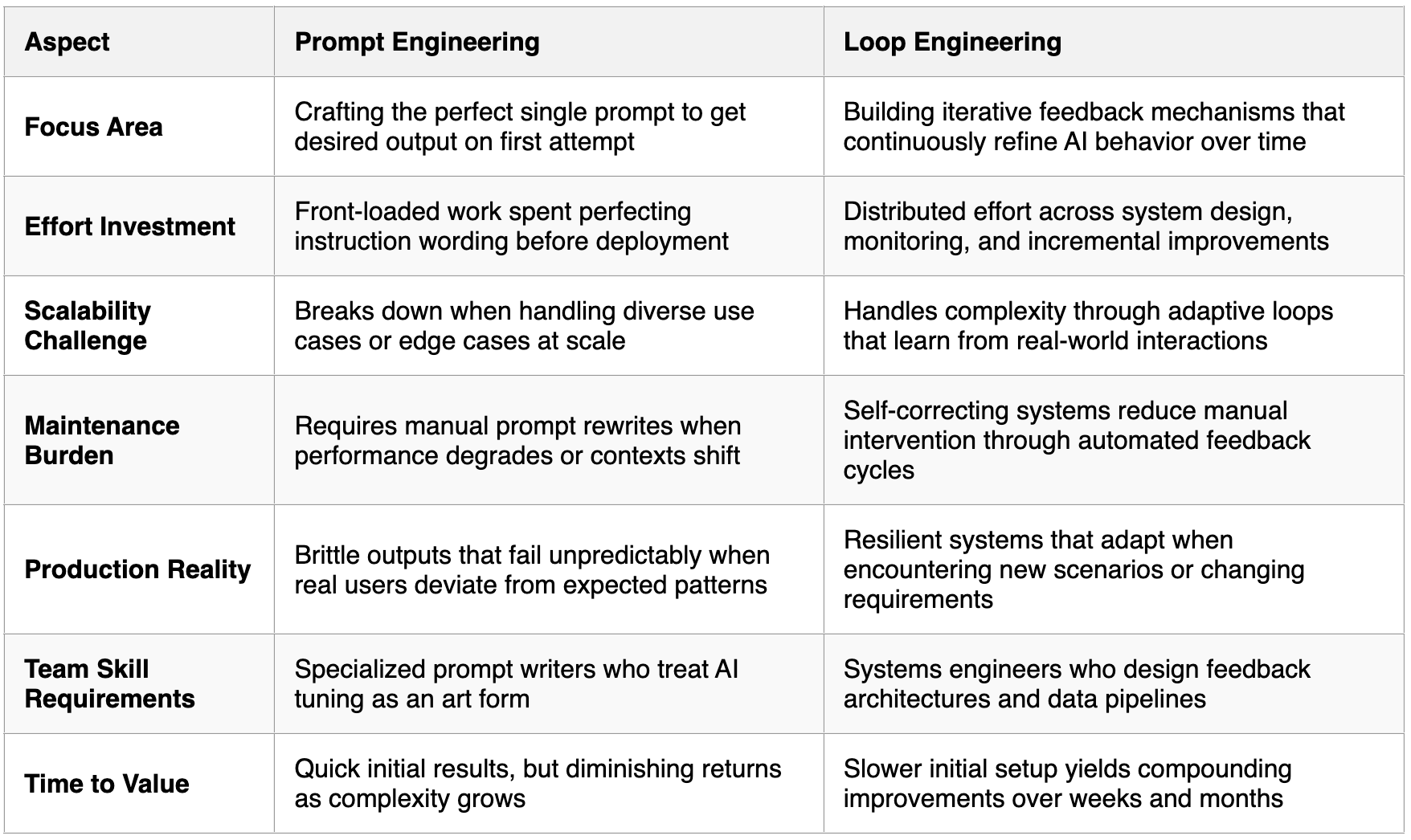
These two approaches sound similar, but they solve different problems. Understanding the split helps founders see why their teams need to shift focus toward the more sustainable path.
First came prompt engineering, focused purely on the words. Then context engineering emerged, focusing on which data sits within the model's context window. Harness engineering followed that, building isolated environments for agents to operate safely. Loop engineering caps that evolution, wrapping all three into a repeating cycle that keeps refining itself.
Where Each Approach Breaks Down
Prompt engineering treats AI interactions like a one-shot puzzle to solve. Teams spend days perfecting exact wording, hoping the model understands instructions correctly on the first try. This works fine for simple tasks, but founders quickly hit a wall when they try to ship it to production.
Loop engineering, by contrast, accepts that day-one perfection is impossible. It builds systems that get smarter with each interaction instead. Feedback flows back into the system, triggering automatic adjustments, so the AI learns what works through structured observation rather than manual tweaking.
The practical difference shows up the moment something goes wrong. With prompt engineering, a degraded response means someone rewrites the prompt and redeploys it. With loop engineering, the system detects drift and corrects course without a human stepping in. That matters enormously once a startup handles thousands of requests a day.
The Real Cost of Autonomous Loops
That automation comes with a catch, though. According to 2026 developer reports analyzing OpenAI Codex subagent tokenomics, runaway agent loops can drain API budgets quickly, with some teams seeing token consumption jump 10 to 20 times normal levels when hard-stop conditions and token budgets aren't built into the loop. Founders need to treat guardrails as a design requirement, not an afterthought.
Real implementation data shows the upside once those guardrails are in place. Monitoring small drift signals allows the system to correct itself before errors can cascade, according to a data engineer who worked on the experiment.
Benefits of Loop Engineering in AI Development
Understanding how loop engineering differs from prompt engineering explains why founders should care about this shift. The real payoff shows up in what these systems deliver once they're running.
An agentic coding loop runs in minutes, in which the AI tests and iterates on its own code. A developer feedback loop runs in hours, where humans steer feature direction. An external feedback loop takes days, where actual user behavior refines the product vision. Each layer reinforces the one below it.
Minutes: What the Agentic Loop Delivers
- Feedback loops catch problems early, saving money by fixing issues before they compound into bigger headaches
- Iterative processes let teams test, learn, and adjust their AI systems without waiting for perfect conditions or complete datasets
- Machine learning models improve faster when they learn from each mistake and refine themselves automatically
Hours: What the Developer Loop Delivers
- Continuous improvement gets built into the workflow, so performance gets better with every cycle instead of staying flat
- System optimization happens naturally as adaptive algorithms adjust behavior based on real-world performance data
- Dynamic adjustment lets AI systems respond to new information without manual rewrites or constant human intervention
Days: What the External Loop Delivers
- Data refinement improves model accuracy by filtering out noise and strengthening the signal that matters most
- Performance enhancement accelerates when teams measure results systematically and apply lessons to the next iteration
- Model training becomes more efficient because feedback loops identify which data points actually move outcomes
These benefits show up quickly in real development work.
Conclusion
Loop engineering changes how founders build AI agents that actually work. It moves teams from chasing the perfect prompt to designing systematic optimization inside recurring processes.
Founders who master loop engineering gain a real edge. Their workflows handle real-world complexity, their automation scales without constant hand-holding, and their goal-oriented systems deliver results that hold up over time.
One question is worth asking right now: is the team still stuck tweaking one-off prompts, or is it building repeatable interaction design that compounds over time?
SWARECO helps organizations structure these engineering systems from day one, pairing senior engineering leadership with AI-enabled workflows to cut the guesswork and deliver production-ready software.
Startups that adopt loop engineering now won't just keep pace with the shift in AI development. They'll lead it, turning workflow optimization into an edge that compounds with every iteration.
Other Articles


We build the engineering. You build the business.
If you are trying to figure out whether SWARECO is the right fit for what you are building, the best way to find out is to talk. Tell us what you have. We will be direct about what we can do and how we would approach it.