
How Agentic AI Redefines The Future Of SaaS MVP Innovation
.jpg)
Jane Green

Building a SaaS MVP feels like a race with no finish line. Founders want smart, sophisticated features in their first product, but the clock and the budget always push back.
That tension is exactly what agentic AI is solving right now.
Agentic AI refers to AI systems that act independently, performing tasks without constant human input. Unlike traditional AI that simply responds to prompts, these systems plan, decide, and execute on their own.
This is how agentic AI SaaS solutions transform the SaaS MVP development process: they help founders ship sophisticated, autonomous products faster than traditional methods allow. The stakes for early-stage companies have never been higher.
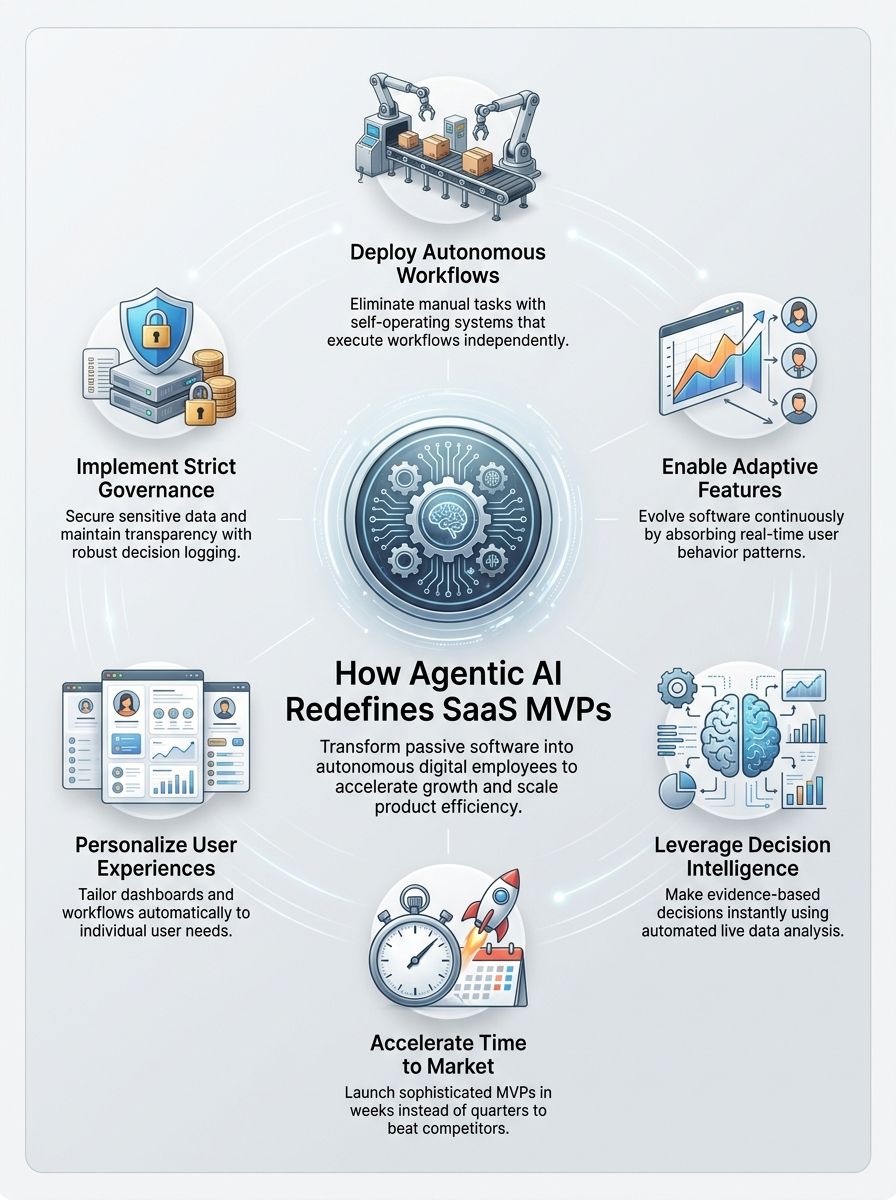
What Is Agentic AI in SaaS?
Agentic AI in SaaS marks a fundamental shift from passive software to active digital employees. Traditional AI systems simply respond to user prompts, like a helpful assistant waiting for directions.
According to a late 2025 forecast by Gartner, 40% of enterprise applications will feature integrated, task-specific AI agents by the end of 2026, up from less than 5% in 2025. That's not a distant trend. It's a baseline that's forming right now.
Agentic AI systems operate differently. They plan, reason, execute tasks, and adapt with minimal human intervention. These systems set their own goals, map out the steps needed to reach them, evaluate results, and refine their methods without constant oversight.
A SaaS MVP powered by agentic AI doesn't just automate processes. It thinks, decides, and acts autonomously across customer support, sales automation, data analytics, and workflow orchestration.
Modern businesses no longer seek just automation. They seek digital employees: systems that function autonomously, not just automate processes.
This distinction matters deeply for founders and startups building SaaS products. Agentic AI MVP innovation transforms how platforms deliver value at scale. Instead of requiring users to trigger every action, agentic systems anticipate needs, execute multi-step workflows, and make real-time decisions without human approval.
A customer support agent powered by agentic AI handles complex issues end-to-end. Sales automation systems identify prospects, craft personalized outreach, and track engagement independently.
Data analytics tools spot patterns, generate insights, and alert teams to critical changes as they happen. This capability fundamentally changes what SaaS platforms can accomplish. Products feel less like tools and more like intelligent partners working alongside their users.
The Rise of Agentic AI in SaaS MVP Development
Agentic AI transforms SaaS MVP development by empowering software to make decisions and take actions without constant human intervention. Startups now use this technology to build products that learn, adapt, and scale faster than traditional approaches ever allowed.
Autonomous Workflows
Autonomous workflows form the backbone of SaaS MVP innovation. These self-operating systems break tasks into smaller, manageable actions that execute without constant human oversight.
Founders and startups can deploy self-operating workflows that significantly reduce manual interventions, freeing teams to focus on strategy and growth. The system adapts to changing conditions, learns from outcomes, and adjusts its approach in real time.
This level of automation transforms how companies operate, cutting delays and streamlining processes from end to end.
- Customer support routing, response drafting, and issue escalation
- Sales prospecting, outreach sequencing, and engagement tracking
- Self-healing system operations that detect and resolve anomalies
- End-to-end process execution without manual checkpoints
AI-powered SaaS MVP solutions use autonomous workflows to handle complete processes without human dependency. Rather than relying on partial tools that need constant monitoring, agentic AI manages entire workflows from start to finish.
A customer support system might automatically route tickets, generate responses, draft solutions, and escalate complex issues, all without a single team member lifting a finger.
The impact on customer support workflows shows measurable proof of this transformation. In one mid-market SaaS trial, an agentic support agent handled triage, draft responses, and escalation routing for 14-day trial customers. The results were striking:
- Average first response time dropped from 9.4 hours to just 47 minutes
- 72% of the weekly 210-ticket load was handled autonomously by the agentic system
- Human escalations fell from 18% to just 6% of all tickets
- The team saved an estimated 95 hours of support labor every month
"Autonomous triage and draft responses reduced our response times from days to under an hour and freed human agents for complex cases."
Startups gain a competitive edge through autonomous workflow automation. Teams accomplish more work with fewer resources, a critical advantage when budgets are tight and timelines are tighter.
The reduction in human dependency means fewer errors slip through, quality improves, and customers experience faster resolutions. Companies implementing these workflows report faster time to market because development cycles shrink considerably.
SaaS MVP innovation accelerates when automation handles the repetitive work, leaving founders and their teams to solve real problems and build features that matter.
Adaptive Features
Adaptive features in agentic AI SaaS solutions operate like a living, breathing system that learns from every interaction. These capabilities absorb user behavior patterns, preferences, and workflows, then adjust the platform's functionality in real time.
Founders and startup leaders gain a significant edge because their MVP doesn't sit static. It evolves. The system continuously improves performance based on actual user feedback rather than guesswork.
This means the product gets smarter each day, delivering better results without requiring constant manual tweaks from the development team.
- Absorbs user behavior patterns and individual preferences
- Adjusts platform functionality and dashboards in real time
- Generates smarter recommendations as usage data grows
- Personalizes workflows to fit each user's specific habits
The competitive advantage here is substantial. An agentic MVP can outpace traditional static solutions because it adapts based on real-time feedback, learning what works across different user segments.
Personalized User Experience Engines take this further, adjusting interfaces based on individual behavior patterns to enhance engagement and productivity. Companies deploying agentic AI SaaS platforms see their products becoming more valuable over time, not less.
As one industry observer noted, "Adaptive systems don't just serve users. They anticipate what users need before users know it themselves." Startups that embrace this approach position themselves as innovators in their respective markets.
AI-Driven Decision Intelligence
AI-Driven Decision Intelligence transforms how founders and startup teams make critical product decisions. This technology analyzes large datasets in real time, identifies patterns that humans might miss, and surfaces actionable insights automatically.
Agentic AI systems detect trends, predict outcomes, and recommend specific actions without waiting for manual intervention. Founders gain a competitive edge because their teams access smarter, faster decision-making capabilities.
Real-time adaptive decision systems continuously monitor live data and adjust strategies or workflows on the fly. A startup can pivot its MVP features based on actual user behavior rather than guesswork. The system works around the clock, spotting shifts in market conditions and customer preferences instantly.
- Identify which features drive the most user engagement
- Flag which user segments need additional attention
- Pinpoint which workflows create the most friction
- Take corrective actions autonomously before problems compound
Data-driven decision-making becomes the default mode when agentic AI powers a SaaS MVP. Founders see product development accelerate because decisions rest on evidence, not assumptions. Companies reduce development cycles significantly by letting AI analyze performance metrics and recommend improvements.
There's a broader business model implication here too. According to the April 2026 IDC FutureScape report on Worldwide Agentic AI, 70% of software vendors will abandon pure seat-based pricing by 2028 in favor of outcome-based or consumption metrics. For founders building MVPs today, that's a signal worth paying attention to. AI decision intelligence doesn't just change how the product works. It changes how to price it.
Key Benefits of Agentic AI for SaaS MVPs
Agentic AI transforms how SaaS startups build MVPs, and the advantages go far beyond what founders might expect at first glance. The sections below break down how this technology reshapes speed, productivity, and customer satisfaction.
Faster Time to Market
Founders and startups face a tough reality: traditional development of complex logic takes months, sometimes stretching into a year or more. Agentic AI flips this script entirely.
Teams can deploy sophisticated features in weeks instead of quarters. The acceleration happens because AI agents handle repetitive tasks, automate decision-making processes, and generate code patterns that would otherwise require manual engineering.
A startup can move from concept to functional MVP in a fraction of the time competitors need. This speed advantage matters tremendously in competitive markets where first-movers capture user attention and market share.
- Basic AI integration: $10,000 to $30,000, with most implementations finishing in 4 to 8 weeks
- Advanced enterprise solutions: $100,000 to $200,000 or more, typically requiring 12 months or longer
- Scalable approach: Start small, prove value, then expand capabilities as revenue grows
One early-stage prototype illustrates this speed advantage clearly. A beta cohort of 30 users tested an MVP that deployed three agentic features: an autonomous onboarding sequence, analytics alerting, and follow-up email automation. The deployment completed in six weeks with a project budget of $18,200.
After four weeks of live operation, the results were significant. Average onboarding completion time dropped 62%, from 8.3 minutes to 3.1 minutes. Weekly feature usage reached 47% among active users.
"In our pilot, the agentic modules were live in six weeks and cut onboarding friction dramatically, letting us test product-market fit faster."
Modern cloud architectures and clean data systems make this speed possible. Companies no longer need massive infrastructure overhauls to integrate agentic AI solutions. Existing platforms, databases, and workflows connect smoothly with AI agents.
The result is straightforward: founders get to market faster, validate assumptions quicker, and adjust their product strategy based on real user feedback. That velocity compounds into a significant competitive edge.
Enhanced Automation and Efficiency
Agentic AI transforms how SaaS startups handle repetitive work. These intelligent systems automate complex tasks with minimal human input, freeing teams to focus on strategy and innovation.
Founders see immediate gains in productivity. Manual processes that once consumed hours now complete in minutes. Operational costs drop significantly as labor demands shrink and inefficiencies disappear.
Data engineering setup typically runs between $15,000 and $80,000 for cleaning and integration pipelines. Agentic systems recoup these investments fast through streamlined workflows and reduced manual oversight.
- Monthly model retraining and optimization costs range from $2,000 to $20,000
- Optimized resource allocation keeps these figures manageable over time
- Agentic systems learn from patterns and continuously adapt to changing demands
- Decisions execute without constant supervision as the system matures
Startups that deploy these solutions experience workflow efficiency improvements that compound over time. Teams accomplish more with fewer resources. Operations run smoother.
Scaling becomes feasible without proportional increases in headcount or overhead. This efficiency advantage gives early-stage companies the breathing room they need to compete against established players.
Improved User Experiences
Agentic AI transforms how users interact with SaaS products, creating personalized and proactive support that feels genuinely attentive. Intelligent digital assistants work alongside users, learning their preferences and anticipating their needs before they ask.
The system adapts to each user's workflow, making the product feel less like a tool and more like a collaborative partner.
- Higher satisfaction rates from proactive, context-aware support
- Improved retention driven by experiences that feel genuinely personal
- Stronger brand loyalty as users rely on the platform more deeply over time
- Faster problem resolution without adding more support headcount
According to McKinsey AI research highlighted in late 2025, companies using autonomous agentic AI systems achieve 3 to 5 times higher productivity gains compared to those relying solely on traditional prompt-based AI tools. That's a meaningful difference in output.
Startups gain a competitive edge through this enhanced personalization, which scales effortlessly across a growing customer base. Instead of hiring more support staff to handle repetitive questions, companies deploy AI agents that handle routine tasks with precision.
Users experience faster problem resolution, smarter recommendations suited to their context, and support that genuinely improves over time. This shift frees human teams to focus on innovation and build lasting customer partnerships.
Future Trends in Agentic AI for SaaS
The road ahead for agentic AI in SaaS demands fresh thinking about how systems learn, adapt, and operate at scale. Founders who grasp these emerging patterns now will shape the competitive landscape for years to come.
AI-Native SaaS Architecture
A May 2026 market analysis report by Bain & Company estimates that agentic AI automation is projected to create a $100 billion SaaS market within the United States by automating enterprise coordination work. For founders building today, that number signals real investor and enterprise appetite for AI-native products.
AI-native SaaS architecture represents a fundamental shift in how software companies build products. Rather than bolting AI features onto traditional platforms, companies now construct their entire systems with intelligent agents at the core.
This approach differs sharply from legacy SaaS models, where AI served as an add-on enhancement. In AI-native architecture, every function operates through intelligent automation, from user onboarding to data analytics to customer support workflows.
- Onboarding processes become smarter and adapt to individual user behaviors
- Analytics dashboards generate insights without manual configuration
- Customer service agents handle inquiries autonomously, learning from each interaction
- Each platform component benefits from embedded intelligence rather than operating in isolation
Development teams can integrate these intelligent systems via APIs, microservices, or modular AI agents that fit seamlessly into existing infrastructure and data structures. Basic integrations typically require four to eight weeks, while more advanced platforms may need up to twelve months to fully implement.
Companies pursuing AI-native architecture position themselves ahead of competitors still relying on traditional SaaS models. Startups can launch faster because intelligent automation handles repetitive tasks that would otherwise demand extensive manual engineering.
The foundation itself becomes self-improving, learning from user interactions and operational patterns. Scaling becomes more efficient since AI agents handle increased workloads without proportional increases in human resources. This architectural choice transforms how organizations deliver value to customers, making products that feel genuinely intelligent rather than simply feature-rich.
Deep Hyper-Personalization
Agentic AI systems learn from every user interaction and preference, creating personalization that scales across thousands of customers at the same time. Founders and startups gain the ability to deliver highly personalized user experiences through customized dashboards, recommendations, and interface adjustments that shift based on individual behavior patterns.
A user logging into a SaaS platform sees a completely different experience than their colleague, with features, content, and workflows arranged specifically for their role and habits.
- Customized dashboards organized around individual roles and daily tasks
- Recommendations that grow smarter with each session
- Interface adjustments driven by real behavior patterns
- Continuous learning that makes suggestions more relevant over time
The business impact proves substantial. Enhanced engagement, productivity, and customer satisfaction result from persistent personalization, which translates directly into lower churn rates and higher lifetime value.
Companies deploying real-time adaptive decision systems respond immediately to market changes, customer behavior shifts, and operational issues without manual intervention. Startups competing against established players can level the playing field by offering personalized experiences that feel like the software was built just for each customer.
This approach transforms generic tools into intelligent assistants that anticipate needs before users even recognize them. That's a competitive advantage that's genuinely difficult for competitors to replicate.
Governance and Ethical Considerations
Agentic AI systems operating within SaaS platforms demand strict governance frameworks and ethical guardrails from day one. Founders and startup leaders must establish controlled, monitored AI decision-making processes that maintain transparency and accountability at every step.
Advanced security frameworks and encryption protocols protect sensitive data flowing through autonomous agents. Compliance with industry regulations remains non-negotiable, especially in healthcare and fintech sectors where the stakes run high.
As of mid-2026, US enterprise procurement teams and state regulators increasingly look for alignment with the NIST AI Risk Management Framework (AI RMF) as a safe-harbor compliance standard. This framework is explicitly referenced in recent legislation like the 2026 Colorado AI Act. For startups pursuing B2B enterprise sales, alignment with the NIST AI RMF is fast becoming a requirement, not a recommendation.
- Enables transparency across all autonomous decisions
- Supports regulatory compliance during audits and reviews
- Aids debugging when unexpected issues arise
- Builds user confidence in the system's reliability
Companies that skip these safeguards risk regulatory penalties, user distrust, and operational chaos when autonomous systems make decisions without proper oversight.
Ethical considerations extend beyond mere compliance checkboxes. Organizations must implement controlled autonomy mechanisms that prevent AI agents from operating in blind spots. Decision transparency requires detailed audit trails documenting why agents took specific actions, what data influenced those choices, and how outcomes aligned with intended business objectives.
Startups building agentic AI solutions should view governance not as a burden slowing innovation, but as a competitive advantage. It attracts enterprise customers, regulators, and investors who demand responsible AI practices. The companies that master the balance between speed and safety will lead the next wave of SaaS innovation.
Conclusion
Agentic AI transforms SaaS MVP development from a reactive process into a proactive, intelligent system. Startups that adopt these autonomous workflows today gain a significant competitive edge, delivering sophisticated features without the traditional development burden.
The shift toward AI-native architectures means founders can reach product-market fit faster, reduce operational costs, and scale operations with minimal manual intervention. Companies across healthcare, fintech, retail, and customer service sectors are already reaping these rewards, automating complex tasks that once demanded constant human attention.
Agentic AI isn't just an enhancement to existing SaaS MVPs. It's the foundation upon which next-generation SaaS platforms are being built. Founders who recognize this now will be the ones setting the pace for everyone else.
Other Articles






We build the engineering. You build the business.
If you are trying to figure out whether SWARECO is the right fit for what you are building, the best way to find out is to talk. Tell us what you have. We will be direct about what we can do and how we would approach it.