
IT Layoffs and the Software Developer Shortage: What Startups Should Know
.jpg)
Jane Green
.png)
Ever posted a job opening and watched hundreds of resumes flood in, yet not one candidate actually fits what you need? That's the strange spot a lot of startup founders sit in right now.
Tech companies keep laying off workers by the thousands, part of the wave of mass IT layoffs hitting the industry. At the same time, a real software developer shortage makes finding the right skills harder than ever.
We've spent years running engineering teams, not just writing about them, and this mass IT layoffs vs software developer shortage puzzle looks familiar to us. That's why we dug into what's actually happening, and found real strategies that help startups win anyway.
The Reality of Mass IT Layoffs
We've watched the tech industry shed hundreds of thousands of jobs over the past two years, and the whiplash has been real. These workforce reductions created a strange paradox that now defines our entire hiring landscape.
Causes of Recent Layoffs
Economic pressures have forced tech companies to make tough calls about their teams. Budgets shrank, growth slowed, and investors started demanding profitability over pure expansion.
Cutting headcount felt like the fastest path to lower costs. Technology evolution added another layer to this, changing what skills companies actually need.
Risk management plays a role too. Here's what tightens the hiring picture even more:
- Risk aversion: Tech firms wait for candidates with exact qualifications instead of investing in training.
- Fast-moving skill needs: The market shifts so quickly that companies struggle to predict which roles matter next quarter.
- Misaligned planning: Companies hire aggressively during boom times, then panic when growth slows.
- Outdated skill bets: Many layoffs happen because teams were built around skill sets that AI made obsolete.
Talent acquisition strategies shifted too. Firms got pickier about who they bring on board, preferring leaner teams of proven performers over larger teams with mixed abilities.
"The real cost of a layoff isn't just the severance package; it's the institutional knowledge that walks out the door."
This reality shapes how startups should think about building teams. We see founders who learned this lesson build smaller, more intentional squads from day one.
Impact on the Tech Job Market
The paradox we're watching in tech hiring right now feels like two opposing forces colliding head-on. Companies are laying off thousands while struggling to find qualified talent, and this contradiction creates real friction for founders and startups navigating the market.
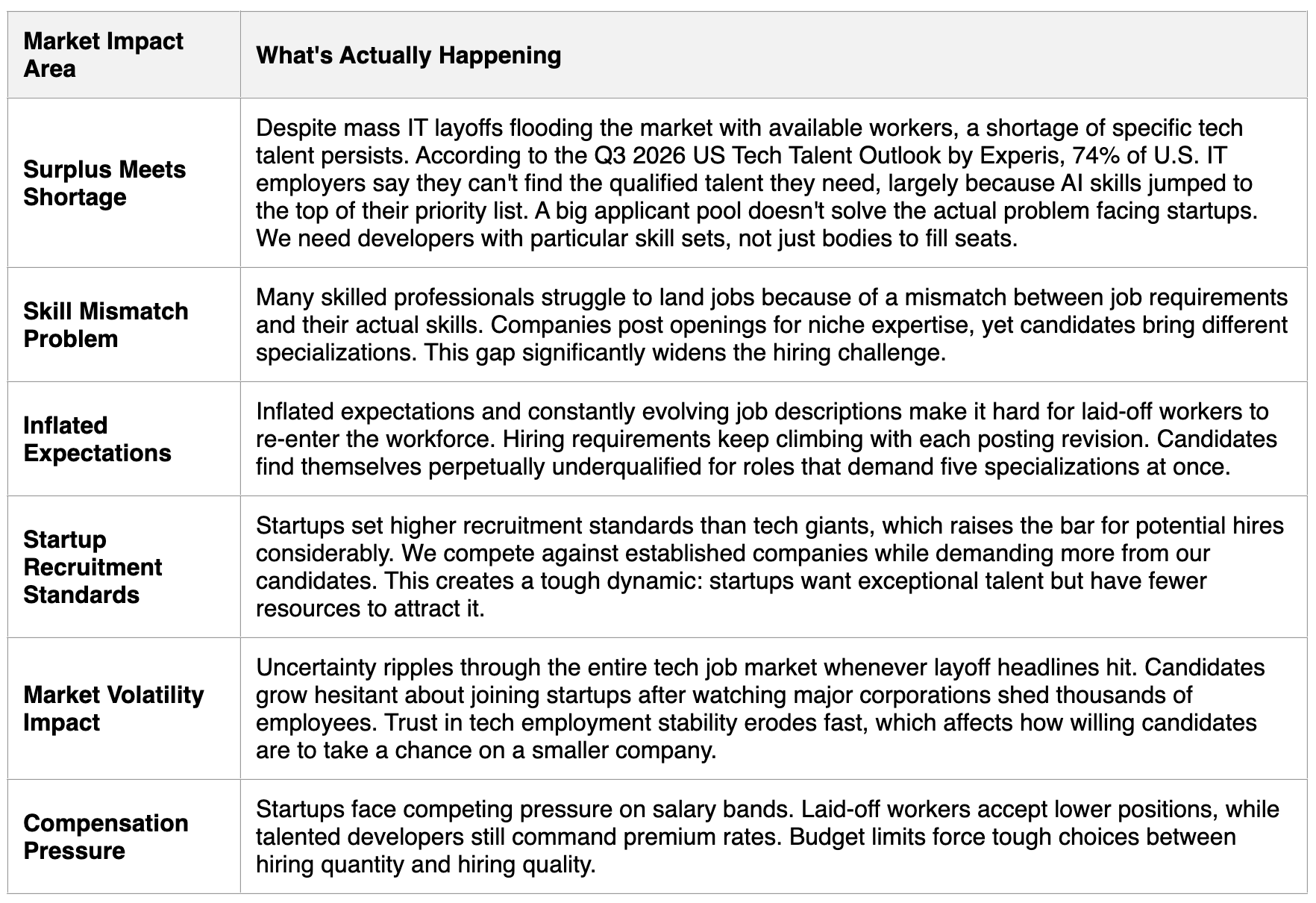
The Software Developer Shortage
We face a real crisis. Talented developers vanish faster than we can hire them, leaving startups scrambling to fill critical roles across the board.
Key Roles in High Demand
The talent market has shifted hard, and the roles companies desperately need today look nothing like the positions we hired for five years ago.
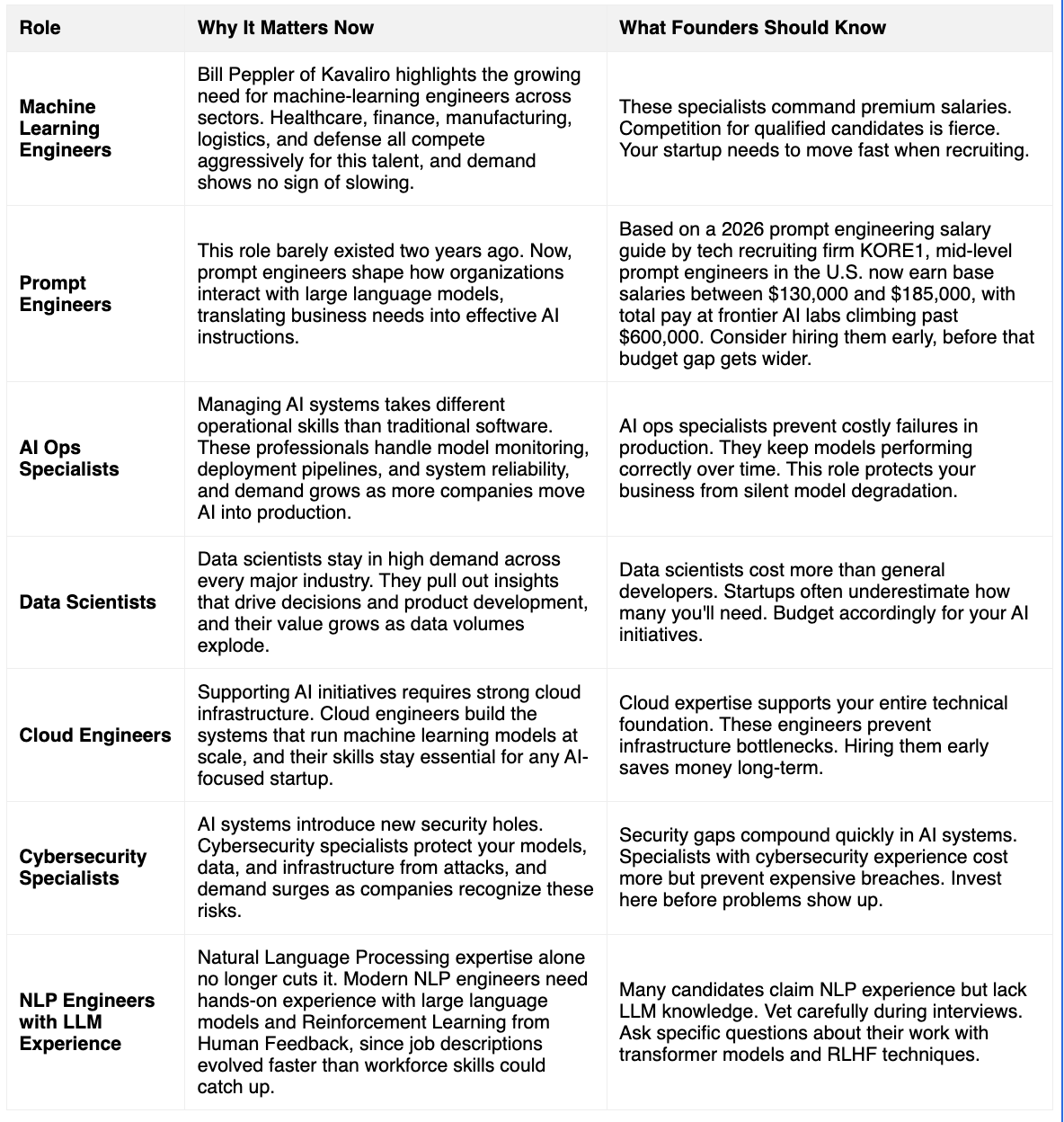
The gap between what companies need and what candidates can deliver creates real friction. We've seen startups struggle because they underestimated the specialized knowledge required. Machine-learning engineers, prompt engineers, and AI ops specialists represent roles that barely existed or were niche specialties just years ago, and today, they're central to competitive advantage.
The Role of AI in the Talent Puzzle
AI is reshaping how we think about engineering roles, forcing startups to rethink what skills matter most. Technology is rewriting job descriptions faster than most companies can hire for them.
AI Shaping Engineering Roles
Machine learning engineers and prompt engineers now sit at the center of what we build. Companies hunt for these roles with real urgency, because AI integration demands specialized expertise that didn't exist five years ago.
Job descriptions now call for hands-on experience with large language models and reinforcement learning from human feedback, known as RLHF. The roles are changing faster than talent can catch up, and we see this shift across every startup we work with.
A few specific skills have moved from "nice to have" to "must have":
- Data science and algorithm development: These have become table stakes for any team that wants to ship.
- Neural networks and predictive analytics: These separate teams that ship from teams that struggle.
- Prompt engineering and data analysis: Chuck Rogers has pointed out that these skills are rising in value fast.
- Robotics and automation: These now work alongside software engineering in ways they never did before.
We're not just hiring coders anymore. These teams need to understand how machines learn and think.
Strategies for Startups to Solve the Talent Puzzle
Startups can't just wait for the perfect developer to walk through the door. You need to act now, think creatively, and build talent strategies that actually work in today's messy job market.
Nearshore Development as a Strategic Solution
Nearshore development gives startups a practical path forward when internal talent feels out of reach. We've watched founders wrestle with two problems at once: they need experienced engineers now, but the local job market feels picked clean.
Nearshore partners work in nearby time zones, speak your language, and understand your business context without the cultural friction that often comes with offshore arrangements.
This proximity matters more than most founders realize. At SWARECO, our hiring model combines senior leadership, AI-enabled workflows, and structured execution to cut execution risk from day one, giving you access to complete engineering functions instead of disconnected developers scattered across a team.
We can operate independently or work alongside your existing people, filling gaps where they exist. This turns software delivery from a constant headache into a long-term growth driver.
A practical engagement typically follows a six-week onboarding rhythm that keeps you in control while filling critical gaps:
- Week 1: Skills audit and sprint planning.
- Week 2: Pair programming between nearshore engineers and your internal lead.
- Weeks 3-4: Feature delivery through a shared continuous integration pipeline.
- Week 5: Runbook creation and monitoring handoff.
- Week 6: Knowledge transfer and a governance checklist review.
In real implementations, this structure gets first production deployments live by week five, with documented rollback steps already in place. One founder using this approach said the six-week rhythm gave his team the confidence to ship without losing control or visibility.
Upskilling and Reskilling Existing Teams
While nearshore development fills immediate capacity gaps, building internal strength matters just as much. Our teams grow stronger when we invest directly in the people already working alongside us.
U.S. tech employers facing severe talent scarcity are now upskilling and reskilling their current workforce instead of relying only on outside hires.
- Start with a skills audit of your current team to find the gap between what you have and what the market demands. Technology often outpaces training programs, so your team likely needs skills that didn't exist two years ago.
- Build structured training around systems thinking, production-level skills, and AI fundamentals rather than trendy buzzwords. Laid-off engineers we've worked with thrive when they focus on these practical areas instead of chasing hype.
- Partner with educational institutions to design courses that match your startup's actual needs. This kind of collaboration helps close the skills mismatch that plagues the industry right now.
- Set aside a real budget for professional development and career growth. Your team performs better when they see a clear path forward inside your company.
- Pair senior and junior engineers through mentorship programs that transfer knowledge directly. This hands-on approach builds skills faster than classroom training alone.
- Measure progress through skill tests and project outcomes, not training hours completed. Track whether your team actually applies what they learn to production systems.
Conclusion
Our strategies, from nearshore development to upskilling current teams, offer practical paths forward. None of them require a massive budget overhaul or a months-long hiring process.
Prioritizing adaptability and learning speed over a "perfect" resume match turns recruitment from a risky gamble into a calculated investment in your team's future.
Take action now. Look at your current workforce, find the skill gaps, and build relationships with talent pools beyond the usual channels.
Other Articles





We build the engineering. You build the business.
If you are trying to figure out whether SWARECO is the right fit for what you are building, the best way to find out is to talk. Tell us what you have. We will be direct about what we can do and how we would approach it.