
Get Better Results with Claude Fable 5
.jpg)
Jane Green
Ever feel like every founder around you is already using Claude Fable 5, and you're still figuring out the basics?
Claude Fable 5 gives startups and companies a real edge, but only if you know how to use it well.
Here's something the SWARECO team picked up after years of running engineering operations across different industries: the tool matters less than how you use it.
Understanding Claude Fable 5
Claude Fable 5 builds on proven foundations, giving teams a smarter way to handle complex workflows and multihour jobs. An orchestrator sits at the center of it all, coordinating subagent tasks, managing context budgets, and keeping assignments moving without a hitch.
Claude Fable 5 handles natural language processing with real speed and accuracy. This lets founders and startup teams build applications that actually understand what users mean, not just what they type.
The model shines at text generation too, producing coherent content across formats and industries. Its conversational agent features let companies roll out customer support systems that feel human, not robotic.
Sentiment analysis helps teams read customer emotions from feedback, reviews, and social posts. Language understanding runs deep, so the model picks up on nuance and intent that simpler tools tend to miss.
The real power of Claude Fable 5 isn't just what it can do, it's how quickly startups can put it to work solving actual business problems.
Contextual comprehension keeps conversation threads intact, so the system doesn't lose track of what happened a few messages ago. Machine learning capabilities also improve results over time, especially when teams feed the model industry-specific data.
Data processing runs fast enough to make real-time applications practical instead of just theoretical.
According to Anthropic's July 2026 availability release, Fable 5 ships with a default 1-million-token context window and supports up to 128,000 output tokens per request, plenty of room for the kind of multihour jobs startups tend to run.
That kind of scale matters because startups need tools that deliver results without burning through engineering hours. Companies see value almost right away, since the model needs far less training time than building a custom solution from scratch.
Differences from previous versions
Moving from older Claude models to Fable 5 opens new doors for teams tackling complex workflows. Here's what separates this version from what came before.
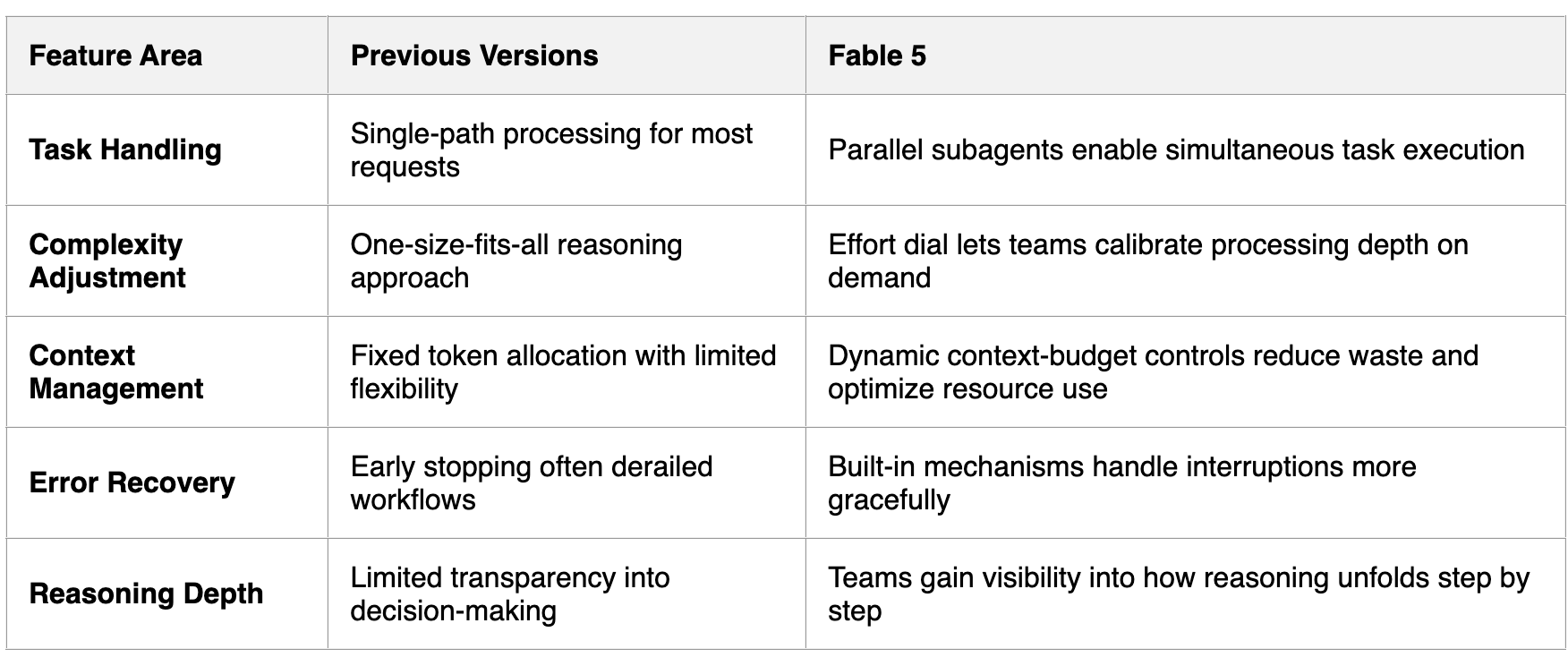
Founders often notice that Fable 5 strips away bottlenecks that plagued earlier versions. Parallel subagents matter most for lean startup teams, since running tasks in parallel significantly reduces execution time.
The effort dial solves a problem engineering leaders face daily: not every prompt needs maximum computational muscle. As detailed in the mid-2026 Claude Platform API updates, Fable 5 runs on an "adaptive thinking" mode. The raw chain of thought never gets returned directly.
Instead, the effort setting controls how much reasoning depth the model applies and summarizes that thinking for the team.
Optimizing Prompts for Better Results
Getting strong results from Claude Fable 5 comes down to how a team writes its prompts. Clear instructions and real context turn ordinary tasks into work that actually moves the needle.
Be specific with instructions
Founders and startup leaders get much better results from Claude Fable 5 when they write instructions with real clarity. Vague requests produce vague answers, so precision changes everything about how the model performs.
- State the exact outcome the team needs, not just the general topic. Tell Claude Fable 5 what success looks like in concrete terms, and it delivers work that matches those specs.
- Include format requirements upfront. Specify whether the output should be a bullet list, paragraph, code snippet, or table. This one step alone prevents rework and saves time.
- Define the audience and context for each task. Mentioning that content targets technical founders versus non-technical investors changes how Fable 5 structures its tone.
- Break complex requests into clear steps or phases. Sequential instructions improve results and cut down on confusion in the response.
- Specify constraints explicitly. Length, vocabulary level, topics to avoid, these boundaries sharpen the final product.
- Show examples of the style or format you want. A sample output helps the model match your exact expectations.
Prompting Tips:
- Use clear and precise language in instructions.
- Break down complex tasks into sequential steps.
- Define constraints and provide examples to guide the model.
Provide context and reasoning in prompts
Startups and companies that feed Claude Fable 5 bare-bones instructions often get bare-bones results back. The model performs best when a team hands over the full picture, not just the bare ask.
Adding background transforms how Claude approaches a task. A startup building a customer support system gets far more value telling Claude about its users, their pain points, and its business goals than simply asking for a response template.
This contextualization helps the model understand the real problem it's solving. According to Anthropic's official July 2026 Fable 5 prompting guide, teams get the most value when they save Fable 5 for their hardest unsolved problems.
"We need this feature to work offline because our users have spotty internet connections, and speed matters more than perfect accuracy here." That single line of reasoning changes everything about how Claude responds.
Claude adjusts its approach based on what a team actually cares about. Efficiency grows and back-and-forth cycles shrink once both sides understand the full context.
Leveraging Advanced Features
Claude Fable 5 gives teams real power through its effort dial and parallel subagents. These tools let organizations handle complex workflows and multihour jobs without breaking a sweat.
Using the effort dial for task complexity
The effort dial works as a control mechanism that teams adjust based on task demands. Founders and startup leaders calibrate this setting to match project requirements, putting resources where they actually matter.
A simple data entry task needs minimal effort, while complex strategy work demands higher settings. This approach prevents wasted computing power on straightforward assignments.
- Dial it down for: data entry, formatting, quick lookups, and routine summaries.
- Dial it up for: strategy work, architecture planning, and tasks with real ambiguity.
Teams get better workflow results by matching effort levels to actual complexity. The dial lets companies make smarter calls about resource allocation without overthinking every single request.
Different projects call for different intensity levels too. A startup developing a new feature might run initial brainstorming at lower effort, then increase intensity once it hits technical architecture planning.
This tiered approach improves results across the board. Project planning gets easier when teams know they can scale effort up or down without penalty.
Employing parallel subagents for multitasking
Adjusting the effort dial helps teams handle complex tasks, but real efficiency shows up when multiple operations run simultaneously. Parallel subagents transform workflow management by executing multiple tasks simultaneously rather than waiting for each task to finish.
- Deploy multiple subagents to handle different workflow segments simultaneously, reducing processing time and freeing engineers for higher-priority work.
- Assign distinct responsibilities, such as data validation, testing, or documentation, to each subagent so nothing gets bottlenecked.
- Structure task dependencies carefully so subagents know what needs to finish before other steps start.
- Monitor performance through real-time dashboards to catch failures early and redirect resources fast.
- Test parallel workflows in staging first, before risking actual production operations.
- Combine subagents with effort dial settings to match processing power to task complexity.
Addressing Common Challenges
Even the best prompting strategy hits a wall sometimes. Context budgets tighten, tasks stall early, and workflows demand more than the system planned for, but none of that has to stop a team from reaching its goals.
Handling early stopping cases
Claude Fable 5 sometimes stops generating a response before finishing a task, and this happens for specific reasons. The model hits convergence limits when it processes complex requests or runs low on computational resources.
As noted in the July 2026 Claude Platform documentation, there's a technical wrinkle worth knowing about. When Fable 5 declines a request because of its strict safety classifiers, often tied to cybersecurity topics, the Messages API still returns a successful HTTP 200 response.
Founders and startup teams should treat early stopping as a signal to restructure their prompts. Breaking large tasks into smaller chunks helps, and clearer context gives the model a better sense of what matters most.
A founder running early stopping tests noted that breaking the job into clear phases fixed most incidents and used compute more efficiently.
One multi-part strategy synthesis run showed exactly how task structure affects completion. During a 30-run experiment, single-shot prompts averaged 38 percent incomplete responses due to early stopping.
Once the team chunked the same task into three sequential prompts, incomplete responses dropped to just 7 percent, and average compute per run fell by 22 percent. The pattern holds: phased prompting improves completion rates while actually using fewer resources than one giant request.
Early stopping cases reveal real truths about prompt design and task structure. Teams that hit frequent interruptions usually rely on vague instructions or skip crucial background details.
- Add specific reasoning steps instead of one blunt ask.
- Define success criteria upfront, before the model starts working.
- Test prompts at different complexity levels before rolling them out fully.
Managing context-budget concerns
Teams working with Fable 5 face a real challenge: token limits can tighten fast on complex projects. Founders and startup leaders need smart resource allocation strategies to avoid hitting walls mid-project.
The platform closely tracks context usage, so teams should monitor spending patterns early and often.
Breaking large tasks into smaller chunks helps stretch the budget further. Parallel subagents handle multiple workstreams without doubling token consumption, which makes this combo ideal for cost control during heavy lifting.
Financial management of AI resources mirrors traditional expense tracking. Companies should size up project scope upfront and allocate tokens based on task complexity and priority.
Conclusion
Claude Fable 5 is powerful, but the biggest advantage comes from knowing how to apply it to real engineering challenges. If you're looking for a team that can help you get the most out of it, SWARECO's engineers are ready to help.
Other Articles







We build the engineering. You build the business.
If you are trying to figure out whether SWARECO is the right fit for what you are building, the best way to find out is to talk. Tell us what you have. We will be direct about what we can do and how we would approach it.