
Custom Ecommerce Development
Software for the operations behind B2B commerce — quoting, contract pricing, approvals, fulfilment and reporting, connected in one system.
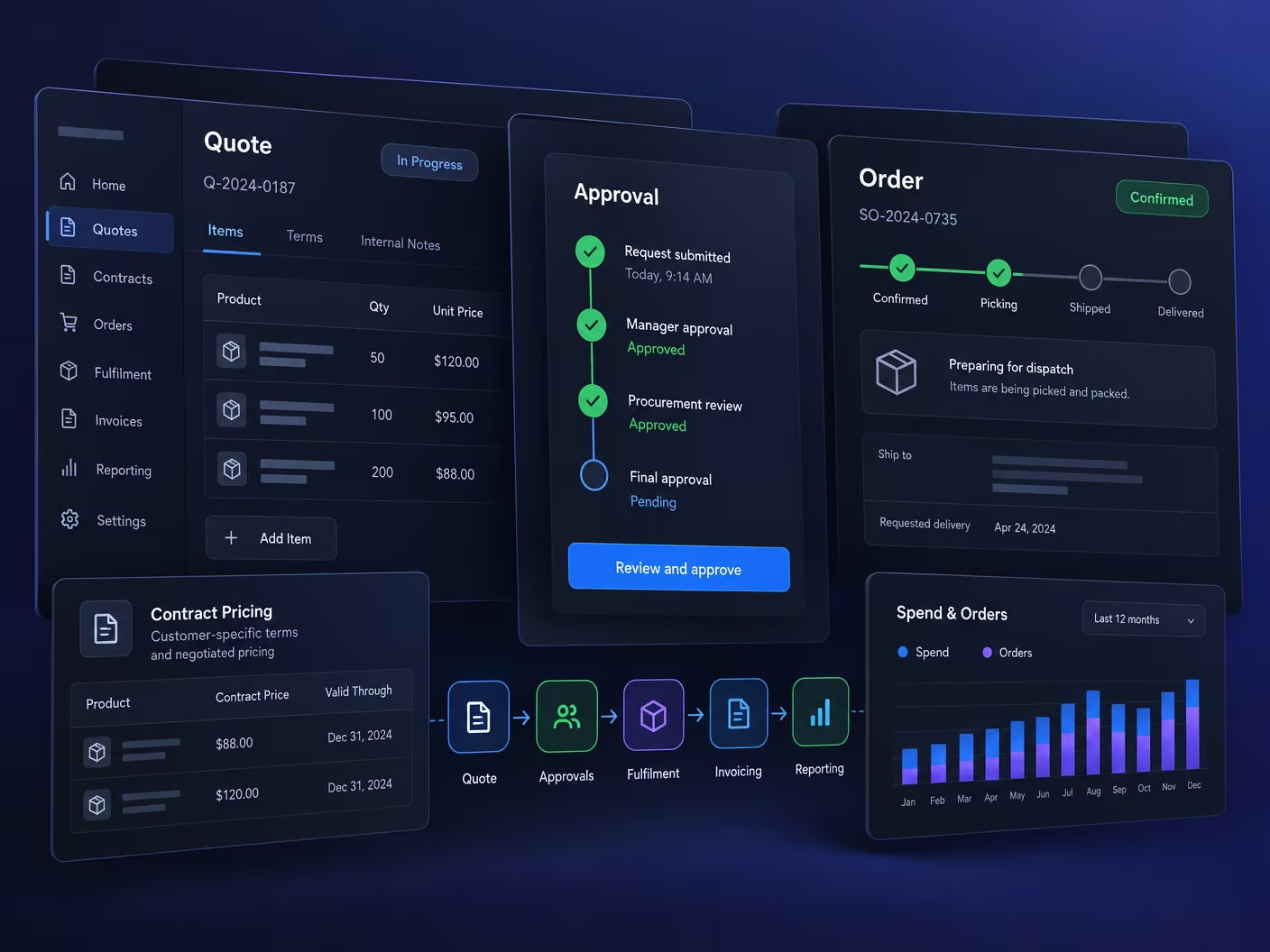
Built for operations with many moving parts
SWARECO is a custom ecommerce development company that builds commerce platforms, B2B portals and custom online stores, along with the operations behind them. Custom ecommerce development is the work of building a store, portal or ordering system around how a business actually sells, rather than reshaping the business to fit an ecommerce platform's assumptions. We build quoting, contract and account-specific pricing, multi-step approvals, purchase orders, catalogue management, checkout, fulfilment, reporting, and the custom API integrations to ERP and inventory systems that keep all of it consistent. That last part is usually where a commerce project succeeds or stalls, and it is why B2B and operationally complex commerce are treated here as their own discipline rather than a consumer storefront with a login on it.
What custom ecommerce development involves
Custom ecommerce development is the design, build, integration and ongoing operation of software that sells, prices, quotes, fulfils and reports — built to a specific business model instead of configured inside a hosted platform. It differs from standing up a Shopify or BigCommerce store in three concrete ways: the pricing and ordering logic is yours rather than the vendor's, the integrations to systems of record are first-class rather than an app-store afterthought, and you own the data model, so it can be extended when the business changes.
In practice an ecommerce project is rarely one application. It is a buyer-facing storefront or portal, an internal system the sales and fulfilment teams operate, and integrations to the systems that hold the truth — an ERP, an inventory system, a payment gateway, a tax engine. Most companies arrive with the middle half-solved: a way of selling that works, held together by spreadsheets and a person who remembers the exceptions.
That is the difference between an ecommerce store and a commerce system. A store takes an order. A commerce system prices it for that account, routes it through the buyer's approval chain, checks it against real stock, and hands it to the ERP without re-keying.
What an ecommerce developer does
An ecommerce developer builds and maintains those systems, and much of the job is modelling rules rather than writing screens. A developer who has only shipped content sites will get the screens right and the rules wrong, and that is the failure we see most often. It means knowing how price is actually determined for a given customer, what availability means when inventory lives in three places, which order states are financially significant, and how to make an integration fail safely — because an ERP outage must not become lost orders.
Correctness matters more here than in most custom software development, because the errors are financial and visible. A wrong price on a contract account, a double-charged card, or stock sold that does not exist all reach a customer directly. That is why SWARECO runs a dedicated QA function that owns the testing framework, with Playwright end-to-end suites in CI covering checkout, pricing and order flows. It is also why we build custom pricing and approval logic from written rules rather than screenshots: a rule nobody can state is a rule nobody can test.
Key features of custom ecommerce development
The feature set of custom ecommerce software is decided by what the platform you rejected could not do, so the list below is what tends to stay custom even when everything else is bought. Each item is a place where an off-the-shelf ecommerce platform holds an opinion and a B2B seller holds a different one.
- Account-specific pricing and catalogues — contract prices, volume breaks, and a product list that differs by account. This is the personalization that matters in B2B: not a recommendation carousel, but a buyer seeing their own prices and their own approved products.
- Quoting and negotiated orders — a quote that becomes an order without re-keying, with versions, expiry and a record of what was agreed.
- Custom checkout — purchase order numbers, cost centres, credit terms, requested delivery dates and split shipping addresses, none of which a standard checkout collects. Custom checkout and payment flows are the most common reason a B2B seller outgrows a hosted ecommerce store.
- Approval chains — multi-step authorisation with spending limits, delegated authority and an audit trail.
- Catalogue management and search — attributes, units, variants, and a search that works on part numbers as well as words.
- Payment gateway and invoicing — card payment through a payment gateway for smaller orders, invoicing and credit terms for the rest, frequently on the same account.
- Order operations and reporting — allocation, partial shipments, backorders and returns, plus reporting the operations team actually trusts.
- API integration — a documented API surface to ERP, inventory, tax and carriers, and often to the customer's own procurement system.
Two of those look optional and are not. Reporting is what makes the system credible internally, and an ordering platform nobody can audit grows shadow spreadsheets within a quarter. And customization has to be a property of the data model rather than a fork of the code — the point of custom development is that the next pricing rule is configuration, not another project.
The most common types of ecommerce software
Buyers who set out to build a custom ecommerce website usually mean one of a small number of things, worth naming precisely because the engineering effort, integration surface and cost differ sharply between them.
- D2C and retail storefronts — a catalogue, a cart and a checkout aimed at consumers. The most commoditised category, and the one where buying an ecommerce platform is usually right.
- B2B ecommerce platforms — selling to businesses, with negotiated pricing, credit terms, purchase orders and approval chains. The rules, not the storefront, are the product.
- B2B portals and customer portals — where an account logs in to see its own pricing, contracts, order history, invoices, shipment status and reorder lists. B2B portal development is frequently the highest-return commerce project a distributor or manufacturer can run, because it removes inbound phone and email load without changing how anything is sold.
- Dealer, distributor and reseller platforms — multi-organisation systems where each account has its own users, permissions, catalogue and terms.
- Quote-to-cash and CPQ systems — configure, price, quote, approve, order, invoice. Common wherever the product is configurable or the price is negotiated per deal.
- Order management and fulfilment systems — the layer between the order and the warehouse: allocation, splitting, backorders, partial shipments, returns.
- Product information management and catalogue systems — one place where product data is correct before it is published anywhere.
SWARECO's ecommerce work sits mainly in the B2B platform, portal, dealer-network, quoting and order-operations categories, plus the ERP and inventory integrations that connect them. Those are the categories where a custom ecommerce solution beats a configured one. Where a requirement is genuinely a commodity online store, we say so during scoping.
Custom ecommerce development versus off-the-shelf platforms
The honest answer is that most companies should buy the commodity and build the differentiator. A payment processor, a tax engine and a shipping rate service are commodities. The way you price for a given account, the approval chain a buyer's procurement team requires, and the workflow that makes each order economic usually are not — and that is where a custom build earns its cost.
When off-the-shelf is the right answer. If you sell a fixed catalogue at list price to anyone with a card, Shopify, BigCommerce or WooCommerce will do it better, cheaper and sooner than anything custom, and a template-based theme will carry you further than a bespoke front end. The same holds if a platform covers 90% of your requirement and the remaining 10% is not what makes you distinctive. Adobe Commerce (formerly Magento) and Salesforce B2B Commerce also cover a real share of B2B ecommerce solutions out of the box, including tiered price lists, company accounts and requisition lists. Magento's B2B module and Shopify's B2B features have both closed part of the gap that used to force a custom build, and it is worth checking them before assuming you are past what a platform can do.
When platforms start to cost more than they save. The failure mode is not that the platform cannot do the thing. It is that it can, through four apps, two webhooks and a middleware subscription, and now nobody can explain how a price is calculated. The signals are consistent: pricing logic spread across extensions, a nightly export someone reconciles by hand, a template you no longer dare touch, and an upgrade you keep postponing because the customisations will break. At that point the platform is not saving integration work, it is hiding it — it covers most business needs and charges for the rest in workarounds.
The middle path is underused. Rather than replacing a working platform, many companies get the larger return from building a thin custom layer over it — a B2B portal for account-specific pricing and reordering, an internal quoting and approval tool, or an order-operations dashboard — while the existing commerce engine stays the transaction record. Headless commerce and composable commerce architectures make this practical in a way it was not five years ago, and they keep the custom surface small enough to maintain. Teams usually frame the decision as pick a platform or build from scratch. The more useful question is which rule the platform forces you to work around, and whether that rule is central to how you sell — custom commerce work earns its cost where the answer is yes, and rarely where it is not.
ERP, inventory and fulfilment integration
Integration is where most ecommerce projects actually get difficult. A commerce platform is worth little if price, stock, credit and order status live somewhere else, so the integration surface — ERP, warehouse management, payments, carriers, tax — usually determines the timeline more than the feature list does.
The hard part is rarely transport. REST and GraphQL APIs, webhooks and scheduled syncs are well understood. The hard part is agreeing what is true. Which system owns the price when the ERP and the ecommerce catalogue disagree? Is available stock the warehouse figure, that figure minus unshipped allocations, or minus everything sitting in an open cart? These are business decisions wearing technical clothing, and skipping them produces a sync that works in staging and oversells in week three.
SWARECO builds custom API integrations to ERP and inventory systems so orders, inventory, pricing and fulfilment stay consistent between the commerce layer and the systems of record, instead of being reconciled by hand. Three rules we hold to. Name one system of record per field. Make every sync idempotent and replayable, because integrations fail mid-batch and the recovery path is the feature. And degrade rather than drop: when the ERP is unreachable, an order should queue in a clear state, not vanish or silently succeed.
We scope the integration surface before designing the application, because it constrains the data model. On Elefta's platform that meant designing a centralized API first, so a React frontend and a React Native mobile app shared one consistent view of inventory and accounts.
Payments, tax and data protection in ecommerce software
Ecommerce carries obligations that ordinary software does not, and they shape the architecture rather than the launch checklist. Card data brings PCI DSS scope, customer records bring GDPR and CCPA obligations, and cross-border selling brings tax determination — all cheaper to design in than to retrofit.
On payments, the practical rule is to keep card data out of your systems entirely. Hosted fields and tokenisation through a payment gateway such as Stripe, Adyen or Braintree reduce PCI scope to its smallest realistic form, and no custom build should handle a raw card number. B2B adds requirements a consumer checkout never has: purchase orders, credit terms and invoicing, partial payments against an order, and payment authority belonging to someone other than the person ordering. Those are the custom payment flows that a hosted checkout cannot express.
Sales tax and VAT determination is a solved problem you should not solve again. Integrating an engine such as Avalara or TaxJar is almost always correct, and the work is supplying it with clean jurisdiction, taxability and exemption data rather than computing rates.
An approval chain is a financial control, so it needs an audit trail: who approved what, at what price, under which contract, and when. SWARECO's QA function validates pricing, approval and checkout paths before release, so a regression in a discount rule surfaces in the pipeline rather than in an invoice.
Performance, accessibility and SEO in ecommerce web development
Ecommerce websites are judged on how fast they load, whether everyone can use them, and whether search engines can read them — and all three are architectural decisions rather than a post-launch pass. B2B shifts the emphasis rather than the requirement: the pages that matter most sit behind a login, so the work moves from ranking towards the daily experience of a buyer placing a repeat order.
Performance. The pages needing optimization in a B2B system are the ones a buyer opens fifty times a week — a filtered catalogue list, a reorder screen, an account's order history. For a repeat buyer, those three screens are the whole ecommerce experience, and they get slow for a specific reason: every line is querying live pricing and stock. Caching those reads correctly, without ever serving a price that has changed, is most of the performance work on a commerce platform. It is also why a scalable ecommerce platform is designed around its pricing and availability queries rather than its page templates, and why we optimize those paths before anything cosmetic. Scalable, in commerce, is a property of the read path rather than the server count. The same optimization work is what keeps a large catalogue usable as it grows.
Accessibility. A checkout and an ordering portal are transactional interfaces, so accessibility is a functional requirement rather than a compliance line: keyboard operation, focus order, form labels, and error messages a screen reader announces. WCAG 2.2 AA is the sensible target, and it is far cheaper as a component-level standard than as a remediation project later. Responsive layout belongs in the same category — buyers approve orders on a phone even when they placed them at a desk, so a responsive checkout is the floor rather than an enhancement.
SEO. For public storefronts the technical SEO work is server-rendered product and category pages, clean URLs that survive a replatform, correct canonical tags across filtered variants, and product structured data. Headless ecommerce web development makes every one of those a deliberate decision rather than a default: headless front ends are usually built in React, often through Next.js, and choosing Next.js over a plain single-page app is largely an SEO decision about rendering. Redirect mapping at migration is where most replatformed ecommerce websites lose organic traffic, and it is entirely avoidable. None of it is something you optimize cheaply after launch, which is why SEO belongs in the build plan for public ecommerce websites rather than in a later phase. Speed and a checkout that does not fight the buyer are also the two things most reliably connected to conversion rate, and neither of them is a redesign.
Where AI genuinely helps in ecommerce software — and where it does not
AI is useful in commerce, narrowly, and mostly in the data and order-entry layers rather than the storefront. The reliable wins share a shape: high-volume, messy input, a human review step, and a recoverable mistake. The cases that pay off first:
- Extracting line items from emailed or PDF purchase orders. Buyers send orders as attachments and someone re-keys them. High-volume, unstructured, reviewable before anything is committed.
- Normalising messy supplier product data. Attributes, units, categories and descriptions arriving in a different shape from every supplier, mapped into one catalogue schema.
- Matching inbound requests to the right SKU. A customer describes what they want in their own words, or with their own part number, and something has to reconcile it with yours.
- Natural-language catalogue search. Buyers know what they need and rarely know your SKU structure. Semantic search over a large catalogue outperforms keyword filters.
- Reorder suggestions from account history. What this account buys, at what cadence, and what is probably due — a recommendation the buyer confirms, not an order placed for them. This is the personalization B2B buyers actually ask for.
Where AI does not belong is anywhere a deterministic rule already works. Contract pricing, discount tiers, credit limits, tax rates, stock availability and approval thresholds are rules with correct answers. A model that produces the right price 98% of the time is worse than a lookup that produces it every time, and it removes your ability to explain the answer.
Two conditions we hold to on every AI feature in a commerce system. Nothing a model produces is committed without a human review step or a deterministic validation. And customer, pricing and order data sent to a third-party model needs a vendor agreement permitting the processing and excluding it from training, or it does not go.
The main challenges in ecommerce software projects
Six recur across almost every commerce project we have seen, and none of them are about writing a checkout.
Pricing logic nobody has written down. The real rules — contract prices, volume breaks, promotional overrides, the exception for the account that has been buying since 2009 — usually live in a spreadsheet and two people's heads. Reconstructing them is discovery work, and it is underestimated every time.
Product data quality. Catalogues carry duplicate SKUs, inconsistent units, missing attributes and descriptions written for a printed sheet. Search, filtering and every AI feature sit on top of this, so cleaning it is part of the project, not preparation for it.
Trading continuity. You cannot take orders offline for a cutover. Replacing a live ecommerce store is an incremental migration with a working path for customers throughout, which means running old and new in parallel longer than a general project would.
Integration debt in systems of record. ERPs were not designed to be integrated with, access is often mediated by a vendor with no incentive to move quickly, and the available API rarely matches the one the plan assumed.
Order complexity treated as an edge case. Partial shipments, backorders, split fulfilment, returns and credit notes are not edge cases in B2B, they are the normal week. A data model that cannot express them produces a system the operations team works around.
Scope pressure from the sales floor. Sales teams correctly want every account's arrangement supported on day one, and a first release that tries to is one that never ships. Sequencing that is among the more valuable things an experienced ecommerce development company brings.
How long custom e-commerce development takes
Timelines in custom e-commerce development are set by discovery rather than by build, so the honest answer depends on two things we can establish in the first fortnight: how much of your pricing and approval logic is written down, and how clean your product data is. Neither of them compresses by adding people, and both are knowable before anyone commits to a date.
Three things reliably stretch a schedule. Undocumented pricing rules have to be reconstructed from spreadsheets and interviews before anything can be built against them. Dirty catalogue data has to be normalised before search, filtering or any AI feature can be trusted. And access to the ERP is usually mediated by a vendor whose timetable is not yours — in our experience, waiting for API credentials delays e-commerce websites more often than any engineering problem does.
Three things reliably shorten it. A narrow first release over an existing commerce engine reaches production far sooner than a full replacement of a live trading system. Naming one system of record per field removes weeks of argument later. And a client who can decide quickly is worth more than a large budget, because most of the waiting on a commerce project is waiting for a rule to be confirmed.
SWARECO does not quote fixed delivery dates, because we run a retained development team rather than a fixed-scope project. What we commit to instead is a first release scoped around one workflow, a sprint cadence you can watch, and one person accountable for it.
How much custom ecommerce development costs
Cost is driven by four things: how many systems the platform must integrate with, how complicated the pricing and approval rules are, how clean the product data is, and whether you are replacing a trading system or building alongside one. Feature count matters far less.
The cheapest useful project is almost always narrow — a B2B portal over an existing commerce engine, an internal quoting tool, or one integration that removes a manual reconciliation. The most expensive is a full replacement of a live platform with dirty product data and undocumented pricing, because the hardest problems there are discovery rather than engineering, and discovery does not compress by adding people.
SWARECO is a managed engineering company: we build and run a dedicated development team on monthly retainers, from MVP to scale, rather than quoting fixed-price projects. Cost is therefore a function of team shape and duration, both visible from the start. That is a different commercial model from an e-commerce development company quoting a fixed price per project, and it exists because the discovery work above cannot be priced honestly up front.
The cost that surprises people is not the build. It is year two: monitoring, maintenance, the peak-season load you did not have last year, and the integration that breaks when a vendor changes an API. Budgeting a commerce project without that line is the most common planning error we see.
How SWARECO builds custom ecommerce software
We run the engineering function rather than deliver a specification: a named team, structured sprints, and one person accountable for the outcome. Our ecommerce development services cover discovery, build and ongoing operation, and the development process on a commerce project runs in this order:
- Write down the pricing and approval rules first, including the exceptions. The highest-value week of the project, and the one most often skipped.
- Scope the integration surface before designing the application. Which system owns price, stock, customer and order, and what happens when each is unavailable.
- Assess the product data honestly, and budget the cleanup rather than discovering it at launch.
- Define a first release around the workflow causing the most operational drag, and be explicit about what is out of it.
- Build in structured sprints with QA in parallel, not after. Our QA function owns the testing framework, and Playwright suites run in CI so pricing, checkout and order regressions surface before release.
- Migrate incrementally, keeping customers able to order throughout, usually by account or product line.
- Instrument and monitor after launch. Integrations drift, catalogues grow and traffic peaks; the monitoring has to exist from day one, and it is what tells you whether the system is still scalable at next year's volume.
One team owns frontend and backend, which is deliberate: in commerce the expensive defects live in the seam between a screen and the rule behind it. Our engineering stack across client work includes Ruby on Rails, React and React Native, with Playwright suites in continuous integration. The stack matters less than the discipline around it, which is the same discipline we apply to any custom web application where a defect has a financial consequence. Custom ecommerce development is custom website development with money moving through it, and that is the whole difference — the same tools, and a far lower tolerance for being approximately right.
Ecommerce development trends in 2026
Four shifts are actually changing how commerce software gets built, as distinct from what gets announced.
Headless and composable architectures becoming the default for custom work. Separating the buying experience from the commerce engine is now the normal way to get a custom result without owning a payment stack, and it has made the middle path — custom layer, bought engine — the most common shape of project.
B2B buyers expecting consumer-grade self-service. Order status, reordering, invoice history and returns are now expected to be self-serve, which is why B2B portal development keeps rising up the priority list ahead of storefront redesigns.
AI moving into the catalogue and order-entry layers, not the storefront. The deployments that survive contact with reality are extraction, normalisation, matching and search. Generated product copy and chat interfaces attract more attention and deliver less.
The ERP reasserting itself as the system of record. Companies that let the ecommerce platform accumulate its own pricing and inventory truth are pulling it back — a data-model project disguised as an integration one.
Ecommerce development work at SWARECO
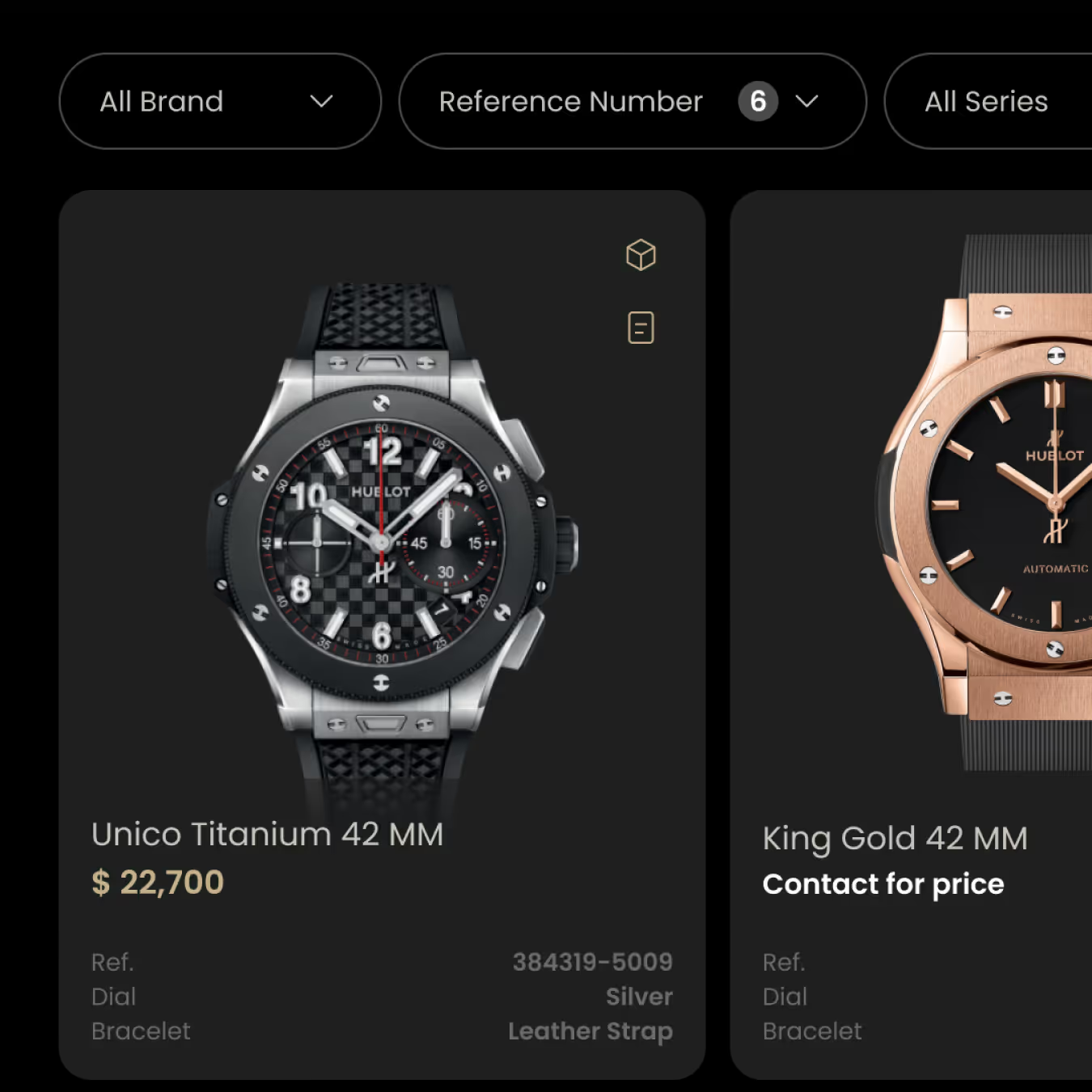
Elefta — a B2B platform for watch dealers. Elefta came to SWARECO with a working proof-of-concept whose architecture would not scale. SWARECO rebuilt the backend in Ruby on Rails, restructured the frontend in React, built a React Native mobile app and designed a centralized API so web and mobile shared one consistent view of inventory and accounts. Elefta now supports over 1,628 users and 534 organizations across more than 30 countries. Read the Elefta case study.
That is the most common starting point for this work: the ecommerce business model is proven, and the architecture that carried a prototype to a demo is not scalable enough to carry multi-organisation accounts.
Common questions about custom ecommerce development services
What is custom ecommerce development?
Custom ecommerce development is building a commerce platform, portal or ordering system to a specific business model rather than configuring a hosted platform to approximate it. It typically covers pricing and quoting logic, order and approval workflows, catalogue management, checkout, fulfilment, reporting, and API integrations to ERP and inventory systems. It is the right choice when how you price or fulfil is central to the business.
What does custom ecommerce website development include?
It includes the storefront or portal a buyer uses, the internal system the sales and fulfilment teams operate, and the integrations between them and the systems of record. On a public site that also means the technical layer an ecommerce website is judged on — server-rendered product pages, clean URLs, structured data, accessibility and page speed. On a logged-in B2B portal the same effort goes into catalogue, reorder and order-history screens instead. Our custom e-commerce development services cover all of that plus the ERP and inventory integrations behind it.
How is B2B commerce software different from a consumer online store?
B2B commerce runs on negotiated pricing, quoting, approval chains, purchase orders, credit terms and account-specific catalogues — none of which a consumer online store handles natively. The buyer is an organisation rather than a person, so users, permissions, spending limits and approval authority all have to be modelled. SWARECO builds for that structure rather than adapting a retail platform to fit.
Should we build a custom platform or use Shopify, BigCommerce or Adobe Commerce?
Buy the platform if you sell a fixed catalogue at list price, or if it covers around 90% of your requirement and the rest is not what makes you distinctive. Build a custom ecommerce platform when your pricing, approval or fulfilment rules are the differentiator, or when Shopify, WooCommerce or Magento only support them through a stack of extensions nobody can explain. A middle path suits most: keep the engine, build a custom portal over it.
Do you do custom online store development, or only B2B platforms?
Both, with a bias we state early. Custom online store development is worth it when the pricing, ordering or fulfilment logic is unusual, and not worth it when the requirement is a catalogue at list price — in that case a hosted platform will beat us on cost and time. Most of our commerce work is B2B because that is where the rules get complicated enough to justify a custom build, and the same team builds the consumer-facing side when a business sells both ways.
Does custom development improve SEO and conversion rate?
Only through build decisions, never on its own. Server-rendered product pages, clean URLs, correct canonicals across filtered variants and product structured data are what make an ecommerce website indexable; page speed and a checkout with fewer required steps are what move conversion rate. A custom build gives you control over all of them, which a template-based store does not — but control is not the same as ranking, and an e-commerce development company promising rankings is selling something else.
What is B2B portal development?
B2B portal development is building the logged-in area where a business customer sees its own pricing, contracts, order history, invoices, shipment status and reorder lists. It is often the highest-return commerce project available to a distributor or manufacturer, because it removes inbound phone and email load without changing how anything is sold, and it can be built over an existing system.
Can you build contract pricing, quoting and approval workflows?
Yes. Account-specific pricing, volume breaks, quote generation and multi-step approvals are the parts most off-the-shelf platforms force you to work around, and they are usually the first thing SWARECO builds properly. Approvals are a financial control, so they carry an audit trail: who approved what, at what price, under which contract, and when.
Can you build a custom checkout and payment flow?
Yes, and in B2B that is normally required rather than optional. A custom checkout collects purchase order numbers, cost centres, requested delivery dates and split shipping addresses, applies credit terms and spending limits, and routes the order through an approval chain before it is placed. Card payments still go through a payment gateway such as Stripe or Adyen with tokenisation, so raw card data never touches the platform.
Can you connect our commerce platform to our ERP and inventory systems?
Yes, and that integration is normally where the value is. SWARECO builds custom API integrations so orders, inventory, pricing and fulfilment stay consistent between the commerce layer and the systems of record, instead of being reconciled by hand. The design work is deciding which system owns each field, and what happens when one is unavailable.
What if our current platform cannot handle our order complexity?
You usually do not need to start over. We assess whether the constraint is the platform itself or the architecture around it, then either extend what exists or rebuild the layer that is failing — modernisation without a full rewrite. Partial shipments, backorders, split fulfilment and returns are the usual pressure points, and they are often fixable in the order layer alone.
Can AI help with quoting, catalogue data or order processing?
Yes, and catalogue and order data is usually where it pays off first. Extracting line items from emailed or PDF purchase orders, normalising messy supplier product data, and matching inbound requests to the right SKU all consume hours of manual work and tolerate a review step before anything is committed.
Can AI improve how customers search and reorder?
Yes. Natural-language search across a large catalogue and reorder suggestions based on account history are two of the clearest wins in B2B ecommerce, because buyers know what they need but rarely know your SKU structure. The suggestion is confirmed by the buyer; it does not place the order.
Where does AI not help in ecommerce?
Anywhere a deterministic rule already gives the correct answer. Contract pricing, discount tiers, credit limits, tax rates, stock availability and approval thresholds should be lookups, not model output — a price that is right 98% of the time is a support problem, and cannot be explained to a customer who disputes it.
How much does a custom ecommerce build cost?
Cost is driven by the number of system integrations, the complexity of your pricing and approval rules, the state of your product data, and whether you are replacing a live trading system — not by feature count. SWARECO builds and runs a dedicated team on a monthly retainer from MVP to scale, so cost is a function of team shape and duration rather than a fixed quote. Budget for year-two maintenance and integration upkeep.
How long does a custom e-commerce build take?
It depends far more on discovery than on build: reconstructing undocumented pricing rules and cleaning product data are the two activities that stretch a schedule, and neither compresses by adding people. A narrow first release over an existing commerce engine reaches production much sooner than a full replacement of a live trading system, which is one reason we scope custom e-commerce development around the single workflow causing the most operational drag.
Have you built a B2B platform that operates internationally?
Yes. Elefta came to SWARECO with a working proof-of-concept for watch dealers whose architecture would not scale. We rebuilt the backend in Ruby on Rails, restructured the frontend in React, built a React Native mobile app and designed a centralized API. Elefta now supports over 1,628 users and 534 organizations across more than 30 countries.
What makes a good ecommerce software development partner?
Ask three things. Will they tell you when buying a platform beats building one? Can they explain how they would handle an ERP outage mid-order? And is there one person accountable for the outcome? A developer who cannot answer the middle question has not run a live commerce integration, whatever the portfolio says.
These companies have relied on us to help expand their engineering teams with top talent who make a real impact.
Companies that trusted us to build and run their engineering.






Case Study
Real results for real clients. Discover how we've helped businesses achieve their digital transformation goals

We build the engineering. You build the business.
If you are trying to figure out whether SWARECO is the right fit for what you are building, the best way to find out is to talk. Tell us what you have. We will be direct about what we can do and how we would approach it.