
Media & Entertainment Software Development
Content and experiences that captivate audiences and drive engagement across digital and traditional media platforms.
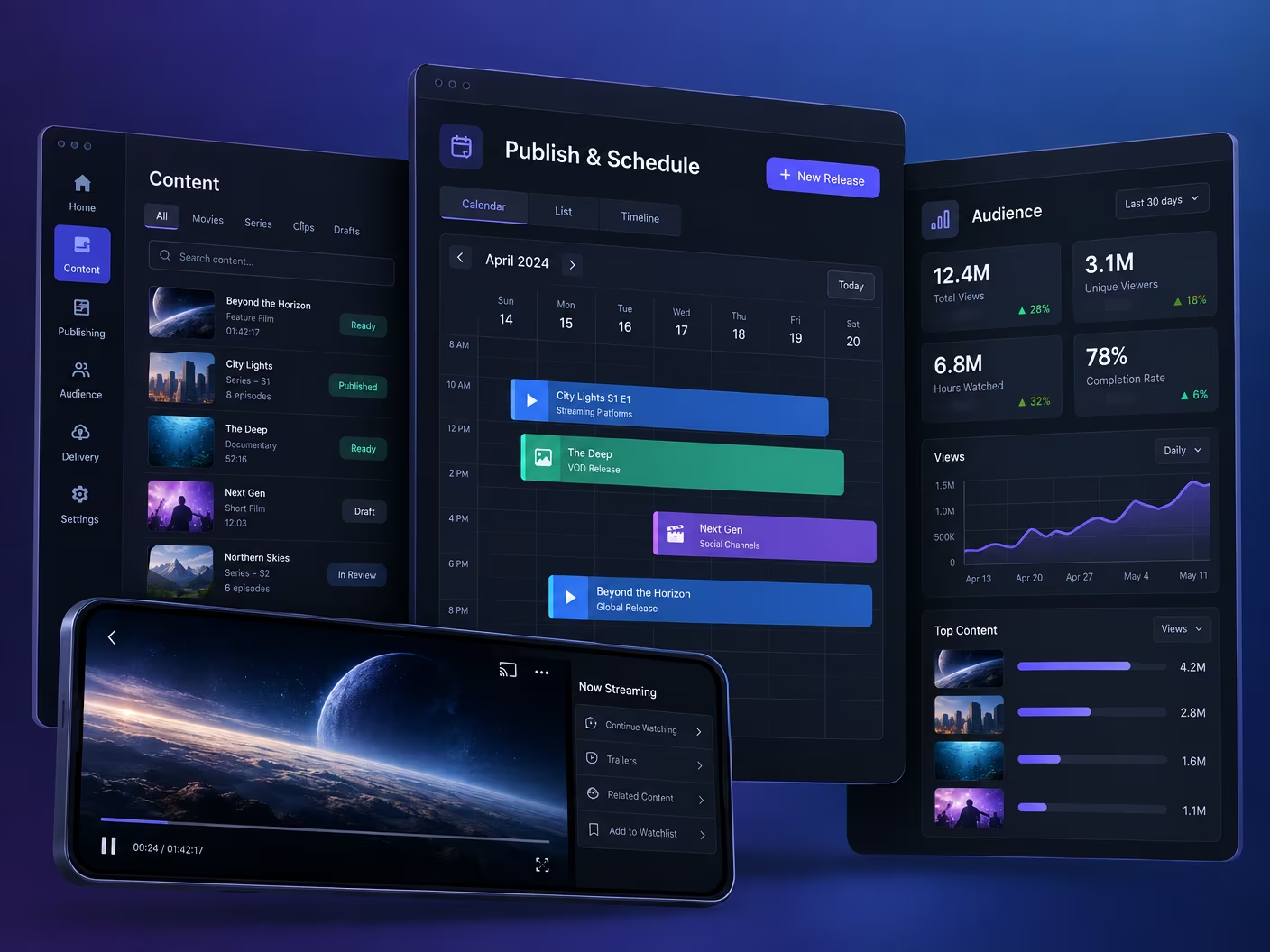
Flexible systems for industries that move fast
SWARECO is a media and entertainment software development company that builds audience-facing platforms across web and mobile, and the media operations behind them — submission, review, approval and publishing workflows, rights management and metadata, creator marketplaces, and the user-facing product itself. Software for media and entertainment is distinctive in three concrete ways: the load is spiky rather than steady, the content carries rights and moderation obligations that ordinary business software does not, and the channels it publishes to change faster than most teams can rebuild for them. Those three constraints make this its own discipline rather than general custom development with a play button attached.
What media and entertainment software development involves
Media and entertainment software development is the design, build, integration and ongoing operation of the systems that move content from creation to audience. That covers the product an audience sees, the internal systems a content team operates, and the pipeline between them — ingest, review, approval, publishing, distribution and measurement. It is custom software development applied to one specific problem: content creation and distribution at a volume and cadence generic business software was never shaped for.
The part that surprises new entrants is the ratio. A media platform looks like a front end and turns out to be an operations problem. What decides whether it scales is the workflow underneath the catalogue or the feed: who reviews a piece of content, what state it is in, which rights attach to it, and what happens to all of that when volume multiplies overnight.
Most media organizations arrive with the ends solved and the middle held together by hand — a clear editorial process, a clear audience, and between them a spreadsheet, a shared drive and one person who knows how it fits. That person is the bottleneck, and replacing them is usually the actual project.
What a media software developer does
A media software developer builds and runs those systems, and the job is more about state and scale than interface work. A developer working on media industry software has to model content that exists in several versions and states at once, attach the rights and metadata that decide where each version may legally appear, keep the publishing path working while the review process changes underneath it, and design for a traffic curve that is flat for weeks and then vertical for an afternoon.
Expertise in the media and entertainment sector matters for a specific reason: software development companies that have not built for digital media will usually get the application right and the content model wrong, and the content model is what everything else hangs on. Rights, metadata, versioning and workflow state are hard to retrofit, because every downstream feature has already assumed a simpler world.
The most common types of media and entertainment software
Buyers across the media and entertainment industry searching for media software development usually mean one of a handful of categories. Naming them precisely matters, because the engineering effort, the operational risk and the cost differ sharply between them.
- Content management systems and publishing — the editorial spine: draft, review, approve, schedule, publish, amend, retract. Most media businesses outgrow a generic CMS or need a custom layer over one.
- Creator and talent marketplaces — two-sided platforms where one side submits work or ideas and the other discovers and commissions it, with a content review workflow in the middle.
- Digital asset management and metadata systems — the catalogue of record for audio and video assets and everything around them: what exists, in which versions, described how, findable by whom. Unglamorous and load-bearing.
- Rights management and licensing — which media content may be shown, where, to whom, and until when. Rules-based, integration-dense, and most often discovered late.
- Streaming, VOD and OTT delivery — ingest, transcoding, packaging, digital rights management and CDN content delivery. Heavier operationally than anything else here, and worth buying unless delivery is the product.
- Audience-facing platforms and apps — catalogues, feeds, players, communities and subscriber accounts on web and mobile, held to consumer standards.
- Production and post-production workflow tools — scheduling, tracking, review and approval on cuts and assets, and coordination between distributed contributors.
- Audience analytics and monetization — engagement, retention and content performance, subscriptions and advertising, plus the data modelling needed before any of those numbers can be trusted.
SWARECO works mainly in media operations, creator marketplaces and user-facing platforms, plus the workflow and metadata systems connecting them. We are not a streaming delivery or DRM vendor; where a product genuinely needs a transcoding and delivery stack, the honest answer is usually to buy that layer and build around it.
The categories also differ in who the software is for. Audience-facing products serve people with no obligation to persevere; content operations tools serve staff under deadline, where a saved click compounds across hundreds of items a week. Media software fails more often from a mismatch here — built for the buyer rather than the daily user — than from any technical defect.
Streaming, VOD and content delivery: what to buy
Buy the delivery layer. Ingest, transcoding, packaging, digital rights management and CDN content delivery are commodities with mature vendors, and building them is justified only when delivery itself is the product — which, for almost every media and entertainment business, it is not.
A streaming platform has three layers and only one of them is yours. Underneath sits infrastructure: object storage, a transcoding pipeline and a CDN, rented from Amazon Web Services (AWS) or a specialist video vendor. In the middle sits the video streaming stack — adaptive bitrate packaging, which is what keeps viewing experiences stable on a bad connection, plus DRM licence issuing and player SDKs. On top sits the catalogue, the entitlements, the audience relationship and the metadata deciding what any given viewer may see. That top layer is the part worth building, because it is the part that differs between businesses.
Live streaming raises the stakes rather than changing the shape. Latency targets are tighter, failure is public and immediate, and there is no second take. If live is central to the product, that is an argument for a specialist vendor underneath, not for building more yourself. Live streaming is also the one case where the delivery layer and the product experience cannot usefully be reasoned about apart.
OTT and VOD products fail commercially far more often than they fail technically. The recurring pattern is a working player and an unusable catalogue: metadata too thin to support search or recommendation, no rights model, and no reliable way to answer what a given subscriber is entitled to watch. That is the content-model problem described above, arriving with a video player attached.
Custom media software development versus off-the-shelf platforms
Most media businesses should buy the commodity and build the differentiator. Transcoding, payments, email delivery, video hosting and authentication are commodities. The specific way your content gets from a submission to an audience, and the internal workflow that makes it economic, usually is not — and that is where custom media software development earns its cost.
Custom media and entertainment software is worth building where the content model, the workflow or the audience relationship is the differentiator. The case is concrete. A custom platform models your actual editorial or commissioning process instead of a vendor's assumptions about content types and approval stages, removes the manual coordination that makes each additional piece of content, creator or channel more expensive than the last, and keeps the catalogue and its metadata yours in a schema you can extend.
The case against is equally real. A custom platform needs maintenance, monitoring, security review and someone accountable after launch. If an off-the-shelf product covers most of the requirement and the remainder is not what makes your business distinctive, buying is the better decision and we will say so.
A middle path exists and is underused here. Rather than replacing a working CMS or asset system, many media companies get the larger return from a thin custom layer over it — a submission and review workflow, an audience-facing experience, something to automate a manual handoff — while the vendor system stays the record. That keeps the build small enough to maintain, and it is usually where the first release should land.
Media operations: content workflows, rights management, metadata and distribution
Integration in media software is less about legacy systems and more about keeping four things consistent: the workflow state of a piece of content, the rights attached to it, the metadata describing it, and the channels it has been published to. Nearly every serious defect in a media platform is a disagreement between two of those four.
Content workflows. Submission, review, approval and publishing sound like a linear pipeline and never are. Content goes back a stage, gets approved conditionally, gets published and then amended, or gets held while a rights question is resolved. Model that as an explicit state machine with full history, not a status field somebody overwrites. The history is what lets you answer "why is this live?" six months later, and in a rights dispute that is not a rhetorical question.
Rights and licensing. Rights are data, not paperwork, and they belong in the model from the first sprint. Territory, window, platform, format and exclusivity constrain what the publishing system may do, so it has to be able to read them. Teams that keep rights in contracts and a spreadsheet enforce them by memory, which works until the catalogue outgrows the person remembering.
Metadata. Metadata is the integration layer of a media platform and it is consistently underinvested. Search, recommendation, rights enforcement, syndication and reporting all read from it, so a weak metadata model caps four features at once. It also arrives dirty — inconsistent taxonomies, free-text fields carrying meaning, duplicates from a previous system — and normalising that is real engineering effort that has to be budgeted.
Distribution channels. Content rarely goes to one place. Web, apps, a social media platform or several, partners and syndication feeds each have different formats and failure modes, and they change on their own schedule rather than yours. The design goal is that adding a channel is an adapter job, not a rewrite — one canonical version of the content, with per-channel transformation at the edge. Publishing should also be asynchronous rather than a request: a fan-out to several destinations will partially fail sooner or later, and the system needs to retry the failed leg without republishing the successful ones.
Moderation, licensing risk and performance under audience spikes
The compliance surface in the media and entertainment industry is content itself: what gets published, whether you had the right to publish it, and whether the platform stays up when a lot of people arrive at once. All three are architectural, not afterthoughts.
Content moderation. Any platform accepting submissions from outside the organization needs a moderation path before launch, not after the first incident — a queue, a defined set of actions, an audit trail of who decided what, and an appeal route. Whether the first pass is automated or human is a tuning decision; the queue itself is not optional, and a platform launching without one is relying on nothing bad happening early.
Rights and licensing enforcement. The risk here is quiet: nothing breaks when content is available in a territory it should not be, or stays up past a licence window — you find out from a rightsholder. Enforcement has to be a property of the publishing system rather than a habit of the team, with windows and territories checked at publish time and re-checked on a schedule.
Performance under audience spikes. Design for the spike rather than the average. Media traffic is not a smooth curve: a release, a campaign or a press mention can multiply concurrent users in minutes, and a system sized for the mean fails exactly when the business is winning. A platform sized for the average is not scalable in the only sense that matters. SWARECO builds media platforms with caching, queueing and monitoring in place from the start, so a release or campaign that multiplies traffic does not destabilise the platform.
Each of the three does a different job. Caching absorbs read load, which is most of a spike. Queueing keeps expensive work such as media processing, notifications and indexing off the request path, so a backlog slows a background job instead of taking down the site. Monitoring tells you which of the two is failing while it is happening, and retrofitting any of them under load is far harder than building them in. The order is to optimize the read path first, then the background work, then the interface.
Audience analytics, user engagement and monetization
Analytics in a media platform is a data-modelling job before it is a dashboard. The numbers a media business runs on — completion rate, retention by cohort, which content earns a return visit — depend on events being defined consistently at the point they are emitted, and no amount of data analysis rescues a stream of events that meant different things in different releases.
Three questions are worth instrumenting from the first release. What did this person watch or read, and how far did they get? Which piece of content brought them back? And which distribution channel delivered the audience that stayed? Those cover most decisions a content team actually makes, and data analytics beyond them tends to be reporting rather than insight.
Monetization sits on the same data and on the same content model. Subscriptions need entitlements and churn measurement. Advertising needs inventory, delivery and viewability. Licensing and syndication need the rights model to say what can be sold where. Transactional and pay-per-view models need the entitlement check to be correct at the moment of play. Each monetization model imposes a different requirement on the content and rights schema, which is why it belongs in the first design conversation rather than a later phase — a platform that added subscriptions after launch usually shows it, with entitlements bolted beside the catalogue instead of inside it.
User engagement is the metric most often reported and least often defined. Decide what it means for your product — sessions, completion, contribution, return visits — before the dashboard exists, because you cannot optimize what nobody has defined, and a data-driven content decision taken from an undefined metric is just a decision with a chart attached. A data-driven editorial team is one that agreed the definitions first.
Media and entertainment app development for web and mobile
The audience-facing half of a media platform is usually a web application and a mobile app sharing one backend, and the decision that matters is which of the two the content model serves first. Mobile app development for media carries constraints the web does not — offline behaviour, background playback, store review cycles, platform payment rules — and retrofitting them is expensive, so they belong in the first architecture conversation rather than the first release notes.
SWARECO does web and mobile development in one team rather than two, on a shared API. A catalogue has to look the same in a browser and in an app, and the reliable way to get that is one canonical backend with thin clients, not two implementations of the same rules drifting apart. In practice the web development side carries the discovery and search load, and the mobile application carries retention.
User experience in media app development is mostly about the second visit. The first is driven by whatever brought the person there; the second depends on whether the app remembers where they were, surfaces something worth returning for, and loads before attention runs out. All three are content-model and performance properties rather than interface decisions, which is why they get settled long before anything is designed. You optimize the second visit, not the first.
Where AI genuinely helps in media and entertainment software — and where it does not
AI in the media industry is useful, narrowly and unglamorously. The reliable wins are transcription and captioning, metadata and tagging at scale, search across a large content library, and first-pass moderation or compliance checks. These are high-volume, judgement-light tasks where a model is genuinely cheaper than a person and where mistakes are recoverable.
Two of those are undervalued. Automated tagging fixes the metadata problem at a volume no team would fund manually, and better metadata improves search, recommendation and rights enforcement at once. Semantic search over a back catalogue makes archive content reusable, which is a revenue argument.
Where AI does not help is anywhere the output is the product. Editorial judgement, commissioning decisions and final moderation calls on contested cases are not judgement-light tasks, and automating them trades away the trust that makes a platform worth visiting. Keep a person in the loop wherever output goes out under your name.
The caveat that matters most is about time. An AI system does not stop learning at deployment — output drifts, edge cases surface, and the monitoring for that has to be built in from the start rather than added after complaints arrive. Concretely: sample and score outputs on a schedule, keep a human escalation path, and set a quality threshold that triggers a rollback rather than a discussion. A model that was accurate at launch and unmeasured since is not a working feature, it is an unreviewed one.
The main challenges in media and entertainment software development
Five recur across almost every media project we have seen, and none are about writing code.
Spiky load. Traffic arrives in bursts tied to releases and campaigns, so planning capacity against an average is planning to fail on your best day. This shapes the architecture, not the launch checklist.
Undocumented editorial process. The real review and approval workflow almost always differs from the documented one, and the difference lives with the people running it. Discovery that skips this produces software nobody uses, and in media that shows within a week, when the team quietly reverts to the shared drive.
Migrating an existing catalogue. Historical content is rarely as structured as the plan assumes: taxonomies are inconsistent and duplicates are common in organizations that have changed systems. Skipping the cleanup produces a search experience nobody trusts, at which point the catalogue goes unused however good the interface is.
Channel churn. Distribution platforms change formats, requirements and APIs on their own schedule. A platform treating today's channels as permanent needs rebuilding every time one moves.
Scope pressure from creative stakeholders. Producers and editors correctly want the software to handle every case they have encountered, and a first release that tries to is one that never ships. Sequencing that is a judgement call, and one of the more valuable things an experienced partner brings.
How much media and entertainment software development costs
Cost is driven by four things: how much of the editorial process is undocumented, how complex the content and rights model is, how many distribution channels the platform must publish to, and whether the product needs a media delivery stack of its own. Feature count matters far less than any of those.
The categories differ sharply. A content operations tool or a submission-and-review workflow over an existing system is the smallest useful build. A creator marketplace or an audience-facing platform is larger, because it carries two user populations, a review workflow between them, and consumer-grade expectations on the front end. Anything owning ingest, transcoding and delivery is a different order of magnitude.
The cost that surprises people is not the build. It is year two: monitoring, capacity work as the catalogue grows, the channel integration that breaks when a platform changes its API, and the moderation and rights work that only exists once real content is flowing. Budgeting a custom media platform without that line is the most common planning error we see.
How SWARECO builds media and entertainment software
SWARECO is a managed engineering company: we build and run a dedicated team of engineers on monthly retainers, from MVP to scale, rather than delivering a specification and leaving. That means a named development team, structured sprints, and one person accountable for the outcome. The sequence we follow on media platform projects:
- Model the content, rights and workflow first. All three constrain everything downstream, so they come before interface design.
- Map the editorial process as it actually runs, including the manual steps and workarounds, with the people who operate it.
- Define an MVP around the workflow causing the most operational drag, and be explicit about what is out of the first release.
- Build for the spike from the first sprint — caching, queueing and monitoring in place before launch, not after the first traffic event.
- Treat publishing as asynchronous and observable, so a failed channel retries and surfaces rather than failing silently.
- Run QA in parallel, not after. Our QA function owns the testing framework, and Playwright end-to-end suites run in continuous integration so regressions surface before release rather than in production.
- Instrument and keep operating after launch. A media platform is not finished at deployment — channels drift, volumes grow, and AI-assisted features degrade quietly unless something is watching.
The tech stack across our client work is Ruby on Rails, React and React Native, with Playwright suites in continuous integration. It matters less than the software engineering discipline around it, which is the same discipline we apply anywhere a defect reaches an audience directly. After launch we stay as the engineering function rather than handing over — support and maintenance services, capacity work as the catalogue grows, and the channel changes that arrive whether or not anyone budgeted for them.
Media and entertainment software trends in 2026
Five shifts are actually changing how media software gets built, as distinct from what gets announced.
AI settling into the metadata and accessibility layer. Transcription, captioning, tagging and semantic search are now routine and genuinely economic. Generation aimed at published output remains a brand risk, and the gap between the two uses is widening.
Archive value unlocked by search. Back catalogues that were effectively invisible become usable assets once the metadata and search layer is good enough. That is a data-model project disguised as a product feature.
Channel volatility as a permanent condition. Distribution platforms change terms, formats and reach often enough that the media landscape a product launched into is not the one it operates in two years later. Adaptability is now a design requirement, pushing teams towards one canonical content model with channel adapters at the edge.
Consolidation of point tools. Media organizations that accumulated separate submission, review, asset and analytics tools are consolidating them — again, a content-model project disguised as a procurement one.
Immersive formats attracting attention ahead of demand. Augmented reality and other immersive experiences come up in most early conversations and reach production in very few of them. SWARECO does not build them, and in our experience a media business asking about immersive formats usually has an unresolved content-operations problem sitting underneath the question. That is not a reason to dismiss the format; it is a reason to sequence it after the catalogue works.
Media and entertainment software development case studies
We publish case studies rather than a logo wall, because the interesting part of a media project is the workflow underneath, not the brand on top.
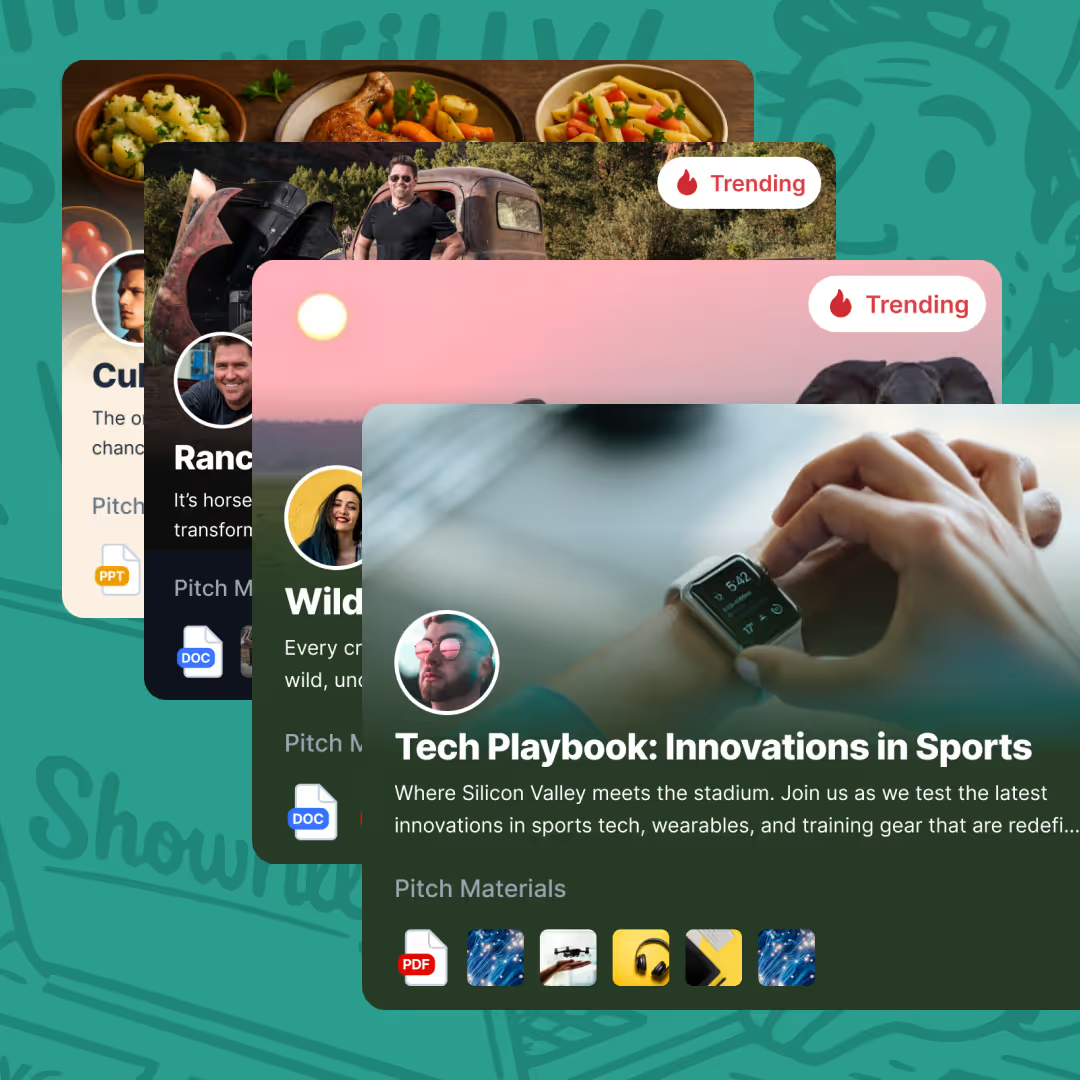
Showrilly — a two-sided marketplace where creators submit unscripted TV ideas and producers discover them. SWARECO took Showrilly from spec to live platform: the creator submission side, the producer discovery side, and the review workflow between them, which is where a marketplace like this either works or quietly stalls. Within two months of launch more than 100 creators had signed up, with roughly 20 percent converting from a single cold outreach campaign. Read the Showrilly case study.
SWARECO's media engagements centre on media operations: submission, review, approval and publishing workflows, rights and metadata management, and the user-facing media platforms those systems feed. That is the layer where most media and entertainment companies are losing time.
How to choose a media and entertainment software development company
Judge a media and entertainment software development company on how it treats the content model, not on its portfolio of finished screens. Most software development companies can build the application; the ones worth hiring will insist on modelling content, rights and workflow before anyone designs an interface, because that is the part nobody can retrofit cheaply.
Four questions separate a development partner from a supplier. Will they map your editorial process as it actually runs, including the workarounds, rather than as it is documented? Will they say which categories they do not do — delivery, transcoding, DRM — instead of quoting for everything? Will they name what is out of scope for the first release? And is there one person accountable for the outcome after launch, when channels change and volumes grow?
One warning sign is worth naming. A team that answers every question with the technology it prefers, rather than with a question about your content, has not understood the problem yet. In media the technology is rarely the constraint.
Common questions about media and entertainment software development services
What is media and entertainment software development?
It is the design, build and ongoing operation of the systems that move content from creation to audience — audience-facing platforms plus the content operations behind them, including submission, review, approval and publishing workflows, rights and metadata management, and distribution to multiple channels. It differs from general custom development because the load is spiky, the content carries rights and moderation obligations, and the channels change on their own schedule rather than yours.
What kind of software do media and entertainment companies need?
Usually a user-facing platform plus the content operations behind it — submission and approval workflows, publishing systems, rights and metadata management, and the internal coordination that keeps a fast content cycle from breaking. SWARECO builds the operational layer as deliberately as the product layer, because that is where the business is normally losing time.
Can you build content and approval workflows for a production team?
Yes. Submission, review, approval and publishing workflows are core to most media platforms we build, and they are where manual coordination costs the most time. We model the workflow on how your team actually reviews work rather than a generic pipeline, and build it as an explicit state machine with full history, so you can always answer why a given item is live.
Can you use AI in content and production workflows?
Yes. The practical wins in media are transcription and captioning, metadata and tagging at scale, search across a large content library, and first-pass moderation or compliance checks. These are high-volume, judgement-light tasks where a model is genuinely cheaper than a person and where mistakes are recoverable.
How do you stop AI features from degrading the audience experience?
By keeping a person in the loop wherever output is published, and by measuring quality rather than assuming it. An AI system does not stop learning at deployment — output drifts, edge cases surface, and the monitoring for that has to be built in from the start rather than added after complaints arrive. In practice, that means sampling and scoring outputs on a schedule against a quality threshold that triggers a rollback.
Where should we not use AI in a media platform?
Anywhere the output is the product. Editorial judgement, commissioning decisions and final moderation calls on contested cases are not high-volume judgement-light tasks, and automating them trades away the trust that makes a platform worth visiting. Generated content published without review is a brand risk, and we would say so rather than ship it as a feature.
How do you handle platform performance when audience volume spikes?
By designing for the spike rather than the average. SWARECO builds media platforms with caching, queueing and monitoring in place from the start, so a release or campaign that multiplies traffic does not destabilise the platform. Caching absorbs the read load, queueing keeps expensive work off the request path, and monitoring shows which is under strain.
Can the platform adapt as distribution channels change?
That is the main design constraint in this sector. Rigid systems break as platforms and formats shift, so we build for change — one canonical version of the content with per-channel adapters at the edge, which makes adding a channel a configuration job rather than a rebuild.
How do you handle rights and licensing in a media platform?
Rights are modelled as data the publishing system can read, not as paperwork the team remembers. Territory, window, platform and format constrain what may be published where, so those checks run at publish time and again on a schedule, which means a licence window expiring takes effect without anyone having to act on it.
Do you have experience with two-sided marketplaces for creators?
Yes. SWARECO built Showrilly, a platform where creators submit unscripted TV ideas and producers discover them, taking it from spec to live platform. Within two months of launch more than 100 creators had signed up, with roughly 20 percent converting from a single cold outreach campaign.
Do you build streaming platforms, VOD or OTT products?
We build the layer above delivery, not the delivery itself. Ingest, transcoding, packaging, DRM and CDN content delivery are commodities now, and the video streaming stack a specialist vendor or Amazon Web Services gives you will beat a custom build unless delivery is your product. What we build on a streaming platform is the catalogue, the entitlements, the rights and metadata model, and the audience-facing product — which is where OTT and VOD businesses usually have the real problem.
Do we need custom entertainment software, or will an off-the-shelf platform do?
Buy the commodity and build the differentiator. Custom entertainment software earns its cost where the content model, the editorial workflow or the audience relationship is what makes the business distinctive; where an off-the-shelf product covers most of the requirement, buying is the better decision and we will say so. The most common right answer is neither extreme: a thin custom layer over a vendor system that stays the record.
Can you build audience analytics and monetization into the platform?
Yes, and both depend on the same content model. Analytics needs events defined consistently at the point they are emitted, or the retention and completion numbers cannot be trusted later. Monetization — subscriptions, advertising, licensing, pay-per-view — each imposes a different requirement on the entitlement and rights schema, so it belongs in the first design conversation rather than a phase after launch.
Do you build mobile apps as well as web platforms?
Yes. A mobile application and a web platform share one backend, with web and mobile development in one team rather than two teams building the same rules twice. Mobile app development for media carries constraints the web does not — offline behaviour, background playback, store review cycles and platform payment rules — and those shape the architecture, so they are decided at the start rather than at the first app release.
How much does a custom media platform cost to build?
Cost is driven by how much of the editorial process is undocumented, how complex the content and rights model is, how many distribution channels are in scope, and whether the product needs its own ingest and delivery stack — not by feature count. Budget for year-two monitoring, capacity and channel maintenance from the start.
What should we look for in a media software development company?
Most software development companies will show you screens. Ask three other things instead. Will they model content, rights and workflow before designing screens? Will they name what is out of scope for the first release? And is there one person accountable for the outcome? Domain familiarity matters, but the failure mode we see most often is a correct application built on a content model that could not carry it.
These companies have relied on us to help expand their engineering teams with top talent who make a real impact.
Companies that trusted us to build and run their engineering.






Case Study
Real results for real clients. Discover how we've helped businesses achieve their digital transformation goals

We build the engineering. You build the business.
If you are trying to figure out whether SWARECO is the right fit for what you are building, the best way to find out is to talk. Tell us what you have. We will be direct about what we can do and how we would approach it.