
Enterprise Software Development
Custom enterprise solutions that optimize workflows and drive operational efficiency
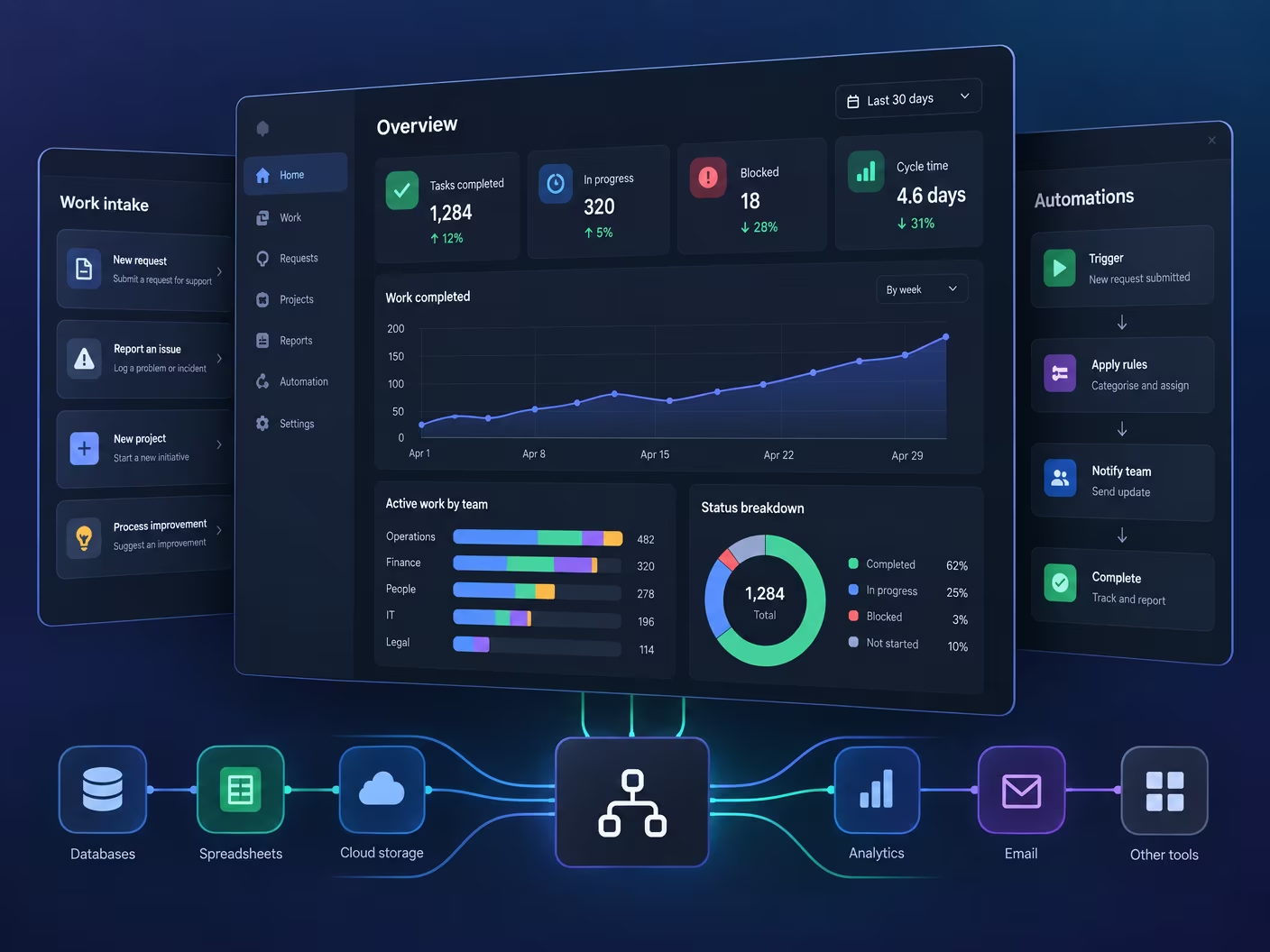
The systems behind the business matter more than they seem
SWARECO is an enterprise software development company that builds the internal systems a business actually runs on: CRM and ERP integrations, operational dashboards, approval workflows and workflow automation. Enterprise operations software is rarely the software product a company sells, which is why it is so often the part that is under-built, and the part that quietly caps how fast the organization can grow. A typical internal platform SWARECO builds reaches production in 16 to 24 weeks, and we continue to run it as a managed engineering function afterwards rather than handing over a repository and leaving. This page sets out what the work involves, where it gets difficult, what drives the cost, and where AI genuinely helps.
Most companies do not arrive asking for custom software. They arrive with three enterprise systems that disagree, a reporting pack assembled by hand every month, and a team whose real job has quietly become moving data between tools. Whether that is called operations work or digital transformation, the fix is the same one: connect the systems of record, remove the manual handoffs, and give the people who work the process an interface built for them.
What enterprise software development involves
Enterprise software development is the design, build, integration and ongoing operation of software used inside an organization rather than sold to its customers. It differs from product development in three concrete ways: it has to fit a process that already exists, it has to connect to systems of record the team does not own, and its users have no choice but to use it. An enterprise application is judged on whether a job gets done faster, not on whether anyone would choose it.
That last point is the one most often missed. A consumer product that is confusing loses users; an internal system that is confusing gains workarounds — the spreadsheet beside the CRM, the manual export before the monthly report.
In practice an enterprise operations project is rarely one application. It is usually a workflow tool the operations team lives in, a reporting layer the managers read, and integrations to the systems of record: a CRM, an ERP, a data warehouse, an internal database.
What an enterprise software developer does
An enterprise software developer builds and maintains those systems, and the job is as much about constraints as code. It means understanding which system is authoritative for each piece of data, what happens when two systems disagree, which steps of a process cannot be interrupted during a release, and how to model records arriving in inconsistent shapes from a CRM, an ERP and a decade of manual entry.
Domain knowledge here means operational knowledge, not industry knowledge. Enterprise software developers who have never replaced a working manual process get the application right and the transition wrong, and the transition is where internal software projects fail.
The technologies for enterprise software
Deliberately boring ones. Internal software is judged on how long it survives and how cheaply it can be changed, so software architecture and language choice are made for maturity, hiring depth and patch availability rather than novelty. Our engineering stack across client work is Ruby on Rails and React, with Playwright end-to-end suites in continuous integration.
What varies between enterprise development projects is not the stack but the data layer. Enterprise data arrives from a CRM, an ERP, a warehouse and a decade of manual entry, in inconsistent shapes and with no shared identifier, and how those software systems are reconciled decides whether the reporting on top of them is trusted. That is the part worth arguing about in week one.
The most common types of enterprise operations software
Buyers searching for enterprise software usually mean one of a small number of categories, and most describe what they want as an enterprise solution before they know which one. Naming them precisely matters, because the engineering effort, the integration burden and the cost differ sharply between them.
- CRM systems — the customer system of record. Most organizations run Salesforce or HubSpot, and the common project is extending or integrating it rather than replacing it.
- ERP systems — enterprise resource planning covers finance, inventory, procurement and the operational spine. ERP software development in practice means integration, extension and reporting on top of a platform such as NetSuite, not writing one.
- Internal dashboards and operational reporting — one place where the state of the business is visible without an export. Usually the fastest-returning work, and usually blocked by a data model problem rather than a charting problem.
- Approval workflows — quotes, discounts, purchase orders, onboarding, access requests. Rules-based and audit-sensitive, and the category where a deterministic system beats a clever one every time.
- Workflow automation — removing the manual handoffs between systems that depend on somebody remembering. This is where headcount cost tends to hide.
- Integration and data layers — the middleware that makes the CRM, the ERP, the internal databases and the reporting environment agree with each other. Invisible when it works, and the single largest source of enterprise project risk.
- Case and order management software — the queues an operations team works through, where the state of each item and who touched it last is the whole point.
- Back-office, partner and field portals — the interfaces teams use to service customers and resolve exceptions. Perennially under-designed relative to the hours spent in them.
Field portals are the one category where mobile app development comes up, and even there a responsive web application usually beats a native build: the audience is small, the release cycle is internal, and an app store review sitting between a bug and its fix is a poor trade. Enterprise app development is otherwise a browser problem.
SWARECO's work sits mainly in integration, dashboards, approval workflows and workflow automation, connecting Salesforce, HubSpot, NetSuite, internal databases and reporting environments. We are not an ERP or CRM vendor, and where a requirement is genuinely met by configuring a platform you already pay for, we will say so.
Custom enterprise software versus off-the-shelf platforms
The honest answer is that most organizations should buy the commodity and build the differentiator. A CRM, an ERP, a payment processor and a data warehouse are commodities with mature vendors, and the enterprise software solutions in each of those categories are good. The specific way your operation coordinates work usually is not, and that is where custom enterprise software earns its cost.
The benefits of building are concrete. A custom internal platform models your actual process instead of forcing it into a vendor's assumptions, removes the manual coordination that makes each additional order, client or region more expensive than the last, and gives you one place where the operational picture lives rather than four tools and a spreadsheet.
The case against building is equally real. Custom software is a long-term commitment: it needs maintenance, monitoring, security review and someone accountable after launch. If an off-the-shelf software solution covers 90% of the requirement and the remaining 10% is not what makes your operation distinctive, configuring the platform wins, and custom software development is the wrong spend.
A middle path exists and is badly underused. Rather than replacing a working system, most companies get the larger return from a thin custom layer over it — an operations interface, an integration that removes a manual handoff, a reporting environment finance trusts — while the vendor platform remains the record. That keeps the custom surface small enough to maintain, and it is usually where custom application development should start.
CRM and ERP integration is where enterprise projects get difficult
Integration, not features, determines an enterprise software timeline. An internal platform is worth little if the customer records, orders and invoices live somewhere else, so the integration surface is scoped before the application is designed. It constrains the data model, and reversing that order is expensive.
Modern platforms have real APIs now, and that helps. What it does not do is make the data agree. The same customer exists three times under different identifiers, a field means one thing in the CRM and another in the ERP, and rate limits shape how often data can move. The engineering work is reconciliation and normalization as much as transport, and it is consistently underestimated.
Settle early which system is authoritative for each entity. Two systems that both believe they own the customer record will diverge, and finance will discover it at month end. Naming one system of record per entity, and making every other copy explicitly derived, prevents a class of bug that is nearly impossible to fix later.
Custom CRM development
Custom CRM development is worth it when the sales or service process is a real differentiator, and not otherwise. If your pipeline is broadly a pipeline, configure Salesforce or HubSpot and spend the budget elsewhere. If it involves entities the vendor has no concept of, or approval chains it cannot express, a custom layer beats fighting the platform for years.
In most engagements the answer is not either. SWARECO builds custom interfaces, workflow and reporting on top of an existing CRM, with the CRM remaining the system of record for the customer.
ERP software development
ERP software development almost never means writing an ERP. It means integrating one, extending it, and building the operational software around it that the platform does not do well. NetSuite and its peers are strong at finance and weak at the coordination work between departments, and that gap is filled by spreadsheets until someone builds it.
The common projects are an integration so a closed deal becomes an order without re-keying, an approval workflow that enforces policy before a purchase order is raised, and reporting finance and operations both accept — each contained and measurable, which beats starting with a platform migration.
Legacy systems and software modernization
Modernize the parts that block you, and leave the rest alone. Legacy software that is stable, understood and doing its job is not a problem to be solved; the problem is the process wrapped around it — the export, the re-keying, the person who knows the workaround. Most of what gets sold as digital transformation is really that wrapper being removed, and it can usually be done without touching the old system at all.
Where a rewrite is genuinely needed, it is incremental. Modernization services that begin with a full replacement carry all the risk at once and pay back nothing until the end. The alternative is to put an interface and an integration layer in front of the legacy system, move one workflow at a time behind it, and decommission the old path only when nothing reads from it — a longer plan on paper that is shorter in practice because the business never stops.
Access control, audit trails and data governance in internal systems
Internal software concentrates risk in a way customer-facing software often does not, so access control has to be designed in rather than added before launch. One operations platform typically holds customer records, financial data, supplier terms and employee information in one place, used by more people with less training than any external product the company runs.
Four things are worth deciding at design time rather than discovering later. Role-based access, so permissions follow a job rather than a person. Audit logging on record changes, so "who changed this and when" is answerable without reading a database. Environment separation with no production data in test, the most common quiet breach in internal tooling. And a defined retention position, because internal platforms hoard by default.
An internal system everybody can edit stops being a system of record and becomes a shared document with a login screen. At SWARECO our QA function owns the testing framework and validates permission and approval paths before release, because a permissions regression in an internal platform is not visible from outside the company.
Where AI genuinely helps in enterprise operations — and where it does not
AI is useful in enterprise operations, narrowly and specifically. The reliable wins are where the input is messy, the volume is high, and a human reviews the output: reading unstructured documents such as invoices, contracts and intake forms; classifying and routing incoming requests to the right team or queue; and summarising activity across systems so a manager does not have to read four tools to understand a week. In each case the alternative is a person doing the same low-judgement reading repeatedly, and a mistake is caught and recoverable.
Where AI does not help is anywhere a deterministic rule already works. If the policy is that discounts above a threshold need a second approver, that is an if statement. A rule is cheaper to run, faster, exactly repeatable and auditable — you can point an auditor at the line. Replacing it with a model adds cost, latency and unpredictability in exchange for nothing. The test we apply is simple: if you can write the rule down, write the rule.
Two failure modes are worth naming. The first is making the model the workflow rather than a component inside it. A model that extracts invoice data belongs behind validation, a confidence threshold and a human queue for anything it is unsure about; a model that is itself the accounts payable process has nowhere to put a mistake. The second is shipping an AI feature with no tests. Non-deterministic output does not excuse a system from having expected behaviour — it means the tests assert on structure, boundaries and the fallback path instead of an exact string. SWARECO maps the workflow first, keeps the deterministic steps deterministic, and applies AI only where messy input genuinely requires judgement.
The main challenges in internal software projects
Six recur across almost every internal software project, and none of them are about writing code.
The documented process is not the real process. The written procedure describes what should happen; the actual process lives in the heads of the people running it, complete with the exceptions they handle by hand. Discovery that reads the documentation and skips the shadowing produces software nobody uses.
Integration debt in systems you do not own. The systems of record were not designed to be integrated with, access is often mediated by a vendor with other priorities, and an API you depend on can change without asking. Enterprise timelines slip on credentials and access at least as often as on engineering.
Adoption is the deliverable, not the launch. An internal tool that ships and is bypassed has cost money and achieved nothing. That makes migration, training and the removal of the old path part of the project rather than an afterthought.
Data quality and duplicate records. Duplicate customers, inconsistent identifiers and free-text fields holding meaningful information are normal in historical operational data. Cleaning this is real engineering effort that has to be budgeted, and skipping it produces reporting nobody trusts.
Migrating without stopping the business. Replacing a working operational process is not a cutover, it is an incremental migration in which the team always has a path that works — usually by running the old and new processes in parallel for longer than anyone wants to.
Scope pressure from every department. Each team correctly wants the system to handle its own exceptions, and a first release that tries to is one that never ships. Sequencing this is one of the more valuable things an experienced development partner brings.
None of the six is a technology problem, which is why enterprise development projects are so rarely rescued by a better framework.
How much an enterprise software project costs
Cost is driven by three things: how many systems the software has to integrate with, how much of the current process is undocumented, and how much historical data has to be migrated and cleaned. Feature count matters far less than any of them, which is why a feature list is a poor basis for an estimate.
Useful reference points rather than a price list. A focused internal operations platform — a real first release, not a prototype — typically reaches production in 16 to 24 weeks. A single CRM-to-ERP integration or one approval workflow is considerably shorter and is often the right way to start, because it produces a measurable result before a larger commitment. Replacing a core platform outright costs multiples of a comparable extension, because migration and parallel running dominate the build.
The cost that surprises people is not the build. It is the second year: maintenance, monitoring, access review, support services, and the integration that breaks when a vendor changes an API. Budgeting a software development project without that line is the most common planning error we see, and it is why internal tools quietly rot.
Choosing an enterprise software development partner
Ask four questions, and weigh the answers above the portfolio. Will they name what is out of scope for the first release? Do they scope the CRM and ERP integrations before designing screens? Is there one accountable owner you can speak to? And who monitors the integrations and fixes the vendor API change next year?
Whether a supplier calls itself an enterprise software development agency, a firm, a consultancy or a managed engineering company matters far less than those four answers. Buyers comparing enterprise software development companies tend to weigh case studies and technology lists, and both are weak signals — most software development companies of a reasonable size can build the application. Sequencing, integration realism and ongoing ownership are what separate a software development partner that ships from one that hands over a repository.
Two more things are worth checking. Custom software development companies vary enormously in who actually does the work: the people on the sales call and the development team assigned to you should be the same people. And a serious partner will ask about your reporting definitions and your access model in the first conversation, because those two decide how much of the build can be reused later.
How SWARECO works as an enterprise software development company
We run the engineering function rather than deliver a specification. This is not consulting services: in practice it means a named, dedicated software development team, structured sprints, and one person accountable for the outcome — which is what clients tell us separated the engagements that worked from the ones that did not.
Our approach to enterprise operations work is a sequence rather than a methodology. Development methodologies matter less than the order the decisions are taken in, and this is the software development process we follow:
- Scope the integration surface first. Which systems, which entities, and which one is authoritative for each. This constrains the data model, so it comes before design.
- Map the process as it actually runs, including the manual steps and the exceptions, with the people who operate it rather than the people who own it.
- Define a first release around the workflow causing the most operational drag, and be explicit about what is out of scope. One workflow done properly beats four done partially.
- Decide what is a rule and what needs judgement, and keep the deterministic parts deterministic.
- Build in structured sprints with QA in parallel, not after. Our dedicated QA function owns the testing framework, and Playwright end-to-end suites run in continuous integration so regressions surface before release rather than in production.
- Migrate incrementally, keeping a working path for the operations team throughout, and retire the old path deliberately rather than hoping it fades.
- Instrument and monitor after launch. The software development lifecycle does not end at deployment — integrations drift, volumes grow, and the monitoring for that has to exist from the start.
QA runs throughout the development process rather than at the end of it, and the stack matters less than the discipline around it. Treating the whole development lifecycle as one engagement, rather than a build followed by a support contract, is the part that keeps an internal platform worth using in year three.
Enterprise software development trends in 2026
Four shifts are actually changing how internal software gets built, as distinct from what gets announced.
AI settling into the document and routing layer, not the decision layer. The deployments that survive contact with reality are extraction, classification, routing and summarisation with a human in the loop. Decision automation is where the retractions happen.
Consolidation of point tools. Organizations that accumulated separate tools for scheduling, ticketing, approvals and reporting are consolidating them, and the enterprise software market is consolidating to match. That is a data-model project disguised as a procurement one, and it is usually costed as the latter.
Integration expectations rising. An API is now assumed rather than negotiated, which removes the excuse for re-keying data between systems.
Internal tooling treated as product. More organizations are giving internal platforms an owner, a roadmap and adoption metrics rather than treating them as a project that ended. That change alone does more for the return on internal software than any technology on this list.
Enterprise operations software development at SWARECO
SWARECO is a managed engineering company that builds and runs dedicated engineering teams on monthly retainers, from MVP through to scale. For enterprise clients that means a team that stays with the platform rather than a vendor that delivers and departs, which matters more here than in product work because integrations drift and internal processes change continuously.
What this enterprise software development company provides is specific: CRM and ERP integrations across Salesforce, HubSpot, NetSuite, internal databases and reporting environments; operational dashboards; approval workflows; and workflow automation that removes manual handoffs between systems. It is enterprise application development in the narrow sense — software engineering aimed at internal throughput, not a product line. These are the systems that help businesses take on more volume without adding headcount in step with it. A typical internal platform reaches production in 16 to 24 weeks, with the first release scoped around whichever workflow is causing the most drag.
Quality is a separate function rather than a developer's spare afternoon. SWARECO runs a dedicated QA function that owns the testing framework, with Playwright end-to-end suites in continuous integration, so permission paths, approval chains and integration behaviour are exercised on every change. That matters disproportionately in internal software, because a broken approval rule or a silent integration failure is invisible outside the company until it has cost something.
Common questions about enterprise operations software
What is enterprise software development?
Enterprise software development is the design, build, integration and ongoing operation of software used inside an organization rather than sold to its customers. It differs from product work because it has to fit a process that already exists, connect to systems of record the team does not own, and serve users who have no choice but to use it — which is why integration and adoption, not features, decide whether it works.
What counts as enterprise operations software?
Enterprise operations software is the internal layer your business runs on — CRM and ERP systems, internal dashboards, approval workflows and the integrations between them. SWARECO builds and customises these software applications around how your organization actually works, rather than making your teams adapt to a generic platform.
What do enterprise software development services usually include?
Scoping the integration surface, building the application, migrating the existing process onto it, and running it afterwards. At SWARECO the same team does all four, because splitting the build from the operation is what produces internal tools nobody owns. Custom enterprise software development services that stop at handover leave the expensive part — the vendor API change, the permissions review, the reporting definition nobody agreed — to whoever is left holding it.
How do we know our internal systems are holding the business back?
The usual signals are workarounds and spreadsheets becoming the real system of record, headcount rising in step with volume, and reporting that different teams no longer trust. If execution depends on manual handoffs between disconnected tools, the constraint is structural rather than a staffing problem.
Can you integrate our existing CRM, ERP and reporting tools instead of replacing them?
Yes, and that is usually the better path. SWARECO connects the systems you already run — Salesforce, HubSpot, NetSuite, internal databases and reporting environments — so information moves cleanly between them. We replace a platform only when integrating it would cost more than rebuilding it.
Should we invest in custom CRM development, or configure the CRM we already have?
Configure first, and build custom only where the platform cannot express your process. Custom CRM development is justified when you have entities, approval chains or a service model the vendor has no concept of; in most engagements the right answer is a custom interface and workflow layer on top, with the CRM remaining the system of record.
Should we build our own ERP?
No, almost certainly not. An ERP is a large, low-differentiation system with mature vendors, so the return on building one is poor. In practice ERP software development means integrating and extending the platform you run — connecting it to the CRM, enforcing policy through approval workflows, and building reporting finance and operations both accept.
Can you use AI to automate internal workflows?
Yes, where the work genuinely needs judgement rather than a rule. The strongest cases in operations are reading unstructured documents such as invoices, contracts and intake forms, classifying and routing incoming requests, and summarising activity across systems for reporting. SWARECO builds these with the model as one component inside a tested workflow, not as the workflow itself.
Where does AI actually help in operations, and where does it not?
It helps where inputs are messy and volume is high. It does not help where the rule is already clear — a deterministic check is cheaper, faster and auditable, and replacing it with a model adds cost and unpredictability. We map the workflow first and apply AI only to the steps that need it. The test is simple: if you can write the rule down, write the rule.
How do you stop an AI feature from becoming unpredictable in production?
By putting the model inside a workflow that has boundaries rather than making it the workflow. That means validation on the output, a confidence threshold, a human review queue for anything the model is unsure about, a defined fallback when the model is unavailable, and automated tests asserting on structure rather than an exact string. Our QA function owns those tests, as it does for any other feature.
How long does an internal operations platform take to build?
A focused internal platform typically reaches production in 16 to 24 weeks, depending on how many systems it has to connect and how much of the current process is undocumented. We scope the first release around the workflow causing the most operational drag, then extend from there.
What drives the cost of an enterprise software project?
Three things: the number of systems it must integrate with, how much of the process is undocumented, and how much historical data has to be migrated and cleaned. Feature count matters far less. Budget for the second year as well — maintenance, monitoring, access review, and the work created when a vendor changes an API.
Will custom internal software scale as we add teams and volume?
It scales if the architecture is designed for it up front, which is the part generic tools and quick builds usually skip. SWARECO builds internal systems on clean architecture with QA and monitoring in place, so adding teams, regions or volume does not require a rebuild.
How do you handle access control and internal system security?
Access control is designed in at the start, because retrofitting it means rebuilding. That means role-based permissions following a job rather than a person, audit logging on record changes, environment separation with no production data in test, and a defined position on data retention. Our QA function validates permission and approval paths before release, since a permissions regression in an internal system is invisible from the outside.
What should we look for in an enterprise software development company?
Ask four things. Will they name what is out of scope for the first release? Do they scope the CRM and ERP integrations before designing screens? Is there one accountable owner you can speak to? And who monitors the integrations and fixes the vendor API change next year? Technical skill is table stakes; sequencing, integration realism and ongoing ownership separate a partner that ships from one that delivers a repository.
These companies have relied on us to help expand their engineering teams with top talent who make a real impact.
Companies that trusted us to build and run their engineering.






Case Study
Real results for real clients. Discover how we've helped businesses achieve their digital transformation goals




We build the engineering. You build the business.
If you are trying to figure out whether SWARECO is the right fit for what you are building, the best way to find out is to talk. Tell us what you have. We will be direct about what we can do and how we would approach it.