
FinTech Software Development
Secure fintech platforms with advanced encryption and seamless user experiences
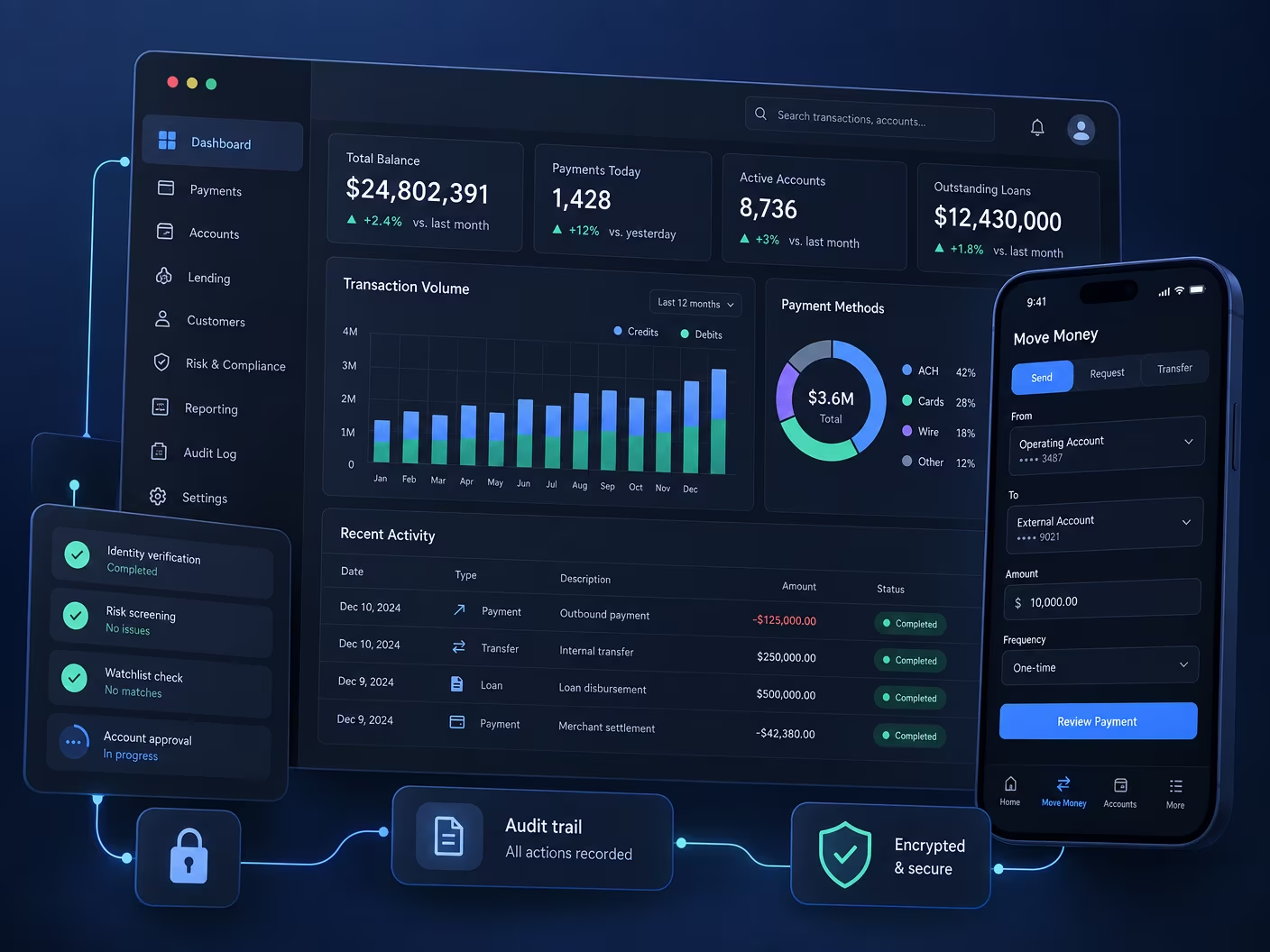
Built for speed, control, and trust
SWARECO is a fintech software development company that builds the operational systems behind financial products — internal platforms, CRM-driven workflows, data management, reporting structures, payments, reconciliation, and secure customer-facing experiences. Financial software carries obligations most software does not: it moves or accounts for other people's money, it has to prove afterwards what happened and who authorised it, and it cannot be taken offline while it is repaired. That changes how it has to be built, and it is why fintech software development is treated here as its own discipline rather than general custom software development with a currency symbol in the interface.
Most of the fintech companies that reach us are not asking for a new consumer fintech app. They are asking why the operation behind a working financial product still runs on spreadsheets, why two systems disagree about the same balance, and what it would take to make the next hundred customers cost less than the last hundred. Those are financial services problems before they are engineering problems, and they are what the rest of this page is about.
What fintech software development involves
Fintech software development is the design, build, integration and ongoing operation of software that moves money, holds financial records, or supports the people who do. It differs from ordinary product work in three concrete ways: the operations are irreversible, the data is regulated, and correctness has to be provable later by someone who was not in the room.
Irreversibility is the one that most changes engineering practice. A duplicated payment, a double-applied fee or a mis-sequenced ledger entry has already reached a customer's balance, so the fix is an operational process as much as a code change. Idempotency is therefore critical for fintech software that moves money: these systems are built around idempotent writes, explicit state machines and reversal paths from the first sprint, not hardened into them later.
Such a fintech project is also rarely a single application, and it is rarely app development in the ordinary sense. It is usually a customer-facing product, an internal platform the operations team runs the business from, and integrations to the third-party services that act as systems of record — processor, banking partner, accounting system, data provider. Most finance companies arrive with the middle and the edges half-solved: a product that works, and a layer of spreadsheets and manual approvals holding the operation together.
What a fintech software developer does
A fintech software developer builds and maintains those systems, and the job is as much about constraints as code. It means knowing where money and sensitive financial data enter and leave the system, which actions must produce an audit record, what happens when a third-party call times out after the money has moved, and how to model amounts, currencies and effective dates so a report run next year still reconciles.
Domain knowledge therefore matters more here than in most custom development. Fintech developers who have not worked in finance usually get the application right and the edges wrong — retries that double-charge, a floating-point amount, a status that assumes the payment provider always answers. The edges are where the financial and regulatory risk lives.
What fintech applications are built with
There is no fintech programming language. A fintech application is usually a conventional web stack — a relational database as the system of record, a mature server language, an API layer, and a front end — chosen for auditability, hiring depth and patch availability rather than novelty. The financial technologies that make it a fintech product sit alongside it: a payment processor, a banking software or ledger provider, an identity and screening vendor, and an accounting system.
That puts API development at the centre of the work rather than front-end development. The difficult engineering is in how the application talks to third-party services and what it records when they answer. Application development in finance is mostly the discipline of representing amounts, currencies, effective dates and states precisely enough that two financial systems can still be reconciled against each other months later.
The main types of fintech software
Buyers searching for a financial software development company usually describe what they want as a fintech solution, but the engineering, the regulatory exposure and the cost differ sharply between the categories underneath that word. It is worth naming them precisely.
- Payments and money movement — collecting, disbursing, splitting and settling financial transactions across card rails, ACH and SEPA. Integration-dense, and where irreversibility bites hardest.
- Lending and credit platforms — origination, underwriting workflow, servicing and collections. Heavily rules-based, with decisions that must stay explainable long after they were made.
- Banking and account infrastructure — accounts, balances, cards and the ledger beneath them. Most companies integrate a partner that already holds the licence and supplies the banking services rather than build this, and the real project is the layer on top.
- Wealth, investment and trading platforms — portfolios, orders, positions and statements, where data quality and time-ordering are first-class engineering problems.
- Financial operations and back-office platforms — reconciliation, approvals, exceptions and case management. This is specialized software that is rarely bought off the shelf in a form that fits, and usually where the largest operational saving sits.
- Reporting and financial data platforms — management and regulatory reporting, plus the data-model work that precedes any trustworthy figure.
- Onboarding, KYC and AML tooling — identity capture, document handling, screening, risk scoring and the case queues a compliance team works through.
- Embedded finance — payments, lending or accounts inside a non-financial product, which inherits financial services obligations without a financial company's operating muscle.
Some of these are run by a licensed financial institution; more are run by companies that rent a licence from one. That distinction changes the compliance boundary far more than it changes the software, because a financial institution carries obligations its technology partner does not.
SWARECO's work sits mainly in the operational and internal categories — platforms for internal teams, CRM-driven workflows, data management, reporting structures, payments and reconciliation — plus the secure customer-facing experiences on top. Where a requirement needs a licence, a regulated entity or a partner bank, we scope it as a partner integration and say so during scoping rather than after a build.
The same categories describe fintech startups building a first financial product and established lenders replacing a decade-old platform. What changes between them is how much undocumented process already exists, not which box the software goes in.
The categories also differ in who the software is for, which is easy to lose in a feature list. Customer-facing products are held to consumer standards by people anxious about their money. Back-office platforms serve staff working queues under deadline, where a saved click compounds across hundreds of daily items. Projects fail more often from a mismatch here — software built for the buyer rather than the daily user — than from any technical defect.
Custom fintech software development versus off-the-shelf platforms
The honest answer is that most finance companies should buy the commodity and build the differentiator. A payment processor, a KYC vendor, a general ledger and an accounting package are commodities, and the off-the-shelf software solutions in each of those categories are mature. The specific way your business prices, approves, services and reconciles usually is not, and that is where custom fintech software development earns its cost.
The reliable way to reduce development time and costs is to rent the commodity, because every integration you buy is a system you do not have to build, secure and keep patched. The benefits of the custom half are concrete rather than abstract. A custom platform models your actual operating process instead of forcing it into a vendor's assumptions. It removes the manual coordination that makes each additional customer, loan or transaction more expensive than the last. It gives you one place where the complete picture lives rather than four disconnected tools and a reconciliation spreadsheet, and it keeps the financial data yours in a schema you can extend.
The case against building is equally real. Custom financial software is a long-term commitment: maintenance, monitoring, security review, and someone accountable after launch. Packaged financial solutions have improved a great deal, and if a fintech solution off the shelf covers 90% of the requirement while the remaining 10% is not what makes your business distinctive, buying is the better decision and we will say so.
A middle path exists and is underused. Rather than replacing a working fintech platform, many finance companies get the larger return from a thin custom layer over it — an internal operations console, an automation that removes a manual approval — while the vendor system stays the record. That keeps the custom software small enough to maintain, and is usually where the first release should land.
Payments, ledgers and reconciliation: the layer that sets the timeline
Integration is where most fintech software projects actually get difficult, and payments are the hardest part of it. The integration surface — processor, banking partner, accounting system, data providers — usually determines the timeline, not the feature list.
Three realities cause most of the pain, and none are visible in an API reference. Payment calls fail after the money has moved, so every write has to be idempotent and every state transition explicit. Webhooks arrive late, twice, or out of order, so event arrival cannot be treated as event ordering. And settlement is not instant, so the balance the customer sees, the balance the processor reports and the balance the accounting system holds are three different numbers, all correct at different times.
The design answer we keep returning to is a ledger the business owns. Record double-entry movements for financial transactions in your own system, treat the provider as a source of events rather than a source of truth, and reconcile continuously against provider statements instead of monthly by hand. That single decision is what makes reporting trustworthy later, because every figure has one provenance.
Standards help at the transport layer without solving the semantics. ISO 20022 messaging, open banking APIs and processor SDKs move data reliably; they do not make it mean the same thing in two systems. Field-level meaning differs between providers and identifiers do not always reconcile. Normalization is consistently underestimated, so we scope the integration surface before designing the application — it constrains the data model.
Fintech security and compliance are architectural decisions, not a final review
At SWARECO security is designed into the architecture rather than reviewed at the end: least-privilege access, encrypted data at rest and in transit, and audit trails on sensitive actions. These shape the data model, not just the deployment checklist, because retrofitting them means rebuilding. The work starts by defining the compliance boundary — which financial systems hold regulated data, who may reach it, and what must be recorded — and only then designs around it.
Three regulatory frames shape architecture more than paperwork, and all three should be settled in the first sprint.
PCI DSS. The winning move is scope reduction, not scope compliance. Route card data through a tokenising provider so raw card numbers never touch your servers, and the audit burden shrinks by an order of magnitude. A week-one decision determines whether you are certifying an application or certifying a vault.
SOC 2. Auditors ask for evidence, so the system has to produce it as a by-product of running rather than as a retrospective document exercise. Access reviews, change history, logging and alerting have to exist as operational facts. Audit trails from the start make the audit an inventory; without them it becomes a project.
KYC and AML. These are data-model requirements before they are policy requirements. Identity evidence, screening results, risk decisions and the reason for each need somewhere structured to live, with retention rules and a case workflow around them. Bolting this onto a product designed without it is one of the more expensive rewrites in finance.
Two practical points matter more than the certificates. There is no such thing as a certified-compliant developer — compliance is a property of a system and an organization's controls, not a badge a vendor holds, and any fintech software development company implying otherwise is worth a second look. And if a third party will process financial or personal data, contract for it before data flows — including AI vendors, which is where this most often goes wrong now.
Where AI genuinely helps in financial software — and where it does not
AI in financial software is useful, narrowly, and the reliable wins are in the back office rather than the decision. Three patterns hold up in production: extraction and classification, anomaly flagging for review, and retrieval-augmented answers over your own verified records.
Extraction and classification. Reading bank statements, invoices, remittance advices and onboarding documents is high-volume work where the input is messy, a person reviews the output, and a mistake is recoverable. It is the clearest return available today, because it removes manual reading without moving a decision away from a human.
Anomaly flagging for human review. Surfacing the transactions, reconciliation breaks or onboarding cases that look unlike the rest is a good use of a model, provided the output is a queue and not an action. A flag is a suggestion, and the person disposing of it is the control.
Retrieval-augmented answers with citations. Constraining a model to answer only from your own verified records, with citations back to source, is far safer than a general-purpose model answering from memory. It also makes wrong answers checkable, which is the property that matters in finance.
The non-negotiable constraint is auditability. Every model output is logged alongside the input that produced it, the prompt and model version behind it, and the person who accepted or rejected it — otherwise the system cannot explain itself later, which is the whole job. And where a wrong answer carries financial consequence, the model proposes and a person approves.
Where AI does not belong is equally specific. It does not compute balances, apply fees or post ledger entries — arithmetic belongs in deterministic code that returns the same answer twice. It does not make unrecorded final decisions on credit, pricing or account closure, and it is not a substitute for reconciliation. A model allowed to answer "what is this customer's balance" from memory rather than from the ledger is a defect, however fluent the answer reads.
The main challenges in fintech software development
Six recur across almost every fintech project we have seen, they are unusually consistent across the fintech sector, and none of them are about writing code.
Reconciliation debt. Companies that grew on manual reconciliation carry a gap between what the product believes and what the bank statement says. That gap has to be closed before automation is safe, and closing it is discovery work nobody budgets for.
Partial failure across systems. Money movement spans systems you do not control, and the interesting cases fail halfway. Designing for timeouts, duplicate webhooks and out-of-order events is most of the difficulty in a payments build.
Compliance treated as a phase. Teams that plan a security review before launch discover architectural problems at the point where they are most expensive to fix.
Undocumented operational process. The real approval chain usually differs from the documented one, and the difference lives in the heads of the two people who run it. Discovery that skips this produces software nobody uses.
Competing versions of the same number. When three teams each maintain their own definition of revenue, the dashboard is not the problem. Fixing where the numbers come from is the only thing that makes reporting trusted.
Scope pressure from risk and compliance stakeholders. They correctly want the software to handle every edge case they have seen. A first release that tries to becomes a first release that never ships. Sequencing this is the hardest judgement call in financial product development, and one of the more valuable things an experienced partner brings.
What fintech software development costs
Cost in financial services software is driven by three things: how many external systems the software must integrate with, how much of the current operational process is undocumented, and how wide the regulatory boundary is. Feature count matters far less than any of those, which is why a feature list is a poor basis for an estimate and an integration inventory is a good one.
SWARECO is a managed engineering company: we build and run dedicated engineering teams on monthly retainers, from MVP to scale. That makes development cost a question of team shape and duration rather than a fixed quotation against a specification, and the estimate that matters is how long the integration surface and the compliance boundary take to work through.
The cost that surprises people is not the build. It is year two: maintenance, monitoring, security review, reconciliation exceptions, and the integration that breaks when a provider changes an API. Budgeting a custom fintech project without that line is the most common planning error we see.
Choosing the right fintech software development company
Three questions separate the engagements that work from the ones that do not, and none of them are about a portfolio. Anyone comparing fintech software development services should ask all three early, because the answers are cheap to give before a contract and expensive to discover after one. Can the company explain its security implementation specifically, rather than asserting compliance? Will it name what is out of scope for the first release, and tell you when buying beats building? And is there one person accountable for the outcome after launch?
No scoring rubric will choose the right fintech software development company for you, but those three get most of the way. An experienced fintech development partner answers all of them in specifics, and volunteers the second before being asked, because naming the boundary of a first release is how a first release ships.
Two further signals are worth checking. A partner that has genuinely worked in finance asks about your reconciliation process and your integration surface in the first conversation, not about your feature list — fintech development services go wrong most often because nobody asked. And choosing the right development partner is partly a question of who you will actually work with: the people on the sales call and the development team assigned to you should be the same people.
How SWARECO builds fintech software
We run the engineering function rather than deliver a specification: a named development team, structured sprints, and one person accountable for the outcome. The fintech software development process we follow:
- Scope the compliance boundary and the integration surface first. Both constrain the data model, so both come before design.
- Map the operational process as it actually runs, including the manual approvals and workarounds, with the staff who work it every day.
- Establish the ledger and the reconciliation path early, so every figure has one provenance before anything is reported on top of it.
- Define an MVP around the workflow causing the most operational drag, and be explicit about what is out of the first release.
- Build in structured sprints — agile development with QA in parallel, not after. Our QA function owns the testing framework, and Playwright end-to-end suites run in CI so regressions surface before release rather than in production.
- Migrate incrementally, keeping a working path for customers and staff throughout, and running old and new in parallel while the numbers are proved to match.
- Instrument and monitor after launch. The development lifecycle does not end at release: providers change and volumes grow, so alerting for a stuck payment or a reconciliation break has to exist from day one.
QA runs throughout the development process rather than at the end of it, and automated testing is what makes it safe to keep shipping into a system that cannot afford downtime — the difference between a platform that stabilises as it grows and one that gets more frightening to touch with every release.
Fintech software trends in 2026
Four shifts are actually changing how software gets built across the fintech industry, as distinct from what gets announced.
AI moving into the back office, not the decision. The deployments that survive contact with an auditor are extraction, classification, summarising and anomaly flagging with a person approving. Vendor claims are ahead of this, and the question being asked now is what was logged.
Auditability becoming an AI procurement requirement. Buyers increasingly ask where model outputs are stored, what input produced them, and who signed off. Teams that instrumented that from the start answer in a meeting; teams that did not answer with a project.
Real-time payments and ISO 20022 raising the floor. Richer message formats and faster settlement remove the overnight window a lot of back-office process quietly depended on, turning batch reconciliation into a continuous problem.
Consolidation of point tools onto one ledger. Finance companies that accumulated separate tools for payments, approvals, reporting and customer records are consolidating them, and the same pattern is visible across the wider financial sector — a data-model project disguised as a procurement one, which surfaces every competing definition of a number at once. Modern fintech platforms are converging on one ledger and one customer record for that reason.
None of the four is a prediction about the fintech market. They are changes already visible in the work.
Fintech software development at SWARECO
SWARECO is a managed engineering company that builds and runs dedicated engineering teams on monthly retainers, from MVP to scale. For finance clients that means we do not hand over a specification and leave. SWARECO provides custom fintech software development as an operated engineering function, with a named team, structured delivery and one person answerable for the outcome.
Our finance-oriented work is concentrated in the systems that help fintech companies keep an operation controlled as it grows: internal platforms, CRM-driven workflows, data management and reporting structures, payments and reconciliation, and the secure customer-facing experiences on top of them.
A successful fintech platform is rarely distinguished by a technology choice. Secure fintech software is a consequence of how a system is built, and what clients point to is that security is designed in rather than reviewed at the end, that a dedicated QA function owns the testing framework instead of developers marking their own homework, and that there is one accountable person to call. In a domain where a mistake reaches a customer's balance, that structure is the product.
Common questions about fintech software
What is fintech software development?
Fintech software development is the design, build, integration and ongoing operation of software that moves money, holds financial records, or supports the people who do. It differs from general application development in three ways: the operations are irreversible, the data is regulated, and correctness has to be provable later — which is why idempotency, audit trails and reconciliation are designed in from the first sprint rather than added afterwards.
What does SWARECO build for fintech companies?
Mostly the operational systems behind the product — internal platforms, CRM-driven workflows, data management, reporting structures, payments, reconciliation and secure customer-facing experiences. SWARECO works where correctness and auditability matter more than surface polish.
How do you handle security and compliance in fintech software?
Security is designed into the architecture rather than reviewed at the end: least-privilege access, encrypted data at rest and in transit, audit trails on sensitive actions, and QA in parallel with development. Our QA function owns the testing framework and validates these paths before release, and we scope the compliance boundary in the first sprint because it determines how the data model is built.
Can we use AI in financial workflows without losing auditability?
Yes, provided no model output is ever unrecorded. The pattern that works in finance is AI for extraction and classification — reading statements, invoices and onboarding documents, flagging anomalies for review — with every output logged alongside the input that produced it, the model version behind it, and the person who accepted or rejected it. That removes the manual reading while keeping the audit trail intact.
How do you stop AI from inventing answers in a financial context?
By constraining what it is allowed to answer from. Retrieval-augmented generation over your own verified records, with citations back to source, is far safer than a general-purpose model answering from memory. Where a wrong answer carries financial consequence, the model proposes and a person approves.
Where does AI actually help in a financial operation?
In the back office rather than the decision. The dependable wins are extraction and classification from documents, anomaly flagging that produces a review queue rather than an action, and answering questions from your own records with citations. All three are high-volume tasks where a person still disposes of the output, which is why they work.
Where should AI not be used in fintech software?
Anywhere the answer must be exact or the decision final. Balances, fees and ledger postings belong in deterministic code that returns the same result twice. Credit, pricing and account-closure decisions need an explainable, recorded basis, so a model may inform them but never make them unrecorded. AI is also not a substitute for reconciliation.
Does adding AI put our audit trail or SOC 2 posture at risk?
Only if it is added outside the control framework. An AI feature stays auditable when every request and response is logged with its input, the vendor relationship is contracted before data flows, the data boundary is defined, and approvals are recorded against a named person. Bolted on without those four things, it is an unlogged decision-maker inside a regulated system.
Can you build reporting that finance teams actually trust?
Yes, and it usually starts by fixing where the numbers come from rather than the dashboard on top. SWARECO centralizes the underlying data first and ties figures back to a ledger with one provenance, so reports reconcile and teams stop maintaining competing versions of the same number. A dashboard built over unreconciled sources gets quietly distrusted within a quarter.
How do you keep a fintech platform stable while adding features?
Structured delivery and automated testing. SWARECO runs Playwright end-to-end suites in CI so regressions surface before release, which is what makes it safe to keep shipping into a system that cannot afford downtime. Releases go out incrementally, with monitoring on the paths that move money.
Do you work with finance-adjacent businesses like lending and payments?
Yes. The common thread across finance-oriented engagements is complexity that has to stay controlled — money movement, approvals, reconciliation and reporting — rather than a specific licence or category. Lending operations, payments-adjacent platforms, and businesses whose product is not financial but whose back office is, all present the same problem.
How much does a fintech software build cost?
It is driven by the number of external integrations, how much of the current process is undocumented, and how wide the regulatory boundary is — not by feature count. SWARECO builds and runs dedicated teams on monthly retainers from MVP to scale, so financial software development services are estimated as team shape and duration rather than as a fixed quotation. Budget for year-two maintenance from the start.
What makes a good fintech software development company to work with?
Specificity and directness. A company that explains its security implementation in detail, names what is out of scope for the first release, tells you when an off-the-shelf platform beats a build, and gives you one accountable person is a safer bet than one with a longer client list. Ask about reconciliation and integrations early — how a partner answers those two reveals whether they have worked in finance.
These companies have relied on us to help expand their engineering teams with top talent who make a real impact.
Companies that trusted us to build and run their engineering.






Case Study
Real results for real clients. Discover how we've helped businesses achieve their digital transformation goals

We build the engineering. You build the business.
If you are trying to figure out whether SWARECO is the right fit for what you are building, the best way to find out is to talk. Tell us what you have. We will be direct about what we can do and how we would approach it.