
Healthcare Software Development
HIPAA-compliant solutions that improve patient care and streamline healthcare operations.
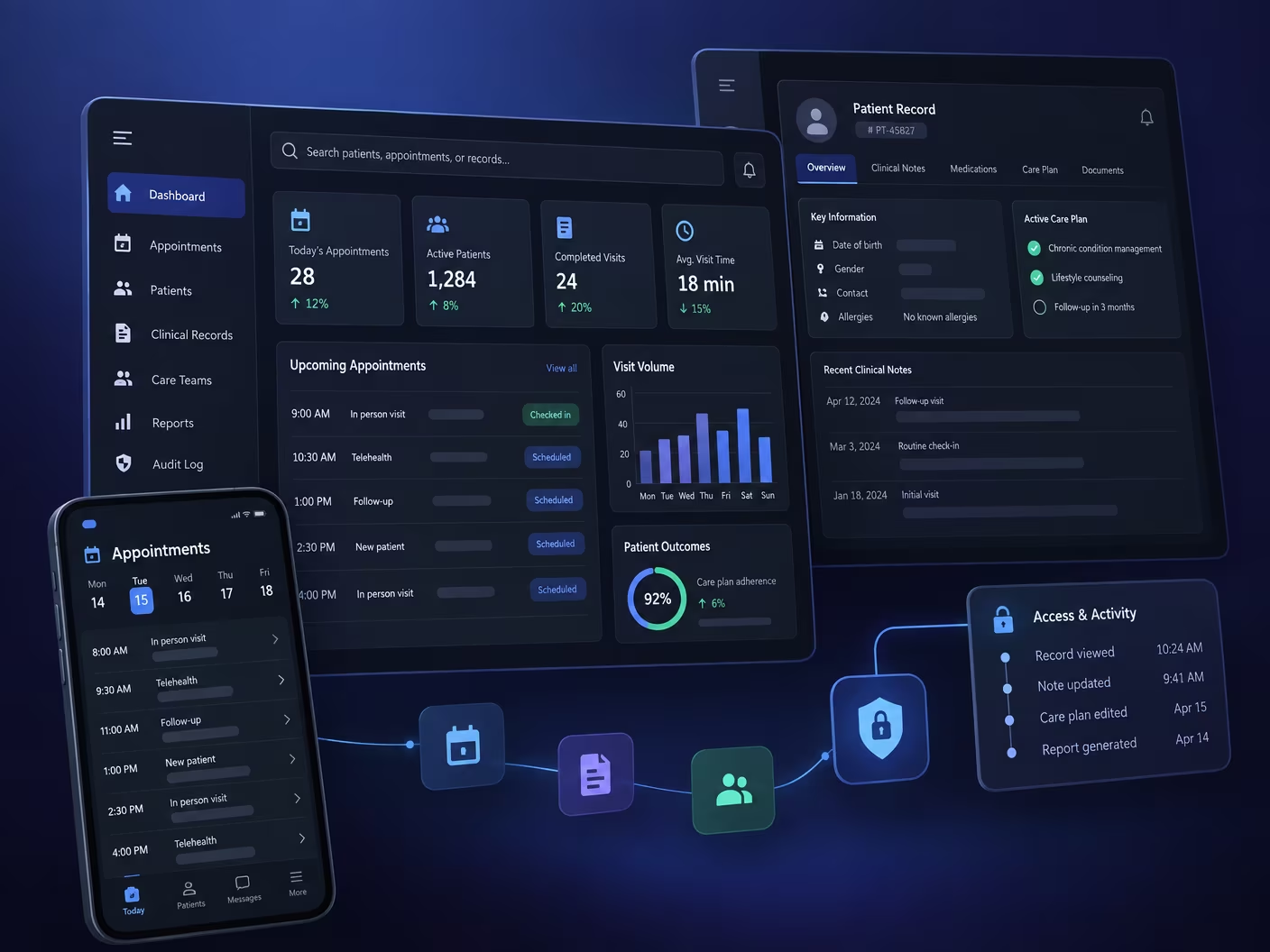
Built for patient care, privacy, and operational safety
SWARECO is a healthcare software development company that builds patient-facing platforms and the clinical and administrative systems behind them. We have delivered custom healthcare software for telehealth, longevity care and healthcare staffing organizations — including a patient platform with biomarker tracking, action plans, scheduling and in-app purchasing that reached a working MVP in approximately four months. Healthcare software carries obligations most software does not: it handles protected health information, it sits inside workflows clinicians depend on, and it cannot be taken offline while it is repaired. That changes how it has to be built, and it is why healthcare software development is treated here as its own discipline rather than general custom software development with a medical logo on it.
What healthcare software development involves
Healthcare software development is the design, build, integration and ongoing operation of software that handles patient data or supports clinical and administrative work. It differs from ordinary software development in three concrete ways: the data is regulated, the workflows are safety-relevant, and the systems it must connect to are older and more rigid than in almost any other sector.
In practice a healthcare software project is rarely a single application. It is usually a patient-facing product, an internal system the clinical or admin team operates, and a set of integrations to the systems of record — an electronic health record, a laboratory, a billing platform, a device feed. Most healthcare organizations arrive with the middle and the edges half-solved: a care model that works and a set of manual processes holding it together.
What a healthcare software developer does
A healthcare software developer builds and maintains those systems, and the job is as much about constraints as code. A developer working on healthcare applications has to understand where protected health information enters and leaves the system, what has to be logged for an audit trail, which parts of a clinical workflow cannot be interrupted during a release, and how to model medical data that arrives in inconsistent formats from labs, devices and legacy healthcare systems.
That is why domain knowledge matters more here than in most custom development. A team that has not worked in the healthcare domain will usually get the application right and the boundary wrong — and the boundary is where the compliance and safety risk lives.
The most common types of healthcare software
Buyers searching for healthcare software development usually mean one of a small number of categories. It is worth naming them precisely, because the engineering, the regulatory exposure and the cost differ sharply between them.
- Electronic health record (EHR/EMR) systems — the clinical system of record. Most organizations buy rather than build one; the common project is integration with an existing EHR, not replacing it.
- Patient portals and patient platforms — where a member or patient sees their own health picture, results, care plan and appointments. This is the category most custom healthcare software work falls into.
- Telehealth and remote patient monitoring software — video consultation, asynchronous messaging, and device or wearable data flowing back to a care team.
- Practice management software — scheduling, intake, eligibility, documentation and the administrative spine of a clinic.
- Revenue cycle management — billing, claims, coding and collections. Heavily rules-based and integration-dense.
- Healthcare analytics — reporting across clinical and operational healthcare data, population-level views, and the data model work that has to happen before any of it is trustworthy.
- Medical device software and software as a medical device (SaMD) — software that is itself regulated as a device. This carries a different and much heavier regulatory pathway than a patient portal, and any healthcare software development company should tell you plainly whether a feature crosses that line.
- Healthcare staffing and operations platforms — the systems healthcare businesses run on that are not clinical at all: client acquisition, workforce coordination, internal workflow automation.
SWARECO's healthcare software development work sits mainly in the patient platform, telehealth, analytics and healthcare operations categories, plus the integrations that connect them. We do not present ourselves as a medical device software or EHR vendor, and where a requirement would make a product a regulated device we say so during scoping rather than after a build.
The categories also differ in who the software is for, which is easy to lose in a feature list. Patient platforms are consumer products held to consumer standards of usability by people who are unwell. Practice management and revenue cycle software serves healthcare professionals under time pressure, where a saved click compounds across hundreds of daily interactions. Analytics serves administrators making resourcing decisions. Medical software development for healthcare providers fails more often from a mismatch here — software built for the buyer rather than the daily user — than from any technical defect. We ask which of the three a feature is for before designing it, because the answer changes the interface, the error handling and what counts as done.
Custom healthcare software development versus off-the-shelf platforms
The honest answer is that most healthcare organizations should buy the commodity and build the differentiator. An EHR, a payment processor and a video provider are commodities. The specific way your service delivers care, and the internal workflow that makes it economic, usually is not — and that is where custom healthcare software development earns its cost.
The benefits of custom healthcare software are concrete rather than abstract. A custom platform models your actual care pathway instead of forcing it into a vendor's assumptions. It removes the manual coordination that makes each additional patient more expensive than the last. It gives you one place where the member's complete picture lives, rather than three disconnected tools and a spreadsheet. And it keeps the data yours, in a schema you can extend, rather than trapped behind an export.
The case against building is equally real. Custom healthcare software is a long-term commitment: it needs maintenance, monitoring, security review and someone accountable for it after launch. If an off-the-shelf healthcare solution covers 90% of the requirement and the remaining 10% is not what makes your service distinctive, buying is the better decision and we will say so.
A middle path exists and is underused. Rather than replacing a working platform, many healthcare companies get the larger return from building a thin custom layer over it — a patient-facing experience, an internal dashboard, an automation that removes a manual handoff — while the vendor system stays the record. This keeps the custom healthcare software solution small enough to maintain, and it is usually where the first release should land. Deciding between the three options is a scoping exercise, not a preference, and it is the first thing we work through with a new healthcare client.
EHR integration and healthcare interoperability
Integration is where most healthcare software projects actually get difficult. A patient platform is worth little if the results, appointments and documentation live somewhere else, so the integration surface — EHR, laboratory information systems, billing, pharmacy, devices — is usually the part that determines the timeline.
Healthcare interoperability has real standards now, principally HL7 and FHIR, and they help. What they do not do is make the data clean. Field-level meaning varies between sending systems, identifiers do not always reconcile, and historical records arrive in formats designed for human reading rather than machine parsing. The engineering work is normalization and reconciliation as much as transport, and it is consistently underestimated.
Our approach is to scope the integration surface before designing the application, because it constrains the data model. On EverSpan's platform that meant modelling blood biomarker and genetic data together so member results could be visualized over time rather than delivered as isolated PDF reports, with the technical foundation built to accept wearable and body-composition device feeds — Apple Watch, Oura Ring — as a later phase rather than a rebuild.
HIPAA compliance is an architectural decision, not a final review
HIPAA obligations shape the data model, not just the deployment checklist. Access controls, encryption at rest and in transit, and audit logging on record access all have to be designed in from the first sprint, because retrofitting them means rebuilding. A HIPAA compliant software development process therefore starts by defining the compliance boundary — which systems hold protected health information, who may reach it, and what must be recorded — and only then designs around it.
Two practical points that matter more than the paperwork. First, there is no such thing as a certified-HIPAA-compliant developer; compliance is a property of a system and an organization's controls, not a badge a vendor holds, and any healthcare software development company claiming otherwise is worth a second look. Second, if a third-party service will process protected health information, that relationship needs a Business Associate Agreement in place before data flows, not after — including for AI vendors, which is where this most often goes wrong now.
At SWARECO our QA function owns the testing framework and validates these paths before release rather than after, and we scope the compliance boundary with the client at the start because it determines how everything downstream is built.
Where AI genuinely helps in healthcare software — and where it does not
AI in healthcare software is useful, narrowly. The reliable wins are in the administrative layer: summarising documentation, extracting values from lab reports and intake forms, drafting patient communications for clinician review, classifying and routing inbound requests, and reducing the coordination overhead that consumes clinical staff time. These are high-volume tasks where the input is messy, a human reviews the output, and a mistake is recoverable.
Clinical decision support is a different regulatory category, and we would tell a client that rather than quietly shipping it as a feature. The distinction is not stylistic — it determines whether the software is a productivity tool or a regulated medical device.
Any AI touching protected health information also needs four things in place before a line of code: a defined data boundary, a vendor agreement that permits the processing, a contractual guarantee that patient data is not used for model training, and audit logging on every request. Where those conditions cannot be met, the correct answer is not to route the data through a model at all. We scope that boundary before designing anything, and we would rather lose the feature than move protected health information somewhere it should not go.
The main challenges in healthcare software development
Six recur across almost every healthcare software project we have seen, and none of them are about writing code.
Service continuity. Replacing a manual clinical workflow is not a cutover. It is an incremental migration in which patients and clinicians always have a working path, which means running the old and new processes in parallel longer than a general software project would.
Integration debt in existing healthcare systems. The systems of record were not designed to be integrated with, and access is often mediated by a vendor with no incentive to move quickly.
Compliance treated as a phase. Teams that plan a compliance review before launch discover architectural problems at the point where they are most expensive to fix.
Undocumented process. The real workflow usually differs from the documented one, and the difference lives in the heads of the staff running it. Discovery that skips this produces software nobody uses.
Healthcare data quality. Historical records are rarely as structured as the project plan assumes. Units are inconsistent, free-text fields carry clinically meaningful information, and duplicate patient identities are common in organizations that have changed systems. Cleaning this is real engineering effort that has to be budgeted, and skipping it produces analytics no clinician trusts — at which point the reporting goes unused however good the interface is.
Scope pressure from clinical stakeholders. Clinicians correctly want the software to handle every case they have seen. A first release that tries to becomes a first release that never ships. Sequencing this is a judgement call, and it is one of the more valuable things an experienced healthcare software development partner brings.
How much healthcare software development costs
Cost is driven by three things: how many systems the software must integrate with, how much of the current process is undocumented, and whether any feature crosses into regulated medical device territory. Feature count matters far less than any of those.
Useful reference points rather than a price list. A focused patient platform or telehealth MVP — a real first release, not a prototype — is typically a three-to-four-month build; EverSpan's reached a functional MVP in approximately four months, about two weeks beyond the original target. An internal healthcare operations platform with several system integrations typically takes 16 to 24 weeks. Anything requiring a regulated device pathway should be scoped separately and expected to cost multiples of a comparable non-regulated build, because the verification and documentation burden dominates.
The cost that surprises people is not the build. It is year two: maintenance, monitoring, security review, and the integration that breaks when a vendor changes an API. Budgeting a custom healthcare software development project without that line is the most common planning error we see.
How SWARECO builds healthcare software
We run the engineering function rather than deliver a specification. In practice that means a named team, structured sprints, and one person accountable for the outcome — the model our healthcare clients have said differentiated us from the offshore-only teams they also evaluated.
The sequence we follow on healthcare software projects:
- Scope the compliance boundary and the integration surface first. Both constrain the data model, so both come before design.
- Map the workflow as it actually runs, including the manual steps and workarounds, with the clinical and admin staff who operate it.
- Define an MVP around the workflow causing the most operational drag, and be explicit about what is out of the first release.
- Build in structured sprints with QA in parallel, not after. Our QA function owns the testing framework, and automated end-to-end suites run in CI so regressions surface before release rather than in production.
- Migrate incrementally, keeping a working path for patients and clinicians throughout.
- Instrument and monitor after launch. Healthcare software is not finished at deployment — integrations drift, data volumes grow, and the monitoring for that has to exist from the start.
Our engineering stack across client work includes Ruby on Rails, React and React Native, with Playwright end-to-end suites in continuous integration. The stack matters less than the discipline around it, but it is the same discipline we apply to platforms outside healthcare that carry comparable correctness requirements.
Healthcare software development trends in 2026
Four shifts are actually changing how healthcare software gets built, as distinct from what gets announced.
AI moving into the administrative layer, not the clinical one. The deployments that survive contact with reality are documentation, extraction, routing and summarisation with a human in the loop. Vendor claims are ahead of this; procurement is catching up.
Remote patient monitoring becoming a data problem. Wearable and device feeds are now easy to obtain and hard to use well. The differentiator is which signals a care team can act on, not how many are collected.
Interoperability expectations rising. FHIR-based access is increasingly assumed rather than negotiated, which raises the floor for any new healthcare platform.
Consolidation of point tools. Healthcare organizations that accumulated separate scheduling, messaging, payment and records tools are consolidating them, which is a data-model project disguised as a procurement one.
Healthcare software development at SWARECO
Two named healthcare engagements, both public.
EverSpan — a longevity care provider combining blood biomarkers, genetic data and one-on-one clinician guidance. Results were being delivered as static PDF reports, action plans explained on calls and forgotten, and scheduling, messaging and purchasing handled in three separate platforms; every new member added coordination cost. SWARECO built a custom patient platform with a unified member dashboard, biomarker data visualized over time, action plans documented in-app, integrated scheduling and concierge communication, an in-app shop, and genetic data incorporated for deeper personalization. A functional MVP shipped in approximately four months against an aggressive three-to-four-month target. Read the EverSpan case study.
Staffing For Doctors — a healthcare staffing company with a 25-person in-office team whose growth was constrained by manual coordination and non-standardized client acquisition. SWARECO designed and built a client acquisition platform to centralize service presentation, let clients engage digitally, and automate internal workflows. The engagement ran on Scrum with in-person meetings, weekly alignment calls and daily contact with project leads — structure the client had specifically been unable to get from offshore-only vendors. As co-founder and CEO Danny Nabavi put it: "Communication is the biggest thing." Read the Staffing For Doctors case study.
Common questions about healthcare software development
What healthcare software does SWARECO build?
Patient-facing platforms and the clinical or administrative operations behind them — member dashboards, biomarker and results tracking, scheduling, secure messaging and in-app purchasing — plus healthcare operations software such as client acquisition and workflow automation platforms. SWARECO has delivered this for telehealth, longevity care and healthcare staffing organizations moving off manual workflows.
What are the most common types of healthcare software?
EHR and EMR systems, patient portals and patient platforms, telehealth and remote patient monitoring software, practice management software, revenue cycle management, healthcare analytics, and medical device software. Most custom healthcare software development projects are patient platforms and integrations rather than new records systems. Medical software development for clinical use and medical software built for administrative use are worth separating early, because the regulatory exposure differs and so does the cost.
Can we build our own EHR system?
You can, and it is almost always the wrong decision. An electronic health record is a large, heavily regulated, low-differentiation system with mature vendors, so the return on building one is poor. The high-value custom work is the layer around it — the patient experience, the internal workflow, and the integrations — with the EHR remaining the clinical system of record.
How do you handle HIPAA compliance and patient data?
Compliance is treated as an architectural requirement, not a checklist at the end. That means access controls, encryption, audit logging on record access, and QA validating those paths before release. We scope the compliance boundary with you at the start, because it determines how the data model is built. Where a third party will process protected health information, a Business Associate Agreement is in place before any data moves.
Can AI be used safely with patient data?
It can, but the constraints come first and they are not negotiable. Any AI touching protected health information needs a defined data boundary, a vendor agreement that permits the processing, a guarantee that your patient data is not used for training, and audit logging on every request. Where those conditions cannot be met, the right answer is not to route the data through a model at all.
Where does AI actually help in a healthcare operation?
Mostly in the administrative layer rather than the clinical one — summarising documentation, extracting values from lab reports and intake forms, drafting patient communications for clinician review, and reducing coordination overhead. Clinical decision support is a different regulatory category, and we would tell you that rather than quietly ship it as a feature.
How much does healthcare software development cost?
Cost is driven by the number of system integrations, how much of the current process is undocumented, and whether any feature crosses into regulated medical device territory — not by feature count. A focused patient platform or telehealth MVP is typically a three-to-four-month build; an internal healthcare operations platform with several integrations typically runs 16 to 24 weeks. Budget for year-two maintenance and integration upkeep from the start.
How quickly can a healthcare MVP realistically launch?
Three to four months is realistic for a focused first release. SWARECO built EverSpan's patient platform — biomarker tracking, action plans, scheduling and in-app purchasing — and shipped a functional MVP in approximately four months, roughly two weeks beyond the original target.
Can you replace manual clinical workflows without disrupting care?
Yes, and it has to be sequenced that way. EverSpan was delivering results as static PDFs and explaining action plans on calls; we moved those into the platform incrementally so members and clinicians were never left without a working path.
Do you integrate with EHR systems and lab data?
Yes. Lab results, genetic data and device data are common integration points, and healthcare interoperability standards such as HL7 and FHIR are the usual transport. EverSpan's platform combines blood biomarkers and genetic data, with wearable integrations including Apple Watch and Oura Ring built on the same foundation.
Do you build medical device software?
Software as a medical device carries a separate regulatory pathway, and we scope it as such rather than treating it as an ordinary feature. If a requirement would make your product a regulated device, we will tell you during scoping — including when that makes us the wrong healthcare software development partner for it.
What makes a good healthcare software development partner?
Ask three things. Can they explain their HIPAA implementation specifically, rather than asserting compliance? Will they name what is out of scope for the first release? And is there one person accountable for the outcome? Healthcare domain knowledge matters, but structure and communication are what healthcare clients consistently tell us separated the engagements that worked from the ones that did not.
These companies have relied on us to help expand their engineering teams with top talent who make a real impact.
Companies that trusted us to build and run their engineering.






Case Study
Real results for real clients. Discover how we've helped businesses achieve their digital transformation goals
We build the engineering. You build the business.
If you are trying to figure out whether SWARECO is the right fit for what you are building, the best way to find out is to talk. Tell us what you have. We will be direct about what we can do and how we would approach it.