
Legal Software Development
Case management, document workflows and compliant settlement platforms for law firms and legal tech companies.
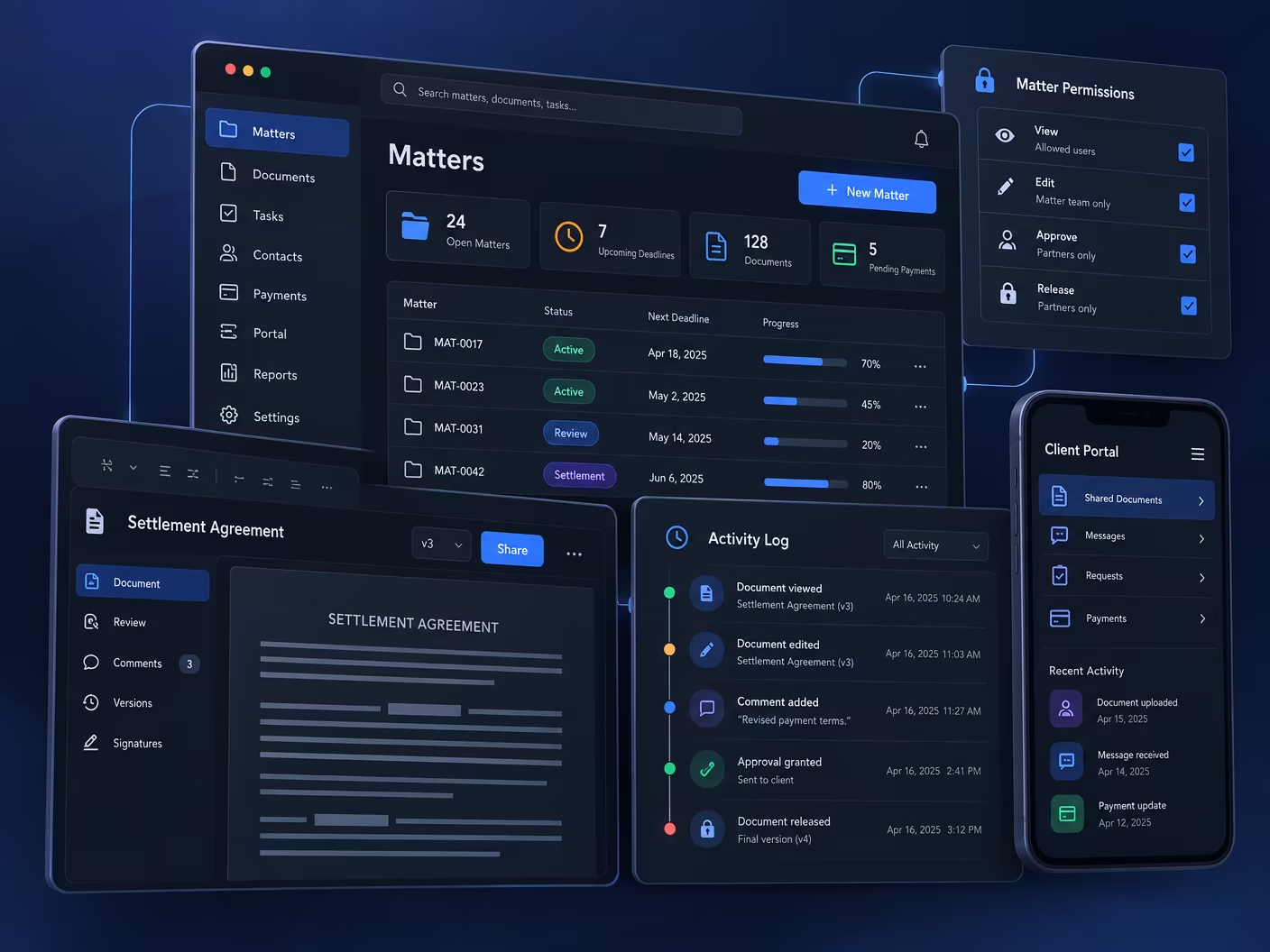
Built for work where a mistake is a compliance event
What legal software development involves
Legal software development is the work of building custom software for law firms, legal departments and legal technology companies — case management, document workflows, client portals, billing, and the compliance layer underneath all of it. SWARECO builds legal software as an engineering partner: a dedicated team that designs the system, ships it, and keeps running it after launch. It is custom software development applied to a regulated field, not a product we resell.
The legal industry is unusual in one way that shapes every technical decision, whatever the legal software solutions involved. Most software can be wrong occasionally and recover. Legal software sits on top of privilege, deadlines, trust accounting and client funds, so a defect is not an inconvenience — it is a compliance event. That is why legal software development is less about features than about traceability: who did what, when, under whose authority, and can you prove it a year later.
What a legal software developer actually does
A legal software developer spends far less time on the visible interface than a first-time buyer expects. The work concentrates in four places: modelling a legal workflow accurately enough that the software does not fight the way the firm really operates; wiring the system into the tools already in use; building the permission and audit layer that regulated work requires; and making the whole thing fast enough that legal professionals actually adopt it rather than reverting to email.
The kinds of legal software we build: common use cases
Most legal software development projects fall into a handful of shapes:
- Legal case management. The spine of a legal practice: matters, parties, deadlines, documents and status in one place, with the matter record as the single source of truth. Legal case management software is where most firms start, because everything else hangs off the matter.
- Document workflow and generation. Assembling documents from templates and matter data, routing them for review and signature, and keeping every version.
- Client and third-party portals. Structured places for clients, opposing counsel, medical providers or insurers to exchange documents and decisions without an email chain.
- Billing, trust accounting and settlement. The money side, where reconciliation and traceability requirements are strictest.
- Document automation. Generating legal documents from matter data and clause libraries so a legal team stops rebuilding the same paperwork by hand.
- Legal research tools. Internal search across a firm's own legal data — prior matters, briefs, opinions — which is where most legal research time is actually lost.
- Legal operations and analytics. Reporting on matter throughput, cycle time, workload and cost that legal ops teams can act on, drawn from a legal database the firm actually controls.
- LegalTech products. For legaltech companies selling software into the legal market, where the buyer is the firm and the product must satisfy their compliance review.
In practice these overlap. A case management platform that does not handle documents is half a system, and matter lifecycle management is usually where custom development earns its place — the stage gates between intake, active matter, settlement and closure are exactly the part every firm does differently.
Who we build legal software for
Three buyers, with genuinely different requirements.
Law firms. Legal firms buying custom software usually have one workflow that no practice management software on the market handles the way they run it. The rest of the stack stays bought; the custom software covers the part that is theirs.
In-house legal teams and corporate legal departments. Here the pressure is volume and visibility — contract intake, approvals, and reporting to a business that wants to know what legal work is in flight and what it costs. Automation pays off fastest in this group because the legal processes are more repeatable than in a firm.
Legaltech companies. The legal technology market is crowded with point tools and thin on anything that spans parties, so building a product here means your own compliance posture becomes a sales obstacle or a sales asset. We act as the development partner for the platform itself, which is a different engagement from internal tooling: your buyers will audit what we build.
A settlement platform we built, and what it had to solve
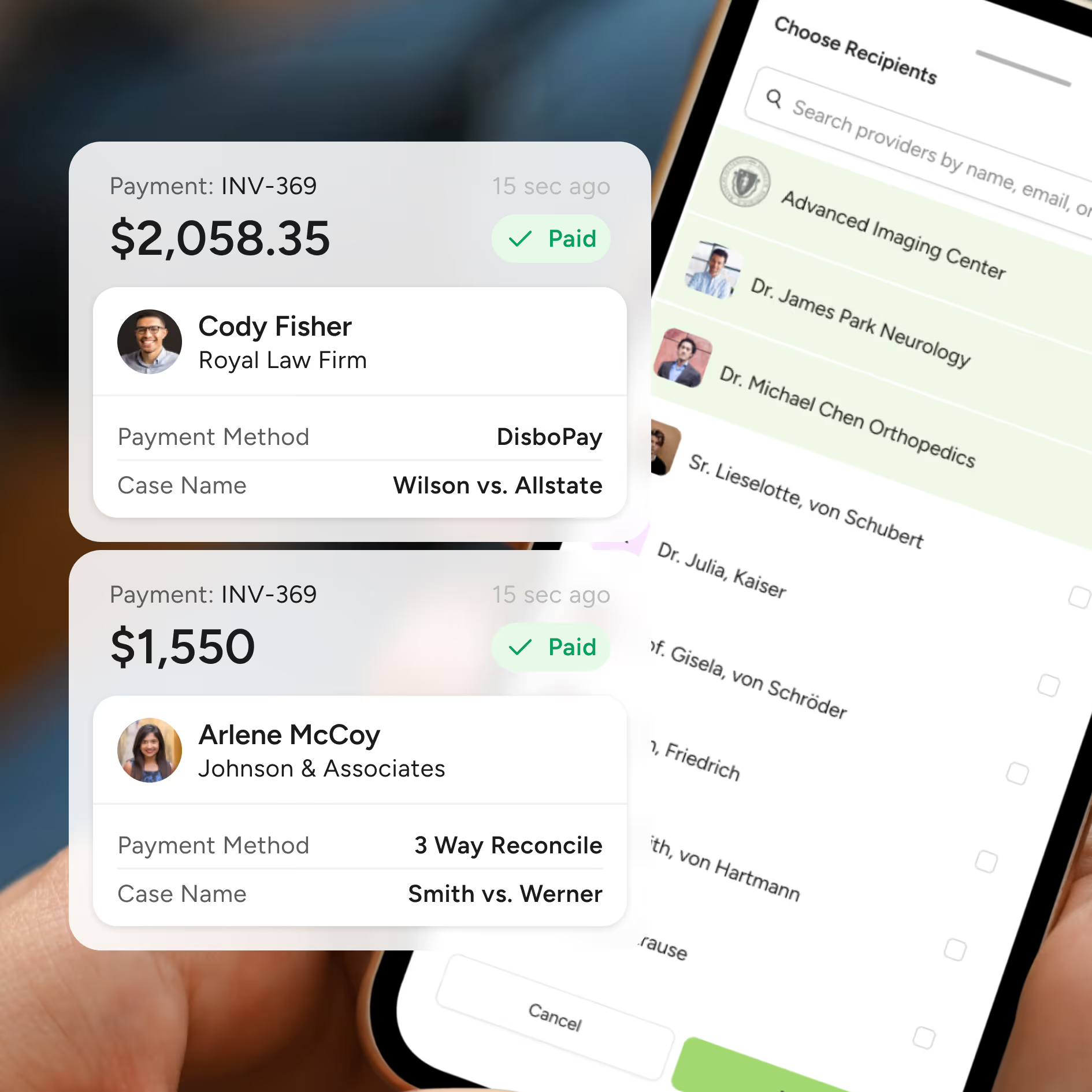
Disbo came to SWARECO with a problem that is a good illustration of legal workflow. When a case in a U.S. law firm reaches settlement, funds have to be distributed to several recipients at once — the client, medical providers, other beneficiaries. That process ran on email exchanges, individually negotiated fees, documents shared across disconnected channels, physical cheques in the mail, and manual confirmation tracking. Nothing connected the parties, so every case carried delay, administrative load, fraud exposure and a trust account reconciliation problem at the end.
We designed and built a centralised platform that replaced it. The work involved connecting law firms, medical providers and other stakeholders inside one structured system, to streamline a legal case from settlement to disbursement; building negotiation flows to replace fragmented email; digitising documentation so the same paperwork was not reprocessed repeatedly; and implementing traceable payment coordination aligned to compliance requirements. Scalability, data integrity and regulatory compliance were treated as architectural constraints from the first sprint rather than as a hardening phase at the end.
We shipped a deliberately scoped MVP first, covering the core disbursement workflow, so the model could be validated against real cases before the surface area grew. The platform is live and still evolving.
Custom legal software versus off-the-shelf legal tech
Buying is often the right answer, and a legal software development company that never says so is selling. Off-the-shelf legal tech is the better choice when your process is genuinely standard, when the vendor's compliance posture is stronger than anything you would build, and when you do not need the system to do something the market does not already offer.
Custom legal software development services earn their cost in three situations. When your workflow is your differentiator and the available products force you to abandon it. When you are coordinating parties outside the firm — providers, insurers, co-counsel — and no product spans that boundary. And when integration cost across several bought tools starts to exceed the cost of the system you actually wanted. In practice most firms end up with both: bought practice management software at the core, and custom software for the workflow that makes them distinct.
Integrating with the legal tools you already run
A custom legal platform that ignores the existing stack creates a second silo, and a legal service that runs across two silos is slower than the one it replaced. Legal software development is therefore largely integration work: document management platforms such as iManage or NetDocuments, practice and case management platforms, e-signature, e-discovery and court filing systems, accounting and trust ledgers, and identity providers for single sign-on.
Document management systems in particular are rarely a simple read: they hold the authoritative copy, so the integration has to respect their locking and versioning rather than work around it. The integration questions that decide a project are unglamorous. Which system owns the matter record. What happens to a document edited in two places. Whether an integration can be replayed after an outage without duplicating a payment or a filing. We answer those before writing the connector, because getting them wrong produces data integrity problems that surface months later during an audit.
Security and compliance in custom legal tech
Securing a legal platform is mostly about access and evidence. The controls we build as standard: role-based access down to the matter, so confidentiality walls are enforced by the software rather than by convention; encryption in transit and at rest; a complete audit trail of who viewed, changed, approved or released anything; scoped, revocable credentials for every integration; and retention and deletion rules that match the firm's obligations rather than a default.
Two practices matter more than any single control. Security tests run in the build pipeline, so a change that weakens access control fails before it merges rather than during a review. And the audit trail is designed as a product feature — something a compliance officer can read unaided — not as a log file an engineer has to interpret.
Where AI genuinely helps in legal software, and where it does not
AI is useful in legal workflows in a narrower band than the market suggests, and the boundary is worth being precise about because the cost of being wrong here is professional rather than commercial.
It works well on retrieval and drafting under review: finding the relevant passages across a large document set, summarising a matter for someone picking it up, extracting structured fields from documents that arrive in dozens of formats, classifying and routing incoming work, and producing a first draft that a qualified person edits. Legal research is the clearest win: narrowing thousands of legal documents to the dozen worth reading. In litigation and investigations, the honest value is in narrowing a review set and surfacing candidates, not in reaching conclusions.
It does not work as an unattended decision-maker on anything that carries legal consequence, and we will say so. Any AI feature we build ships with an evaluation set scored against known-correct cases before anyone trusts it, permission scopes limiting what it can reach, a full log of what it did, and a human approving each action until the measurements justify widening that. Where a rule is writable, we write the rule — deterministic code is cheaper, faster and never surprises an auditor.
What legal software development costs, and how long it takes
Cost in legal software development is driven by three things far more than by feature count: how many external parties the system has to coordinate, how strict the compliance and traceability requirements are, and how many existing systems it must integrate with. A single-firm internal tool with two integrations is a different order of work from a multi-party platform handling client funds.
On timeline, a focused MVP covering one core workflow end to end is typically a matter of months rather than quarters, and that is deliberately how we start — the Disbo platform launched as a scoped MVP covering the disbursement workflow before it broadened. Full replacement of a practice's operational stack is a longer, staged programme, and any firm quoting a fixed date for that without seeing your integrations is guessing.
Scale and performance for larger firms
Custom legal software scales for large firms when the architecture anticipates it. The pressures are specific: matter and document volumes that grow indefinitely because retention rules forbid deletion; permission checks on nearly every read; reporting across the whole estate; and usage that spikes around filing deadlines. We build on PostgreSQL with indexing and query plans reviewed against realistic data volumes rather than seed data, move slow work to background jobs, and load-test the paths that matter. Performance is an adoption issue, not a vanity metric — legal professionals abandon a system that is slower than the workaround.
How to evaluate a legal software development company
Four questions separate firms that have shipped legal software from firms that have shipped proposals.
Ask what they will not build. A partner who has never talked a client out of custom software has not met the case where buying was correct.
Ask how the audit trail works, before asking about features. If the answer is about logging rather than about what a compliance officer can read, the compliance layer is an afterthought.
Ask who operates it in month twelve. Legal software is not a build-and-hand-over discipline. If the answer is your team, ask exactly what they are being handed.
Ask what happens when an integration fails mid-transaction. The answer tells you whether they have run a regulated workflow in production or only diagrammed one.
How SWARECO builds legal software
SWARECO is a managed engineering company. You get a dedicated team — engineers, QA and technical leadership — that owns delivery rather than a pool of contractors billed by the hour. Our engineers work across Latin America on US hours, so the team overlaps with your day, and the same people who build the platform keep running it. That continuity is what makes us a development partner rather than a vendor.
The stack is Ruby on Rails and React with TypeScript over PostgreSQL, with background job processing, deployed on AWS or Heroku, and Playwright covering the paths a person still walks. Every engineer is technically evaluated before joining a client project, and that evaluation includes how well they work with AI tooling — which matters on regulated work, where verifying generated code is the job.
We are a software company that has delivered in the legal domain, not a legal specialist that also writes code. That distinction is worth making because it sets expectations honestly: we bring engineering judgment and the legal field experience earned on a live settlement platform, and we expect your people to bring the legal expertise. Projects go wrong when a development partner pretends otherwise.
Common questions about legal software development
How much does custom legal software development cost?
It is driven by the number of parties the system coordinates, the strictness of the compliance requirements, and the number of integrations — not by a feature list. We scope a core workflow first so there is a real number attached to a real deliverable before a larger commitment.
How long does it take to build custom legal software?
A scoped MVP covering one workflow end to end is typically months, not quarters. Disbo launched that way, covering settlement disbursement, before the platform broadened.
Can you integrate with iManage, NetDocuments or our case management system?
Yes, and that integration work is usually the larger half of the project. We settle which system owns the matter record and how conflicts and retries behave before building the connector.
Custom legal tech or off-the-shelf software — which is better?
Buy when your process is standard and the vendor's compliance posture beats anything you would build. Build when the workflow is your differentiator, when you must coordinate parties outside the firm, or when integration cost between bought tools exceeds the cost of the system you wanted. Most firms end up with both.
How do you secure a custom legal tech platform?
Role-based access enforced to the matter, encryption in transit and at rest, a complete and readable audit trail, scoped revocable integration credentials, and retention rules matched to your obligations — with security checks running in the build pipeline so a regression fails before it merges.
Is custom legal software scalable for large firms?
Yes, when the architecture plans for permanently growing document volumes, permission checks on nearly every read, estate-wide reporting and deadline-driven spikes. We test against realistic volumes rather than seed data.
How can legal tech help with litigation and investigations?
Mainly by narrowing the review set: retrieval across large document collections, structured extraction, classification and routing, and summarising a matter for whoever picks it up. It surfaces candidates for a qualified person to judge; it does not reach the conclusion.
Do we need our own legal experience in-house to run this?
Yes, and you already have it. We supply the engineering and the legal management systems knowledge from having built one; you supply the practice knowledge. A vendor claiming to supply both usually has neither.
Do you work with legal technology companies as well as law firms?
Yes. Disbo is a legal technology company, not a firm — its buyers are law firms and medical providers, which means the platform has to satisfy someone else's compliance review as well as its own.
What does SWARECO keep doing after launch?
The same team operates the platform: monitoring, dependency and security updates, integration changes when a vendor's API moves, and continued delivery. Legal software that nobody maintains becomes a compliance risk on its own.
These companies have relied on us to help expand their engineering teams with top talent who make a real impact.
Companies that trusted us to build and run their engineering.






Case Study
Real results for real clients. Discover how we've helped businesses achieve their digital transformation goals

We build the engineering. You build the business.
If you are trying to figure out whether SWARECO is the right fit for what you are building, the best way to find out is to talk. Tell us what you have. We will be direct about what we can do and how we would approach it.