
Real Estate Software Development
Property management and listing platforms with virtual tours and smart search
Better systems for businesses that run on coordination
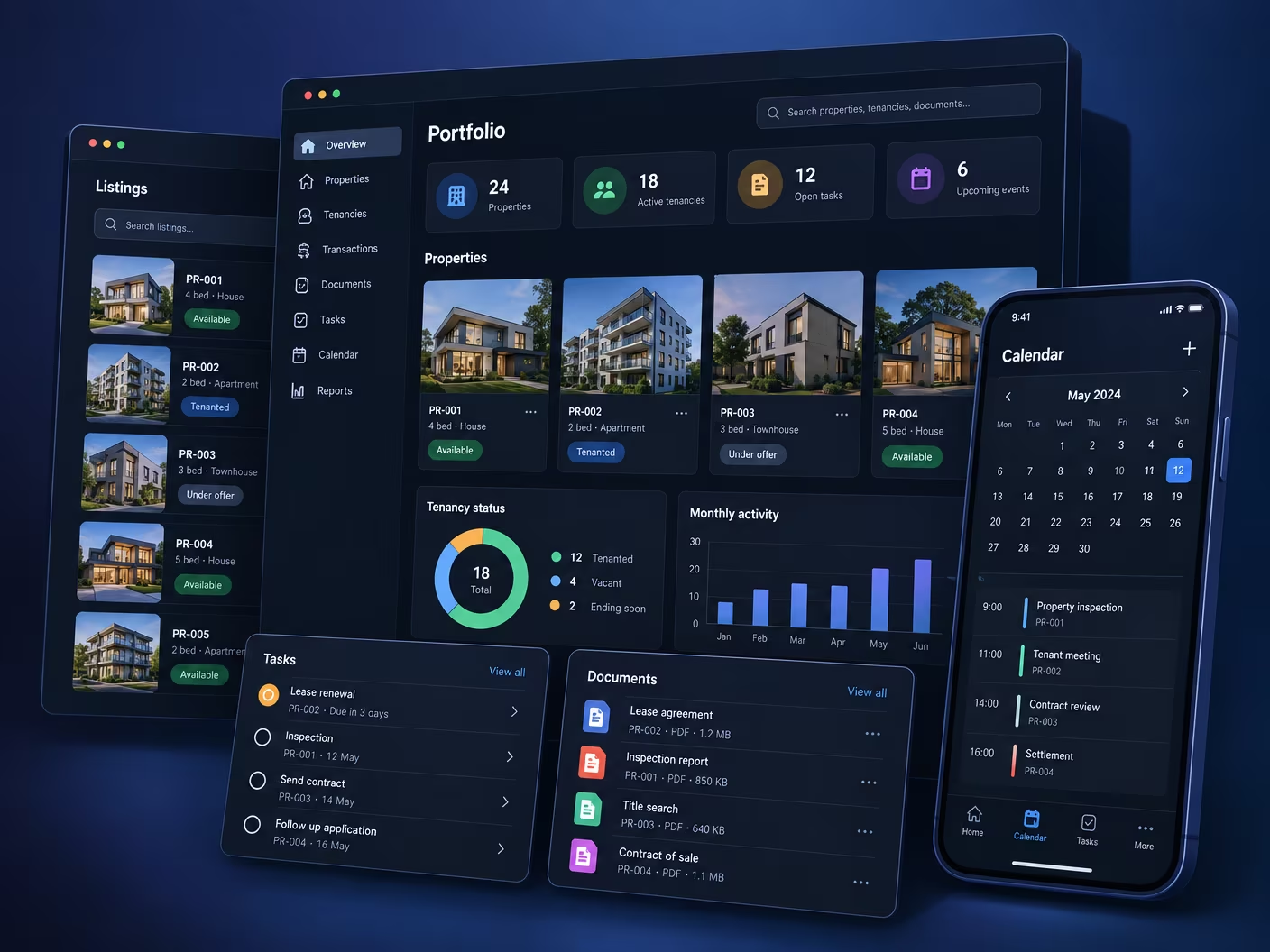
SWARECO is a real estate software development company that builds listing and property management platforms, agent dashboards, lead routing and automation, follow-up sequences, and the internal operations tooling behind them. Software for the real estate industry has a particular shape: it is coordination software. Most of the data it depends on originates in systems you do not control, the people using it are in the field rather than at a desk, and a listing that is wrong for six hours is a commercial problem rather than a cosmetic one. That is why real estate software development is treated here as its own discipline rather than general custom software development with a house icon on it.
What real estate software development involves
Real estate software development is the design, build, integration and ongoing operation of software that manages listings, properties, agents, leads and transactions. It differs from general custom software in three concrete ways: the most important data arrives from external systems on someone else's schedule, the primary user is a real estate agent who is mobile and interrupted, and the value comes from removing coordination rather than adding features.
A real estate project is rarely a single application. It is usually an agent-facing or client-facing product, an internal system the operations team runs the business on, and integrations to the systems of record holding the real estate data — an MLS or IDX feed, a CRM, a syndication pipeline, a payments platform. Most companies arrive with the ends half-solved and nothing joining them: a working service, tools that each do one part of it, and a spreadsheet holding the seams together.
Buyers comparing real estate software development services should ask which of those three a real estate software development company is actually quoting for, because a price for the application alone is not a price for the system.
What a real estate software developer does
A real estate software developer builds and maintains those systems, and much of the job is defensive engineering around data nobody on the team owns. It means knowing how listing data enters the system and how often it changes, which fields are authoritative and which are free text, what happens when a feed is late or partial, and how to reconcile the same property appearing under three identifiers.
Domain knowledge shows up in the boundary rather than the interface. A development team that has not worked in real estate will usually get the application right and the ingestion wrong, and the ingestion is where the risk lives. General software development experience does not transfer to that boundary on its own.
The most common types of real estate software
Buyers searching for real estate software usually mean one of a small number of categories, and naming them precisely matters, because the engineering effort, the integration surface and the cost differ sharply between them.
- Listing and property search platforms and real estate marketplaces — IDX-powered search, map and polygon search, saved searches and alerts, lead capture. Performance-sensitive, because search must stay fast while the data changes continuously.
- Property management platforms — tenant and owner portals, lease and unit records, rent collection, maintenance work orders and owner reporting.
- Real estate CRM and lead management — capture, deduplication, routing, scoring, follow-up sequences and pipeline reporting. Real estate CRM software is the highest-return first project more often than not, because the manual version is expensive and measurable.
- Agent dashboards and marketing platforms — what a real estate agent or franchisee logs into to produce listings, content and campaigns for their own market.
- Transaction and deal management — documents, milestones, disclosures, e-signature workflows and the record of who approved what and when in a real estate transaction.
- Investment and underwriting tools — modelling, portfolio reporting and the data pipelines behind them. Closer to fintech than to listing software.
- Real estate data analytics — reporting across listing, transaction and operational data, and the data-model work that must happen before any of it is trustworthy.
- Real estate development software — used to manage real estate development projects: budgets, draws, permits, contractor milestones and unit release schedules. A different domain from brokerage software despite the shared name, and worth stating plainly, because the two get confused at enquiry stage.
- Internal operations tooling — what the business runs on that no customer sees: fulfilment queues, content production, onboarding and workflow automation.
The categories also differ in who the software is for, which is easy to lose in a feature list. Tenant and owner portals are opened a few times a year and must be obvious with no training; internal tooling serves a few people who use it all day, where density beats simplicity. Real estate software fails more often from a mismatch here than from any technical defect.
Property management software development
Property management software development is its own category because the software is a system of record for money and obligations, not just a directory of properties. Leases, rent ledgers, deposits and owner statements all have to reconcile, and a missed state transition is a dispute rather than a bug report. That means strict audit trails, idempotent handling of payment events, and a data model covering the awkward cases — mid-term rent changes, partial payments, multiple owners on one property.
Off-the-shelf property management solutions from established vendors already cover rent collection, accounting software integration and standard tenant portals well. Custom property management software is worth its cost only where the operating model genuinely does not fit those products — unusual ownership structures, mixed portfolios, or a maintenance and vendor workflow that is the business rather than an afterthought.
Custom real estate software development versus off-the-shelf platforms
The honest answer is that most real estate businesses should buy the commodity and build the differentiator. Accounting, e-signature, payments, video hosting and mapping are commodities with mature vendors. The specific way your business acquires clients, produces work and coordinates people usually is not, and that is where custom real estate software development earns its cost.
A custom platform models your actual process instead of forcing it into a vendor's assumptions, removes the manual coordination that makes each additional client, listing or unit more expensive than the last, and keeps the data in a schema you can extend rather than trapped behind a vendor export.
The calculus differs by segment. Commercial real estate firms tend to have fewer, larger transactions and heavily bespoke reporting, so the custom case is usually the reporting and underwriting layer. Residential brokerages run higher volume with far more feed dependency, so the custom case is usually ingestion and lead handling. Both are real estate firms buying software for real estate work, and a quote that does not distinguish them is not a quote. Knowing which segment you are in does more to help real estate buyers scope a first release than any feature list.
The case against is equally real. Custom software needs maintenance, monitoring, feed upkeep and someone accountable after launch. If an off-the-shelf platform covers most of the requirement and the remainder is not what makes your business distinctive, buying is the better decision and we will say so. A real estate software development company that never recommends buying is selling.
A middle path exists and is underused. Rather than replacing existing software that works, many real estate companies get the larger return from a thin custom layer over it — an agent-facing experience, an internal dashboard, an automation that removes a handoff — while the vendor platform stays the record. That is usually where the first release should land.
MLS and IDX feeds, CRM sync and listing syndication
Integration is where most real estate software projects actually get difficult, and it runs in both directions: listing data coming in from MLS and IDX feeds, and listing data going back out to portals. The integration surface determines the timeline more than the feature list does.
Inbound MLS and IDX data. The RESO Web API and RESO Data Dictionary have made this far more tractable than the legacy RETS era, and they are the standard to build against. What standards do not do is make the data uniform. Each MLS has its own rules about what may be displayed, which fields are populated, and how fast a status change must be reflected. A platform spanning several MLSs needs a normalization layer between ingestion and the application, not conditionals scattered through product code.
IDX versus VOW display rules. These are contractual rather than technical, and they constrain the product: what can be shown publicly, what requires a registered user, and what must come down when a listing closes. Getting this wrong is a compliance issue with the MLS, so display rules belong in the requirements.
CRM synchronization. Bidirectional sync between your platform and CRM software is where data quality quietly degrades — the two systems disagree about who owns a contact, and a retry loop turns one duplicate into hundreds. The fix is unglamorous: one authoritative side per field, deterministic deduplication on a stable key, and sync jobs that are idempotent so a replay is safe.
Outbound listing syndication. Pushing listings to portals is a publishing pipeline and needs to be treated like one — versioned payloads, per-destination validation before send, a record of what was sent and accepted, and a reconciliation pass comparing what the destination shows against what you published. Without that step, discrepancies are found by agents and sellers rather than by engineers.
Listing data integrity, fair housing, and what happens when a feed breaks
Real estate software carries three risks that are routinely underestimated: inaccurate listing data, automated content that strays into fair-housing territory, and silent feed failures. All three are architectural problems, not review-stage ones.
Listing-data integrity. A price, a status or a square-footage figure shown to real estate agents and buyers is a representation, and stale data is the most common way real estate platforms damage trust. The controls that matter are a last-successful-sync timestamp on every record, staleness thresholds that flag or hide data rather than display it confidently, and never letting a partial feed overwrite records wholesale.
Fair housing in automated content. Fair-housing rules restrict language expressing a preference or limitation based on protected characteristics, and they apply to copy a model wrote just as much as to copy a person wrote. The failure mode is rarely overt: it is descriptive language about neighbourhoods, schools or who a property would suit, generated at volume and published without review. Automated listing copy needs a constrained prompt, a blocked-term check, and a human approval step.
When a syndication feed breaks. It will, and the design question is what the system does about it. The pattern that holds up is per-feed monitoring that alerts on absence rather than only on errors, a dead-letter queue so failed records are retained instead of dropped, idempotent delta processing so a replay cannot duplicate listings, and a reconciliation job reporting drift against the destination. The worst outcome is not an outage: it is a feed that looks healthy while publishing nothing for two days.
SWARECO's QA function owns the testing framework and validates these paths before release, with end-to-end suites covering ingestion, deduplication and publication as well as the interface.
Real estate mobile app development
Most agent-facing software is used on a phone, so mobile is a scoping decision rather than a later port. The choice is between a responsive real estate web application and a native real estate mobile app, and it turns on three questions: does the software need the camera, offline capture or push notifications; will agents install anything at all; and can you sustain two release trains.
When a native app earns its cost. Photo and video capture at a property, offline entry that syncs later, and push notification of a new lead or a status change are the cases where real estate app development is justified. Notification latency is usually the deciding factor — a lead that surfaces twenty minutes late has often already been answered by someone else.
When responsive web is the right answer. If the work is reviewing, approving and reporting, a responsive build reaches every device from one codebase with no app-store review sitting between a fix and the agents who need it. Most internal real estate operations tooling should stay on the web for that reason alone.
What mobile app development usually gets wrong. The common mistake is shipping the desktop console shrunk down. A real estate mobile app should carry the three or four tasks that genuinely happen in the field and hand the rest back to the web application. Application development that chases feature parity produces something slower than the workaround it was meant to replace, and real estate mobile tools that are slower than the workaround do not get used.
Where AI genuinely helps in real estate software — and where it does not
AI in real estate applications is useful, narrowly. Three applications are worth building: drafting listing and marketing copy for human review, scoring inbound leads before they reach an agent, and summarising local market data into something an agent can act on. All three are high-volume tasks where a person reviews the output and a mistake is recoverable.
Listing and marketing copy. A model is good at turning structured property facts into readable drafts at volume, and bad at knowing what it must not say. Generate from verified fields only, apply brand and fair-housing constraints in the prompt, and require human approval before anything publishes.
Lead scoring and triage. Ranking inbound enquiries before they reach an agent is a strong fit, because the volume is high and the cost of a mis-ranked lead is low. Scoring should influence order of contact rather than eligibility, and the reasons behind a score have to be visible — an opaque number gets ignored.
Market data summarisation. Turning comparables and local trend data into a short, sourced briefing saves real preparation time, provided every figure traces back to a record in your own data so the agent can check it before repeating it.
The caveat matters more than the use cases. AI-generated content damages the brand and search rankings if it ships unreviewed, which is the mistake most teams make. These workflows need a human approval step and brand constraints applied in the prompt, so the model accelerates drafting rather than deciding what gets published.
Where AI does not belong is anywhere its output is treated as authoritative rather than draft: models that predict real estate values and present the number as fact, any judgement touching a protected characteristic, and autonomous publishing to portals. A hallucinated property detail is a representation to a buyer, not a content problem. Zentap's platform was built with a foundation prepared for AI-driven enhancement — data model and review workflow first, model second.
The main challenges faced by real estate software projects
Five recur across almost every real estate project we have seen, and none of them are about writing code.
Data you do not control. Listing, market and portal data arrive from third parties whose schemas, rate limits and uptime are not yours to manage. Systems designed as though the feed is always available and always complete break in their first bad week.
Agent adoption is voluntary in practice. Real estate agents are often independent, and a tool slower than their existing habit goes unused. That is why agent-facing releases should be scoped narrow enough to be obviously faster than the workaround.
The field is the primary environment. The real usage context is a phone, one hand, poor signal, between appointments. Offline tolerance, forgiving forms and fast interaction on a mid-range device are functional requirements, not polish.
Duplicate and conflicting records. The same property, contact or lead exists several times under different identifiers, carrying contradictory values. Deduplication is real engineering effort that has to be budgeted, and skipping it produces reporting nobody trusts.
The internal system gets neglected. Attention goes to the customer-facing product because it is visible, while the operations tooling that determines capacity stays manual. That is the wrong order, and it is the constraint that caps growth.
How much real estate software development costs
Cost is driven by four things: how many external feeds and systems the software must integrate with, how much of the current process is undocumented, whether the product is a single internal system or a multi-tenant platform serving many agents, and how much data has to be kept fresh. The number of software features matters far less than any of those.
Integration count is usually dominant. A single-market platform reading one MLS feed is a fundamentally different project from a multi-market platform normalizing several, and the second costs more than the ratio suggests, because normalization and reconciliation grow with the number of sources.
SWARECO works on monthly retainers rather than fixed-bid projects, running a dedicated development team from MVP through to scale. Scope on this kind of work genuinely changes once real data is flowing, and a real estate software development company that fixes a bid before the feeds are understood is guessing — as are you, when you accept it.
The development cost that surprises people is not the build. It is the second year: feed maintenance, monitoring, the reconciliation work that keeps listing data accurate, and the integration that breaks when a portal or CRM changes its API.
How SWARECO builds real estate software
SWARECO is a managed engineering company: we run the engineering function across the whole development lifecycle rather than deliver a specification and leave. That means a named, dedicated development team on a monthly retainer, structured sprints, and one person accountable for the outcome, from MVP through to scale. The sequence we follow to develop real estate software:
- Scope the integration surface first. Which feeds, which CRM, which portals, what is authoritative for each field, and what the product does when a source is late. All of it constrains the data model and the software architecture, so it comes before design.
- Map the workflow as it actually runs, including the manual steps and workarounds, with the coordinators and agents who operate it. Count the handoffs.
- Automate the manual and repetitive work before building anything customer-facing. Centralizing the data usually helps real estate businesses more than adding another tool on top of it.
- Define an MVP around the workflow causing the most operational drag, and be explicit about what is out of the first release.
- Build in structured sprints with QA in parallel, not after. Our QA function owns the testing framework, and Playwright end-to-end suites run in continuous integration so regressions surface before release rather than in production.
- Split the agent-facing and internal systems deliberately, so each can evolve without destabilising the other, while sharing one data model underneath.
- Instrument and monitor after launch. Feeds drift and volumes grow, so the monitoring for that has to exist from the first release.
How to choose the right real estate software development company
Ask four questions, and treat vague answers as the answer. Can they describe how they would handle a partial or late MLS feed, specifically? Will they name what is out of scope for the first release? Who is accountable for the outcome, by name? And who maintains the integrations in year two? Most real estate software development companies answer the first one in generalities, which is itself the signal.
Real estate technology familiarity matters because the difficult parts are conventions rather than code: IDX and VOW display rules, syndication behaviour, how status changes propagate. Ask about that boundary rather than the language or the development tools, which matter far less than the conventions around them. A firm describing itself as a proptech software development specialist is not automatically better at any of it, so ask the four questions regardless.
Structure and communication are what real estate clients tell us separated the engagements that worked from the ones that did not, and that is really what choosing the right development partner comes down to. A real estate software development company that cannot tell you what it will not build is not being agreeable, it is being unscoped.
Trends in real estate software development for 2026
Four shifts are actually changing how software development for real estate businesses gets done, as distinct from what gets announced.
AI moving into drafting and triage, not decisions. The deployments that survive contact with reality are listing copy drafted for review, lead scoring that orders a queue, and market summaries an agent verifies.
RESO Web API as the assumed baseline. Standards-based access has replaced the legacy feed era, which raises the floor for any modern real estate software platform and makes multi-market builds more feasible than they were. Cloud-based real estate platforms are the default alongside it; on-premises deployment is now rare outside large enterprise brokerages.
Transaction documentation moving into software. Changes in how buyer representation and compensation are documented have pushed paperwork that used to live in email and PDFs into structured workflows.
Consolidation of point tools. Businesses across the real estate sector that accumulated separate CRM, marketing, transaction and reporting tools are consolidating them, which is a data-model project disguised as a procurement one.
Real estate software development at SWARECO
Zentap — a real estate marketing company running social media, branded video, lead generation and custom websites almost entirely through manual processes. Growth had hit a ceiling. SWARECO built a customer-facing marketing dashboard for agents alongside an internal management system for operations, producing a 10x increase in content production capacity and a full transition from service agency to product-driven platform. The platform was built with a foundation prepared for AI-driven enhancement. Read the Zentap case study.
The dual-platform structure is the part worth generalizing, and the internal half is usually what determines how far a business can scale. Platforms for real estate agents are only as good as the real estate management work happening behind them, which is why a real estate software development company should be scoping both before anyone talks about features.
Common questions about real estate software development
What makes SWARECO a real estate software development company rather than a general software agency?
The domain sits in the boundary, not the interface. SWARECO scopes MLS and IDX ingestion, RESO normalization, IDX and VOW display rules and syndication reconciliation before designing the application, because those constrain the data model. A general agency will usually build the application correctly and the ingestion incorrectly, and the ingestion is where listing data goes wrong.
What software do real estate businesses usually need built?
Most real estate businesses need two things: a customer-facing platform for agents or clients, and an internal system to manage operations behind it. SWARECO builds both — listing and property management platforms, agent dashboards, lead routing and the internal tooling that keeps them running. They are usually built together, because a customer-facing product can only be as good as the operations process feeding it.
We run on spreadsheets and disconnected tools — where do we start?
Start by mapping which workflows are manual, repetitive or error-prone, then automate those before building anything customer-facing. SWARECO begins engagements with that mapping exercise, because centralizing the data usually removes more friction than adding another tool.
Can you automate follow-ups and lead routing?
Yes. Follow-up sequences, lead assignment and status tracking are among the most common automations we build for real estate businesses, because they are high-volume, rules-based and expensive to do by hand. The prerequisite is deduplication — routing rules applied to a list with duplicates in it will send the same lead to two agents.
Do you integrate with MLS and IDX feeds?
Yes, and we scope the feed before designing the application, because it constrains the data model. The RESO Web API and Data Dictionary are the standard we build against, with a normalization layer so per-MLS differences do not leak into application code. IDX and VOW display rules are treated as requirements at scoping time.
Do you build real estate mobile apps or responsive web applications?
Both, and the choice is made at scoping rather than assumed. Native real estate mobile app development is justified by camera capture, offline entry and push notifications; a responsive real estate web application is the better answer when the work is reviewing, approving and reporting, because one codebase reaches every device and fixes ship without an app-store review.
What happens when a listing feed breaks?
The system should notice before your agents do, and that has to be designed in: per-feed monitoring that alerts on absence as well as on errors, a dead-letter queue so failed records are retained rather than dropped, idempotent processing so a replay cannot create duplicates, and reconciliation against what the destination is actually showing.
Should we build property management software or buy it?
Buy it unless property management is where your business differentiates. Rent collection, accounting and standard tenant portals are commodity functionality with mature vendors, and property management software development is only worth the cost when your operating model genuinely does not fit them.
Can AI help with listing content, lead qualification or market insights?
Yes, and those are the three most useful applications in real estate. Drafting listing and marketing copy for human review, scoring inbound leads before they reach an agent, and summarising local market data into something an agent can act on. Zentap's platform was built with a foundation prepared for exactly this kind of AI-driven enhancement.
Will AI-generated content damage our brand or our search rankings?
It will if it ships unreviewed, which is the mistake most teams make. We build AI content workflows with a human approval step and brand constraints applied in the prompt, so the model accelerates drafting rather than deciding what gets published. Generation should draw only on verified property fields, so a draft cannot invent a detail that becomes a representation to a buyer.
Is it safe to use AI on listing copy given fair housing rules?
Only with constraints and a human approving before publication. Fair-housing rules restrict language expressing a preference or limitation based on protected characteristics, and they apply to copy a model wrote exactly as they apply to copy a person wrote. The controls are a constrained prompt, a blocked-term check, generation from verified fields, and a named person approving.
Do you build agent-facing dashboards as well as internal systems?
Yes, and usually together. For Zentap we built a dual-platform system: a marketing dashboard for agents alongside an internal management system for operations. Splitting the two lets each side evolve without destabilising the other, while both work from one data model underneath.
How did SWARECO help a real estate marketing agency scale?
Zentap was running social media, branded video, lead generation and custom websites almost entirely through manual processes, and growth had hit a ceiling. SWARECO built a customer-facing marketing dashboard and an internal operations system, producing a 10x increase in content production capacity and a full transition from service agency to product-driven platform.
How much does real estate software development cost?
Cost is driven by the number of external feeds to integrate, how much of the current process is undocumented, whether the product is a single internal system or a multi-tenant platform, and how much data must be kept fresh — not by feature count. SWARECO works on monthly retainers with a dedicated team rather than fixed-bid projects, because scope genuinely changes once real data is flowing.
What should we look for in a real estate software development company?
Ask how they would handle a partial or late MLS feed, and judge the specificity of the answer. Then ask what is out of scope for the first release, who is accountable by name, and who maintains the integrations in year two. Domain familiarity matters because the hard parts are conventions rather than code.
These companies have relied on us to help expand their engineering teams with top talent who make a real impact.
Companies that trusted us to build and run their engineering.






Case Study
Real results for real clients. Discover how we've helped businesses achieve their digital transformation goals

We build the engineering. You build the business.
If you are trying to figure out whether SWARECO is the right fit for what you are building, the best way to find out is to talk. Tell us what you have. We will be direct about what we can do and how we would approach it.