
Code Audit Services
An independent review of your codebase, with findings ranked by what they cost you.
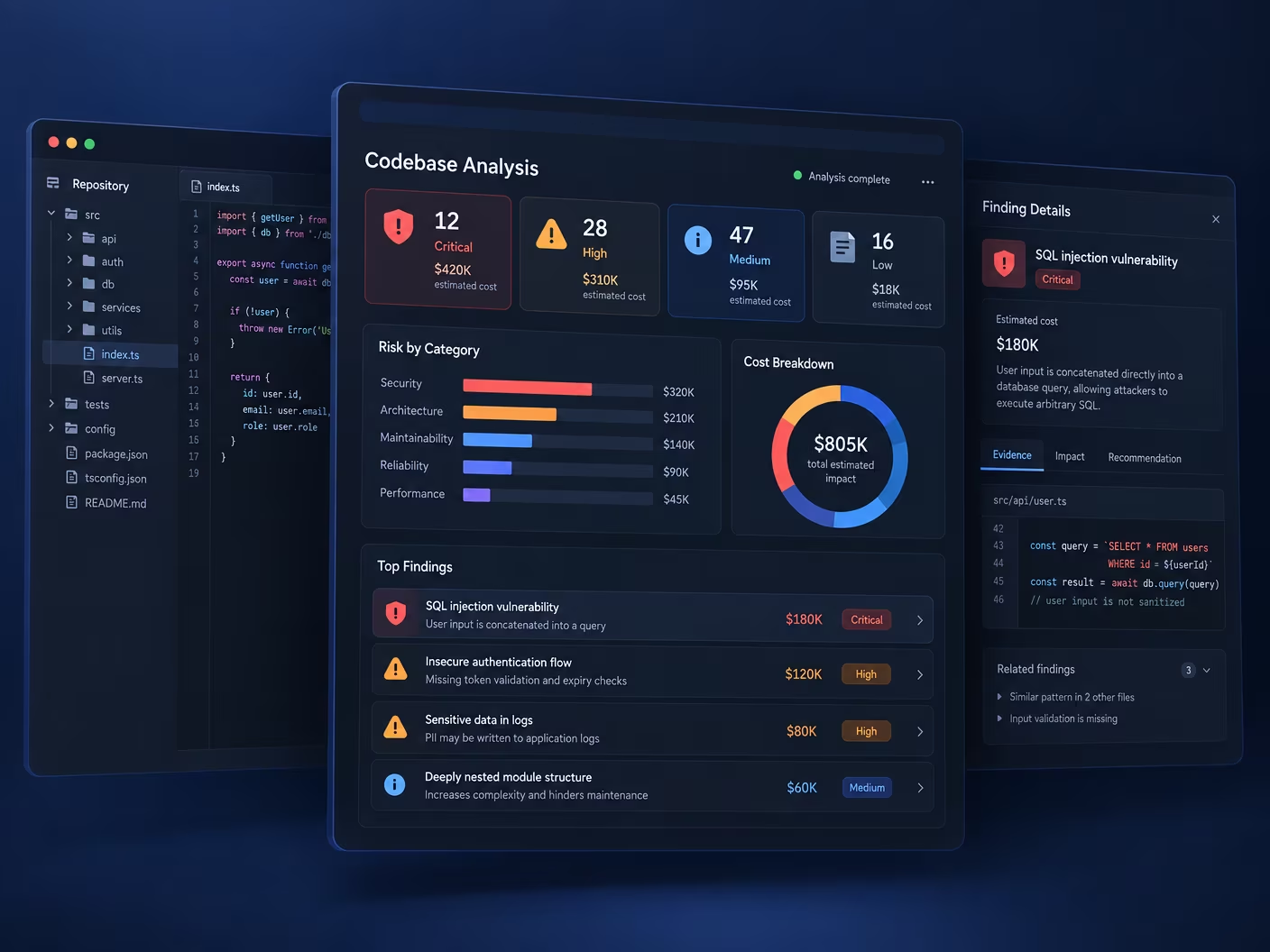
Code Audit Services
A code audit is a structured review of an existing codebase that reports what is actually true about its architecture, security and performance. SWARECO provides code audit and software audit services for companies who need that read from someone who did not write the code.
The usual trigger is a gap between what the software is supposed to do and what it does. Delivery has slowed and nobody can say why. A security question has been asked that nobody in-house can answer. Or a rewrite is being proposed, and the cost of it needs testing before it gets approved.
What a Code Audit Examines
Architecture and maintainability: how the system is structured, where coupling makes change expensive, test coverage, and the technical debt that shows up as slower releases rather than as bugs.
Security and access control: authentication and authorisation, data handling, secrets management, dependency vulnerabilities, and the exposure introduced by third-party packages nobody has reviewed since they were added.
Performance and scalability: the bottlenecks that appear under real load rather than in development, database and query behaviour, and whether the architecture supports the growth being planned on top of it.
AI-generated code: where generated code entered the codebase, whether it was reviewed to the same standard as the rest, and the specific failure patterns it tends to leave behind. This is now a routine part of an audit rather than a special case.
How a Code Audit Works
We start by asking what decision the audit is meant to inform, because an audit for a security sign-off and an audit for a rewrite decision look different. Scope follows from the question, not from a template.
Then read-only access to the repository and, where it helps, a running environment. Static analysis and dependency scanning cover the mechanical layer; engineers read the code that matters most for your question. We also review commit and incident history, because the places a system has already broken are the places to look first.
You get a written report: findings ranked by severity and by remediation cost, a short list of what to fix first, and a plain answer to the question you commissioned it for. A smaller codebase takes about a week.
How This Benefits Your Business
An audit earns its cost when a decision depends on it. The output is a ranked list you can act on, not a document that catalogues everything at equal weight.
Findings you can price
Every issue carries remediation effort and consequence, which turns "fix it later" into a costed choice rather than a hope.
A second opinion on the rewrite question
Teams close to a system tend to propose rebuilding it. An audit tests whether the problem is really the architecture or the practice around it — two very different bills.
No obligation to hire us to fix it
The audit stands on its own. If the right answer is that your existing team fixes it against a plan, that is what the report says.
The Stack We Audit, and What the Report Contains
SWARECO audits source code across Ruby on Rails, React, React Native, TypeScript, PostgreSQL, Sidekiq, Redis, Elasticsearch or OpenSearch, Docker, AWS and Heroku — the same stack we build and run for clients, which is why the remediation estimates in the report are ones we would have to stand behind ourselves.
What the tooling covers, and where it stops
Static analysis and dependency scanning run first because they are cheap and exhaustive: linters and security scanners against the whole source code tree, dependency audits for known vulnerabilities and unmaintained packages, and coverage measurement to find which paths the test suite never touches. That layer reliably finds a known vulnerability in a published package. It cannot tell you that an authorisation check is missing from an endpoint that should have one, or that two modules disagree about who owns a piece of state.
So the mechanical pass produces a shortlist and a senior engineer reads the code that matters. A tool-generated report forwarded without that step is not a code audit, and it is the main thing we are asked to replace.
How we judge code quality
Code quality is only meaningful against the cost of change, so we measure it that way rather than by style compliance. The questions are how much of the system a typical feature has to touch, how long the test suite takes and how much of the revenue-generating path it covers, how much duplicated logic exists in the places that change most often, and how far the codebase has drifted from the conventions of its own framework. Rails and React both have strong community best practices, and a codebase that ignores them is expensive to hire for even when it works — a new engineer cannot use what they already know.
Security and regulatory compliance
We check authentication and authorisation, how personal data is stored and logged, secrets management, and third-party dependency exposure. Where you have a specific regulatory compliance obligation, tell us which one before we scope: the audit can be pointed at the evidence a particular framework asks for, and that changes what we read and what the report has to prove.
What the report actually contains
Every finding carries a severity, a location in the source code, the consequence if it is left alone, and an estimate of the effort to fix it. Findings are then ordered so the first section is the short list worth acting on this quarter, because a flat catalogue of two hundred issues at equal weight is a document that gets read once and filed.
The report also states plainly what we did not find. An audit that only lists problems tells you nothing about the parts of the system that are sound, and those are usually the parts a rewrite proposal is quietly planning to throw away. Where a security question was the trigger, the report answers that question in its first paragraph rather than at the end of a tour of the codebase.
What it takes to uncover, and what happens next
A smaller codebase takes about a week. Larger systems, or audits scoped around a specific regulatory compliance question, take longer because the reading is deeper rather than because the tooling is slower. We agree the scope against the decision you need to make, so the risk of paying for a broad survey when a narrow question was the real requirement is removed up front.
Remediation is a separate conversation and a separate engagement. Where the right answer is that your existing team fixes the findings against the plan in the report, that is what the report recommends, and SWARECO writes it the same way whether or not we expect to do the work.
Industries We Serve
Deep industry expertise combined with cutting-edge technology to solve your unique challenges
Why Work With SWARECO for a Code Audit
We audit systems in the same technologies we build and run, so the standard we measure against is one we have to meet ourselves. That is what keeps recommendations specific and effort estimates honest.
Audits are performed by senior engineers rather than run through a tool and forwarded. Static analysis is where we start, not what we deliver. And where an audit turns into a rescue, we can take over delivery — though the report is written as if we will not.
These companies have relied on us to help expand their engineering teams with top talent who make a real impact.
Companies that trusted us to build and run their engineering.






Case Study
Real results for real clients. Discover how we've helped businesses achieve their digital transformation goals

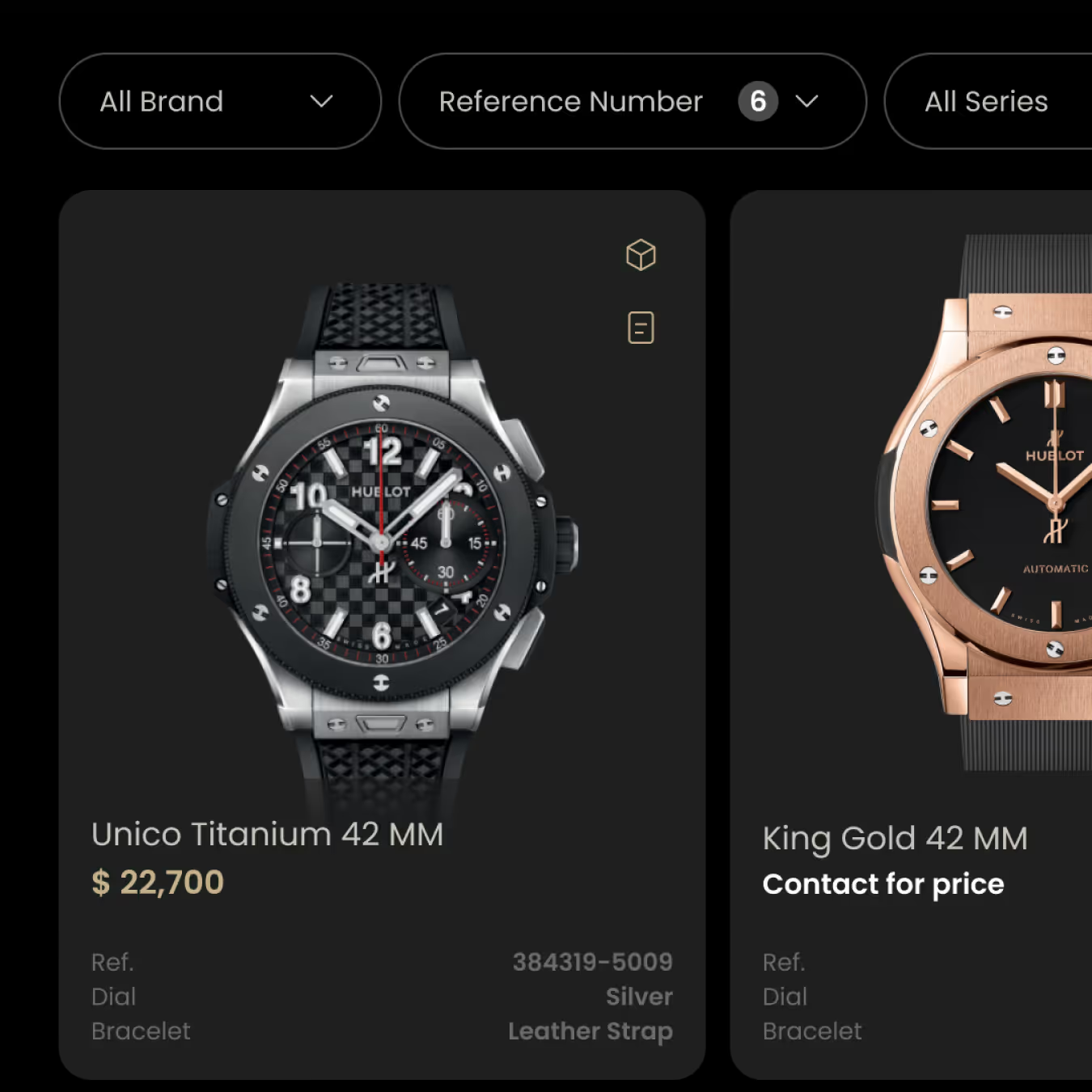
Elefta: Turning a Dealer Prototype into a B2B SaaS Platform Operating Across 30+ Countries
1,628 users, 534 organizations, 30+ countries: SWARECO rebuilt Elefta's watch-dealer prototype into a scalable B2B SaaS inventory management platform.
FAQs
What is a code audit?
A code audit is a structured review of an existing codebase by engineers who did not write it, reporting on architecture and maintainability, security and access control, and performance and scalability. The output is a ranked list of findings with the cost of fixing each one.
It is a diagnostic, not a cleanup. The audit tells you what is true about the system; fixing it is a separate decision made with that information in hand.
What does a code audit include?
Architecture and maintainability, security and access control, performance and scalability, dependency and third-party package risk, and test coverage. SWARECO also reviews commit and incident history, because where a system has already broken predicts where it will break next.
AI-generated code is now examined as a matter of course: where it entered the codebase, whether it was reviewed to the same standard as the rest, and the particular failure patterns it tends to leave behind.
How long does a code audit take?
About a week for a smaller codebase, longer where multiple services and environments are in scope.
Most of the elapsed time is engineers reading code, not tooling. Static analysis and dependency scanning complete quickly and cover the mechanical layer; the judgement about whether an architecture will hold is the part that takes the time and the part worth paying for.
When should you get a code audit?
When a decision depends on knowing the real state of the system. The common triggers are delivery slowing for reasons nobody can explain, a security or compliance question nobody in-house can answer, a proposed rewrite whose business case needs testing, or a lead developer leaving and the remaining team inheriting a system they did not design.
Auditing before a major release or a scaling push is cheaper than auditing after an incident, though the second is how most audits actually get commissioned.
Can a code audit tell us whether to rewrite or refactor?
Yes, and it is one of the most valuable questions to point an audit at. Teams close to a system tend to propose rebuilding it, because the problems are vivid and the alternative is abstract.
An audit tests whether the cost is coming from the architecture itself or from the practice around it — missing tests, no deployment pipeline, undocumented decisions. Those are very different bills, and only one of them is fixed by a rewrite.
Do you audit AI-generated code?
Yes, as a standard part of the audit rather than an add-on. The questions are where generated code entered the codebase, whether it went through the same review as hand-written code, and whether it carries the failure patterns typical of generated output.
Those patterns are specific: plausible-looking error handling that swallows failures, duplicated logic that no longer shares a source of truth, and dependencies added to solve a problem the codebase had already solved elsewhere.
What is the difference between a code audit and software audit services?
In practice the terms are used interchangeably, and SWARECO treats them as the same engagement. Code audit emphasises the codebase; software audit services is sometimes used more broadly to include the infrastructure and licensing position around it.
What matters more than the label is the scope agreed up front: which repositories, which environments, and which question the report has to answer.
Other Services
Find out what your codebase is actually costing you.
A scoped code audit with findings ranked by severity and remediation cost, and a clear answer to the question you need settled.