
API Integrations
Connect your tools. Automate your data. Stop copying between systems
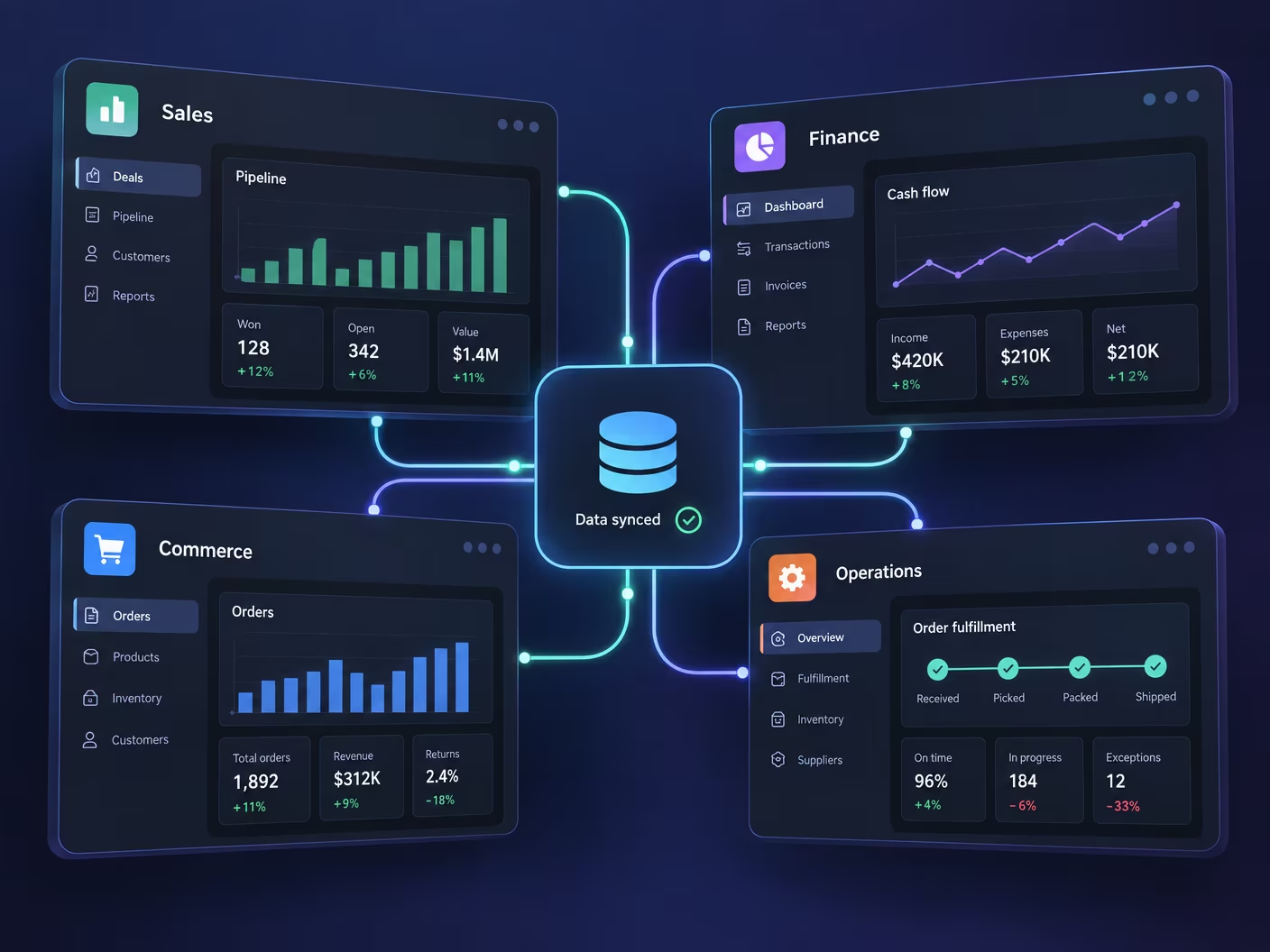
API Integrations for Growing Businesses
Most businesses run on more than one piece of software. The problem is that most of those tools were not built to talk to each other. So data gets copied manually, reports go out of sync, and your team spends hours every week doing work that software should be doing automatically.
API integrations fix this. They create reliable connections between your systems so data moves automatically, operations stay in sync, and your team can focus on work that actually requires human judgment.
We build integrations designed around how your business actually operates, not generic connectors that almost fit. Whether you are connecting internal platforms, linking to third-party tools, or building the plumbing between a new and legacy system, we handle the full build... mapping, development, testing, and ongoing maintenance.
Custom API Integrations Built Around Your Systems
We focus on API integrations that:
- Connect your systems without creating fragile dependencies
- Automate data exchange across teams, tools, and external partners
- Handle errors, edge cases, and changes without manual intervention
Integrations Built for How Your Business Actually Runs
As businesses grow, they add more applications, more data sources, and more external partners. Without the right connections, this creates data silos, repeated manual work, and costly errors that compound over time.
Strong API integrations solve these issues at the root.
They create consistent data flow, speed up daily operations, and give you the flexibility to add new tools or partners without rebuilding what already works.
How This Benefits Your Business
Integrations fail quietly. Data stops syncing, nobody notices for a week, and by then two systems disagree about the same customer. What you get from us is integration work that surfaces its own failures.
Your tools stop needing a human in the middle
The most expensive integration is a person copying fields between two screens. We remove that step, which removes the transcription errors that come with it.
Failures announce themselves
Every integration we build logs what it did, retries what it can, and alerts when something needs a decision. Silent failure is the expensive kind.
Built to survive the vendor's next release
Third-party APIs change without asking. Modular connectors mean a breaking change on one service is a contained fix, not a rebuild.
The Platforms We Connect, and How
SWARECO's API integration services cover the platforms our clients actually run on: Salesforce and HubSpot for CRM and marketing data, Shopify for commerce, and NetSuite for finance and ERP. Those four cover most of what we are asked to connect, and each has its own idea of how an application programming interface should behave — Salesforce governor limits, HubSpot's per-portal rate limits, Shopify's bulk operations and webhook topics, NetSuite's SuiteTalk and SuiteQL. Knowing the specific quirk before the build starts is the difference between a two-week integration and a two-month one.
What we build with
Integration work runs on Ruby on Rails with Sidekiq for background jobs and retries, PostgreSQL for the mapping and audit tables, and Redis for queues and idempotency keys. Docker containers on AWS or Heroku keep environments identical, and Playwright covers the user-facing flows that depend on an integration completing. Where search is involved we use Elasticsearch or OpenSearch rather than pushing the load into the database.
How we build it
Every integration starts with a data map rather than code. We write down which system owns each field, what happens when both change the same record, and what the integration should do when one side is unavailable. Most API integration failures are not bugs - they are two systems that were never told which of them is right, and the map is where that gets decided.
Then we agree on the direction of travel. A one-way push is far cheaper to build and to reason about than a two-way sync, and a surprising number of requirements described as "keep them in sync" are satisfied by a push in one direction plus a read in the other. Where a genuine two-way data integration is required we say so, and we scope the conflict-resolution rules as part of the work rather than discovering them in production.
Build follows the mapping, and the integration process looks like ordinary API development done carefully. Which type of API a platform exposes - REST, GraphQL or an older SOAP service - shapes the build, but the habits of modern integration hold everywhere: we prefer webhooks over polling where the platform supports them, and handle authentication properly - OAuth token refresh, rotating secrets, and per-environment API keys, so nothing depends on one person's credentials. Rate limits are designed for rather than discovered: requests are queued and backed off, and bulk operations use the platform's batch API endpoints where they exist.
Then the parts that decide whether an integration survives its first year. Every operation is idempotent, so a retry cannot create a duplicate record. Failed jobs are retried with backoff and, if they still fail, land somewhere a human will see them. Every run logs what it touched. And there is an alert when a sync stops entirely, because the failure mode that costs real money is the silent one that nobody notices for a week.
We also tell you when not to build. If a supported native connector or an integration platform as a service - MuleSoft, Boomi, Workato and their peers - does the job, that is cheaper than any custom API integration services we could quote, and we will say so up front. Custom API integration work earns its cost when the logic is specific to your business, the volume is beyond what those platforms price sensibly, or the systems involved have no connector worth trusting. Either way, you get a scoped integration project with a fixed data map, not an open-ended retainer.
Examples of API integration we deliver most often
The most common API integration use cases we are asked for: CRM-to-ERP application integration for customer and order sync, ecommerce order flow from Shopify into NetSuite, marketing data integration between HubSpot and a product database, and internal dashboards that need one API layer over several systems. The benefits of API integration in each case are the same — one source of truth per field, no re-keying, and reporting that does not need three exports to answer one question. That is what well-built API integration services enable, and it is measurable in hours of manual work that disappear.
API management, gateways and secure APIs
Where several consumers need the same data, we put a unified API in front of it rather than wiring point-to-point: one documented RESTful API layer with authentication, rate limiting and versioning, which is API management at the scale most mid-sized companies actually need. If you already run an API gateway or an API management platform — Azure API Management, IBM API Management, Oracle Integration Cloud — SWARECO builds to its policies instead of around them. Every secure API we ship uses OAuth or scoped API keys, validates inbound payloads, and comes with API documentation the next developer can work from. The same applies to cloud integration between SaaS tools and to older SOAP web services: the api strategy is decided once, in the data map, and enforced in code.
Connecting to a legacy system with no API
Plenty of the systems that most need integrating do not expose an API. The options, in order of preference, are a supported export we can schedule, direct read-only database access, a thin API we build in front of the legacy application, or file exchange over SFTP where nothing better exists. We will tell you which of those your system actually supports before promising a real-time integration, because "real time" against a nightly batch export is a claim that cannot be met.
The cost of API integration, and what happens after it ships
The cost of API integration is driven by the number of systems, the direction of data flow, and how much conflict-resolution logic the data map uncovers — a one-way push between two well-documented platforms is days of work, a two-way sync across three systems with a legacy component is a project. An integration is also a long-lived dependency on somebody else's product, and third-party APIs change on their own schedule. We keep connectors modular so a breaking change on one service is a contained fix rather than a rebuild, watch vendor deprecation notices for the platforms we have connected, and hold the monitoring that tells you a sync has stopped. Where you would rather own it, the handover includes the data map, the runbook and the alerting, not just the repository.
Industries We Serve
Deep industry expertise combined with cutting-edge technology to solve your unique challenges
Why Work With Us for API Integrations
We build integrations that solve real operational problems, not just technical plumbing. Every decision we make considers how the data needs to flow, how the integration must perform at scale, and how it will hold up when either connected system changes.
We design around how your company actually works. The result is integrations that are reliable, easy to maintain, and built to grow with your business.
These companies have relied on us to help expand their engineering teams with top talent who make a real impact.
Companies that trusted us to build and run their engineering.






Case Study
Real results for real clients. Discover how we've helped businesses achieve their digital transformation goals

FAQs
What are API integrations?
API integrations are the connections that allow different software systems to share data and communicate automatically. Instead of manually copying information between tools, integrations move data in real time without human involvement.
How do I know if I need API integrations?
If your team copies data between systems, waits for updates to sync, or deals with inconsistent information across tools, better integrations can solve those problems. The cost is usually in manual time and errors that people have stopped noticing.
How long does an API integration project take?
Most integration projects take 6 to 16 weeks depending on the number of systems involved, complexity of data flows, and whether legacy systems are part of the scope.
Can you integrate with the tools we already use?
Yes. We connect CRMs, ERPs, payment platforms, marketing tools, internal databases, and most major SaaS platforms. We work with what you have rather than requiring you to switch.
What if one of our systems is old or has limited API support?
We have worked with legacy systems that have limited or no native API support. We can build middleware, connectors, or custom solutions to bridge the gap.
Do you provide ongoing support after the integration goes live?
Yes. We handle monitoring, updates, and improvements after launch, including changes when connected systems update their own APIs.
How do you ensure the integrations are secure?
Security is built in from the start. We follow best practices for authentication, encryption, data validation, and error handling at every connection point.
Can you update or replace our existing integrations?
Yes. We can audit existing integrations, identify where they are fragile or failing, and rebuild them to be more reliable and maintainable.
Will the integrations keep working as our business scales?
Yes. We design for the volume and growth trajectory of your business, not just current usage. Scalability is part of the architecture, not an afterthought.
Other Services
Your tools should work together. We make that happen.
Tell us which systems you are trying to connect and what you need them to do. We will map the right solution and build it.