
Data Centralization Services & Visualization
One place for all your data. Dashboards that actually tell you something — plus AI-assisted analysis where reading the numbers manually doesn't scale.
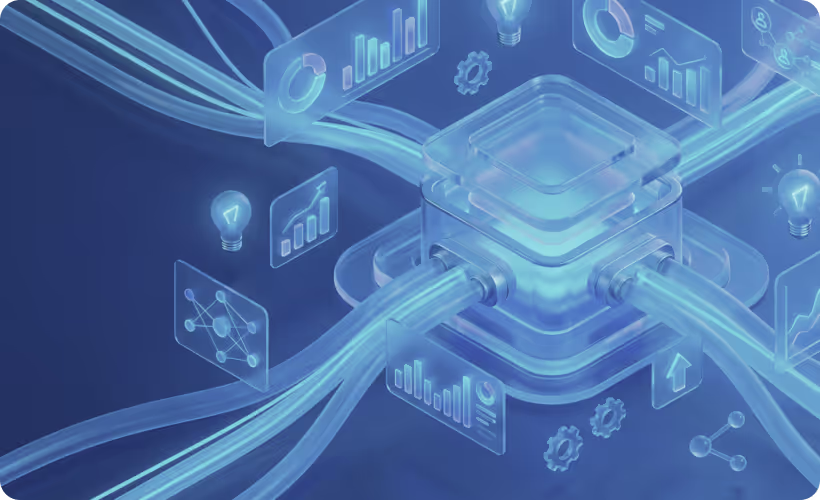
Data Centralization
Your data is scattered. Sales works from one set of numbers, marketing from another, and operations from a third. Reports disagree. Decisions get made on incomplete information. Every hour your team spends reconciling data across tools is an hour not spent using it.
Data centralization fixes the root problem. We connect your data from every source into one unified, trustworthy platform that becomes your single source of truth. Everyone works from the same accurate picture. No more manual reconciliation. No more conflicting reports. Just clear, reliable information your team can actually act on.
We build data platforms that are straightforward to use, secure, and built to grow with your business. We eliminate data silos, handle the integration work, and turn scattered information into something you can make decisions from.
Data Centralization Built Around How Your Business Works
Data becomes scattered naturally as businesses grow. You add new tools, expand teams, and build processes in different places. What starts simple becomes a tangle of disconnected spreadsheets, separate databases, and systems that do not talk to each other.
We centralize your data so it:
- Lives in one organized, secure location
- Stays consistent and current regardless of which team is accessing it
- Can be found quickly by the right people
- Powers faster reports, cleaner analytics, and better decisions
We handle this work carefully. We do not discard what you have built. We connect it so your data becomes more valuable and easier to manage.
A Single Source of Truth That Grows With Your Business
Scattered data creates hidden costs. Teams repeat work, reports disagree, compliance becomes harder to manage, and opportunities stay invisible because the data to spot them is buried in five different tools.
The longer the problem persists, the more time your team spends managing data instead of using it. Our centralization approach addresses the core issue. We consolidate your data from every source, preserve its context, and build the infrastructure to keep it accurate and accessible as your business grows.
How This Benefits Your Business
Most companies do not have a reporting problem. They have four systems that each hold part of the answer and disagree about the rest.
One number, not four versions of it
When finance, sales and operations pull from the same layer, meetings stop being about whose figure is right and start being about what to do.
Reports that do not need rebuilding monthly
Pipelines run on a schedule and validate themselves. The dashboard is current because the data is, not because somebody refreshed it before the meeting.
An AI-ready foundation, as a side effect
Clean, centralised, documented data is the actual prerequisite for anything AI-driven. Companies that skip this step buy tools that have nothing reliable to read.
The Stack Behind the Single Source of Truth
SWARECO builds data centralization services on PostgreSQL as the warehouse, Ruby on Rails pipelines with Sidekiq running the scheduled sync and transform jobs, Redis for queues, and Elasticsearch or OpenSearch for the aggregations and search that would otherwise slow the database. Dashboards are React and TypeScript, tested end-to-end with Playwright, deployed in Docker on AWS or Heroku.
How we approach it
We centralize data in the order that protects trust in the numbers. First, an audit of every data source - the SaaS tools, databases and spreadsheets where the business actually keeps facts - and a map of which system owns which field. Most reporting disagreements are not data quality problems; they are two systems that both believe they own the same number. Deciding ownership is the real work of any project to unify company data, and it is a business decision we facilitate rather than make for you.
Then we build the pipelines. Sync jobs pull from each data source into one PostgreSQL data warehouse on a schedule the business can see, transform records into one agreed shape, and log every run. When a sync fails, it alerts; centralized data that silently goes stale is worse than the silos it replaced, because people have stopped double-checking it.
Data governance is settled while the pipes are built, not after: who can see what, how long records are kept, and what the data dictionary says each field means. It is lighter than the word sounds - a dozen decisions, written down - but it is the difference between a single source of truth and a second copy of the argument.
Dashboards come last, deliberately. Once the warehouse holds one version of the truth, the analytics layer is straightforward, and decision-making stops waiting on exports. We build the views each team actually uses - pipeline, operations, finance - and retire the spreadsheet reports they replace, one by one, so nothing depends on both.
Where the data comes from
The connectors we build most: Salesforce and HubSpot for customer and pipeline data, Shopify for orders, NetSuite for finance, Google Sheets and Analytics for the numbers that live nowhere else, and read-only pulls from the operational databases behind internal tools. Each connector is idempotent and logged, so a re-run cannot duplicate records and every number in the warehouse can be traced to its source.
Why centralize into a database rather than a BI tool
Pointing a dashboard tool at six data sources hides the silo problem instead of solving it: every chart re-implements the joins, and no two charts agree. Centralizing the data first - one warehouse, one set of definitions - means every downstream tool, dashboard, and export reads the same facts. It also leaves you AI-ready: models and assistants are only as good as the data quality underneath them, and a governed warehouse is what makes their answers checkable.
What it costs to keep true
A centralized data platform is a living system, not a project artifact. Schemas drift, APIs deprecate, and a new tool arrives every year. We hold the monitoring, update connectors when vendors change them, and review the data management rules quarterly - or hand the runbook, alerting and data dictionary to your team when you would rather own it. Either way, the test of successful data centralization is the same: six months in, nobody has quietly started a new spreadsheet.
How SWARECO adds AI on top of centralized data
Centralization is what makes AI analysis trustworthy. Once the data lives in one governed place — PostgreSQL as the system of record, Elasticsearch or OpenSearch where search matters — we layer models on top: natural-language querying so an operator can ask "which accounts went quiet last quarter?" without writing SQL, retrieval-augmented generation (RAG) that answers only from your verified records with citations back to source, and scheduled AI summaries of what changed and why, delivered where your team already works.
The connection layer is the Model Context Protocol (MCP): SWARECO builds MCP servers over centralized data so assistants like Claude can query it directly — same permissions, same audit trail, no data leaving your boundary for training. Dashboards answer the questions you thought to build; an assistant over governed data answers the ones you didn't.
Where a wrong answer has a cost, the model proposes and a person approves — and every model output is logged with the input that produced it. AI on top of bad data is confident nonsense at scale; the order of operations is the product.
Industries We Serve
Deep industry expertise combined with cutting-edge technology to solve your unique challenges
Why Work With Us for Data Centralization
We build practical data platforms, not complex data infrastructure projects that take years and do not deliver useful results. We focus on what you can actually use: clean, accurate data in one place that your team can access and trust.
We approach this work carefully. Your data reflects years of business activity. We handle the migration, integration, and architecture work with respect for what you have built, and we build something that is easier to manage and more valuable going forward.
These companies have relied on us to help expand their engineering teams with top talent who make a real impact.
Companies that trusted us to build and run their engineering.






Case Study
Real results for real clients. Discover how we've helped businesses achieve their digital transformation goals

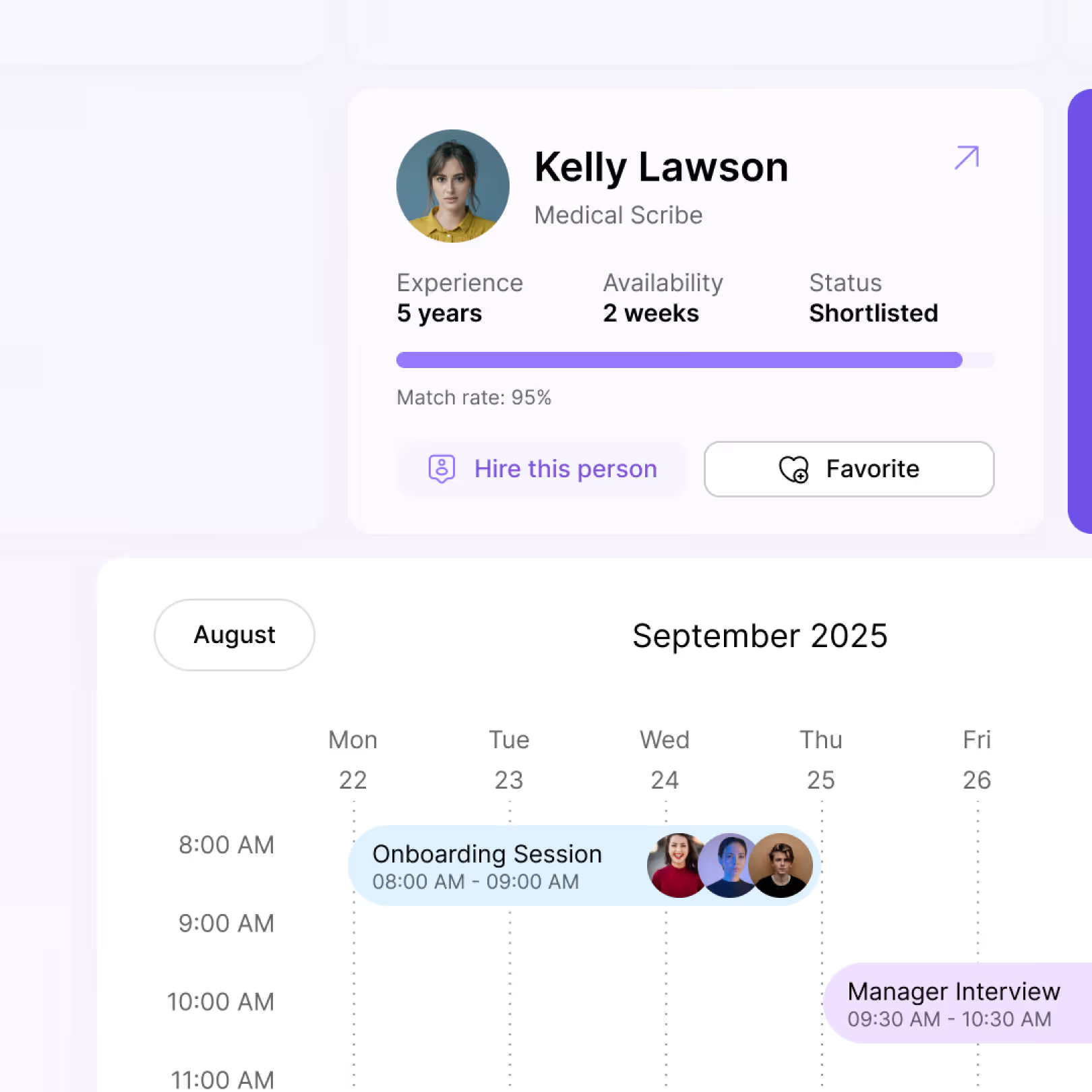
Staffing for Doctors: A Scalable Client Acquisition Platform for a Growing Healthcare Staffing Company
SWARECO built a client acquisition platform for a 25-person healthcare staffing company: standardized workflows, automation and room to scale.
FAQs
What is data centralization?
It is the process of collecting data from multiple disconnected systems and consolidating it into a single, unified platform that serves as the single source of truth for your organization.
Why centralize data instead of keeping it in separate systems?
Centralized data removes inconsistency, eliminates the manual work of reconciling between tools, gives every team the same accurate picture, and makes compliance and security far easier to manage.
How long does a data centralization project take?
Smaller projects with fewer data sources typically take 8 to 16 weeks. Larger enterprise efforts with many systems, complex data relationships, and governance requirements range from 3 to 12 months. We share clear milestones from the start.
Will our data stay safe and accurate during the project?
Yes. We migrate data in controlled phases, run parallel systems during transitions, and test accuracy at every stage before anything is cut over.
Can you connect the central platform to the tools we already use?
Yes. Connecting CRMs, ERPs, marketing platforms, analytics tools, and other business systems to the central platform is a core part of how we build.
Do you support cloud-based data platforms?
Yes. We build on AWS, Google Cloud, Azure, and modern platforms like Snowflake and Databricks depending on your requirements and scale.
How do you keep risk low?
We work in incremental phases, maintain original systems during migration, apply data validation at every step, and involve your team in verifying results before final cutover.
Can we add AI or advanced analytics capabilities at the same time?
Yes. Many clients include AI-ready data foundations, real-time dashboards, and predictive analytics as part of the project scope.
Do you provide ongoing support after the platform goes live?
Yes. We handle data quality monitoring, pipeline maintenance, security updates, and help with new data sources or features as your business grows.
What results can we expect?
Clients typically gain faster decision-making, significantly less manual data work, improved data accuracy, better team alignment, reduced operating costs, and a strong foundation for future analytics and growth initiatives.
Can AI query our business data in plain English?
Yes, once the data is centralized and governed. SWARECO builds natural-language query layers and MCP connections over PostgreSQL and Elasticsearch, so an operator can ask questions conversationally and get answers drawn only from verified records — with citations, permissions and audit logging intact.
How do you stop AI from making up numbers in reports?
By constraining what it answers from. Retrieval-augmented generation over your own centralized records, with citations back to source, prevents the model from answering from memory. Where a figure carries financial consequence, the model proposes and a person approves — and every output is logged with its input.
Other Services
Your data should be working for you, not against you.
Tell us where your data lives today and what you need to be able to do with it. We will map the right approach and build it.