
AI Agent Development Services
AI agents built into your product and operations, with the evaluation and governance layer that makes them accountable.
What an AI agent development company does
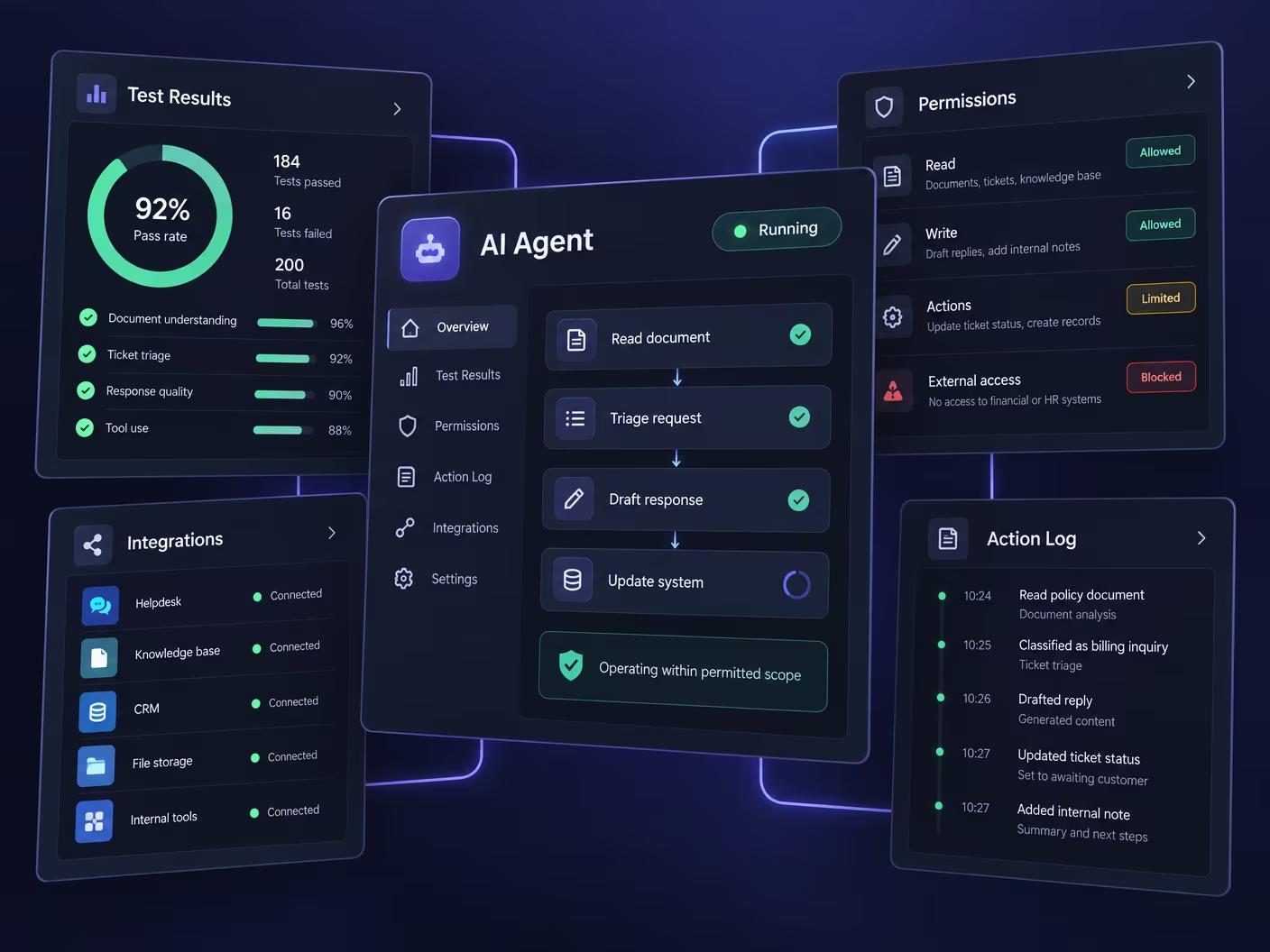
An AI agent development company builds software that decides and acts, not software that answers. SWARECO is an AI agent development company in the narrow sense that matters commercially: we build custom AI agents against your systems, we prove they work with a test set before anyone trusts them, and the same engineering team keeps running them after launch. The agent is the modality. The engineering execution around it is the substance, and it is the part that decides whether the project survives contact with production.
Most AI agent development services describe the model layer. The model layer is the cheapest part. What costs time is everything that makes an AI system safe to deploy: the tools it can call, the scopes those tools run under, the evaluation suite that says whether a change made it better or worse, the logging that lets you reconstruct a decision three weeks later, and the rollout plan that starts with a human approving every action. We build custom AI agents with that layer attached, because without it you have a demo.
This is ordinary software development with an unusual failure mode. Our AI development work sits inside the same delivery practice as the rest of our custom software development, and the AI-specific parts are additions to it, not a replacement for it.
How AI agents differ from chatbots and RPA
A chatbot answers within a conversation. Conversational AI of that kind is a genuinely useful product surface, and we build it. Robotic process automation replays a fixed sequence of clicks and fields. An intelligent agent chooses: it reads the situation, picks a tool, calls it, reads the result, and decides what to do next. That difference in decision-making is the whole reason agentic AI needs a different engineering practice.
A chatbot that is wrong produces a bad sentence. An RPA script that meets an unexpected screen stops. An AI agent that is wrong takes an action in a real system, under real credentials, and the failure looks like ordinary work until someone checks. So the question we ask before any AI agent development engagement is not whether a large language model can do this, because it usually can. It is what happens the first time it is confidently wrong, and who finds out. If there is no answer, the step needs a rule, not an agent.
Where AI agents pay off, and where they do not
The return on investment on an agent is easy to estimate once you stop thinking about the model and start counting the judgment. Agents earn their keep on high-volume steps where a person currently reads something unstructured and decides: triaging inbound support by intent and urgency, pulling fields out of documents that arrive in forty different layouts, drafting a first-pass reply that a person edits, checking a submission against a policy and flagging the exceptions, or answering internal questions out of scattered documentation.
They do not pay off where the rule is already writable. If the step is a matter of thresholds and account types, an automation rule is cheaper to build, cheaper to run, instant, and it never surprises you. Some of the most valuable AI consulting we do ends with a client not building an agent. An AI strategy that cannot say no to itself is a spending plan.
Generative AI raised the ceiling on what can be automated and did nothing to the floor: the boring, deterministic majority of most workflows is still better served by deterministic code. Deploying AI well means knowing which is which.
How we build AI agents
The development process is deliberately unglamorous, and it is the same for a customer-facing agent and an internal one.
1. Find the judgment. We map the workflow and mark every step. Steps with a rule get a rule. Steps that need reading, weighing or deciding are candidates for an agent. Most workflows are mostly rules, and saying so early saves the budget for the part that needs it.
2. Build the evaluation set first. Real cases, known outcomes, including the awkward ones. This is the deliverable that outlives the model you start on.
3. Give it tools, not permissions. Each capability is a named tool with a narrow scope, exposed over MCP. The agent gets exactly what the task needs.
4. Ship it proposing, not acting. A human approves every action while the log fills up. The approval rate is the signal for whether autonomy should widen.
5. Widen on evidence. Autonomy expands one step at a time, each step justified by the eval set and the production log, and each step reversible.
6. Keep running it. Failures become eval cases. The numbers get re-read. The agent stays accountable.
AI agent development services we deliver
Measured before it is trusted
Every AI agent development project here starts with an evaluation set, not a prompt. We collect real examples of the task with known-correct outcomes, and we run every version of the agent against them. That set is what turns a good-looking demo into a number you can argue with, and it is what lets us change a prompt, a tool or a model without guessing whether we improved anything.
The set grows with the deployment. Every production failure becomes a case in it, which is how AI agents learn the specific things they got wrong, rather than getting better in general. This is reliability engineering applied to a probabilistic component, and it is the discipline most AI projects skip.
AI governance you can show an auditor
Our AI agents run under explicit permission scopes, not under a human's full access. Tools are exposed through Model Context Protocol servers, so an agent can read the CRM without being able to delete from it, and every call it makes is logged with its inputs, its outputs and the decision that led there. Autonomy is a dial: agents ship in propose-and-approve mode, where a person confirms each action, and the dial moves only when the evaluation numbers and the production log both say it should.
AI governance frameworks tend to arrive as documents. Ours arrive as scopes, logs and tests, because a policy nobody can enforce in code is a policy nobody enforces.
Built inside your stack, not beside it
An AI agent that cannot reach your systems is a toy. AI integration is most of this work: Rails and React applications, PostgreSQL, background job queues, and the business systems that actually hold the data, including Salesforce, HubSpot, Shopify and NetSuite. We build retrieval-augmented generation over your own documents with a vector database, we build the MCP servers that expose your systems to the agent under controlled permissions, and we build the plain, boring API glue in between. Enterprise AI fails far more often at the integration seam than at the model.
A team that runs it after launch
SWARECO is a managed engineering company, so the team that builds your AI agent is the team that operates it. Model versions change, vendors deprecate endpoints, your data shifts underneath the retrieval layer, and an agent that was accurate in March quietly is not in June. Someone has to watch the eval numbers, rotate the failing cases into the set, and decide when to re-tune. That ongoing ownership is the difference between AI agent development as a project and as an AI capability your business keeps.
Agent architecture, the stack, and the proof
What is actually inside an agent
Agent is a loose word, so here is the agent architecture we build and the decisions inside it. Every one of these is a place a project goes wrong.
The task boundary. What the agent is asked to do, and where it stops. Narrow beats clever. An agent that triages one queue well is worth more than one that half-handles four.
Tools. Named, typed capabilities with narrow scopes: read this, write that, never delete. Tools are how you constrain an AI system without trying to constrain its reasoning, which you cannot.
Memory and context. What the agent knows at the moment it decides: the task, the retrieved documents, the prior turns. Retrieval-augmented generation belongs here, and so does the discipline of not stuffing everything in. Context that is always loaded is paid for on every single run.
Routing. Which model handles which step. A cheap fast model for classification and a stronger one for the judgment call is usually correct, and it changes the economics more than any prompt tuning.
Multi-agent systems, carefully. A multi-agent system, several specialised agents handing work between them, is genuinely right for some workflows and a debugging nightmare for others. We reach for one when the sub-tasks have real boundaries and separate tools. We do not reach for one because it sounds advanced.
The feedback path. How a human corrects it, and where that correction lands. If a correction does not become an eval case, it is lost.
The stack, and where AI connects
SWARECO builds agents on Anthropic Claude, OpenAI and Google Gemini, chosen per workload rather than by allegiance, and we expect to change that choice as the models move. Around them: Model Context Protocol servers for tool access, retrieval-augmented generation with a vector database over your own content, and the application stack the agent lives inside, which is Ruby on Rails, React with TypeScript, PostgreSQL, Redis and background workers, deployed on AWS or Heroku, with Playwright covering the paths a human still walks.
Our engineers are hired against this. The open senior engineering role at SWARECO requires production work with large language models, including AI agents, document processing, knowledge bases and conversational AI experiences, plus retrieval-augmented generation and vector databases. It is a hiring bar, not a marketing line, and it is public on our careers page.
Proof you can read before you call us
We publish the working practice rather than describing it. Our agent configuration is open on GitHub at github.com/SWARECO/dotclaude. We have written up the walls and rails an agentic coding setup needs, a real remote-code-execution path through a coding agent's own git configuration, and the principles for securing autonomous agents.
We also run agents on ourselves. Our project-management agent sweeps a client Slack workspace and proposes tickets for a human to accept or reject with a reaction. The Rails application behind it is ten files, and the gate that decides whether the agent runs at all is thirty-five lines of entirely mechanical checks, because every judgment call belongs to the agent and every mechanical one belongs to the code.
What this is not
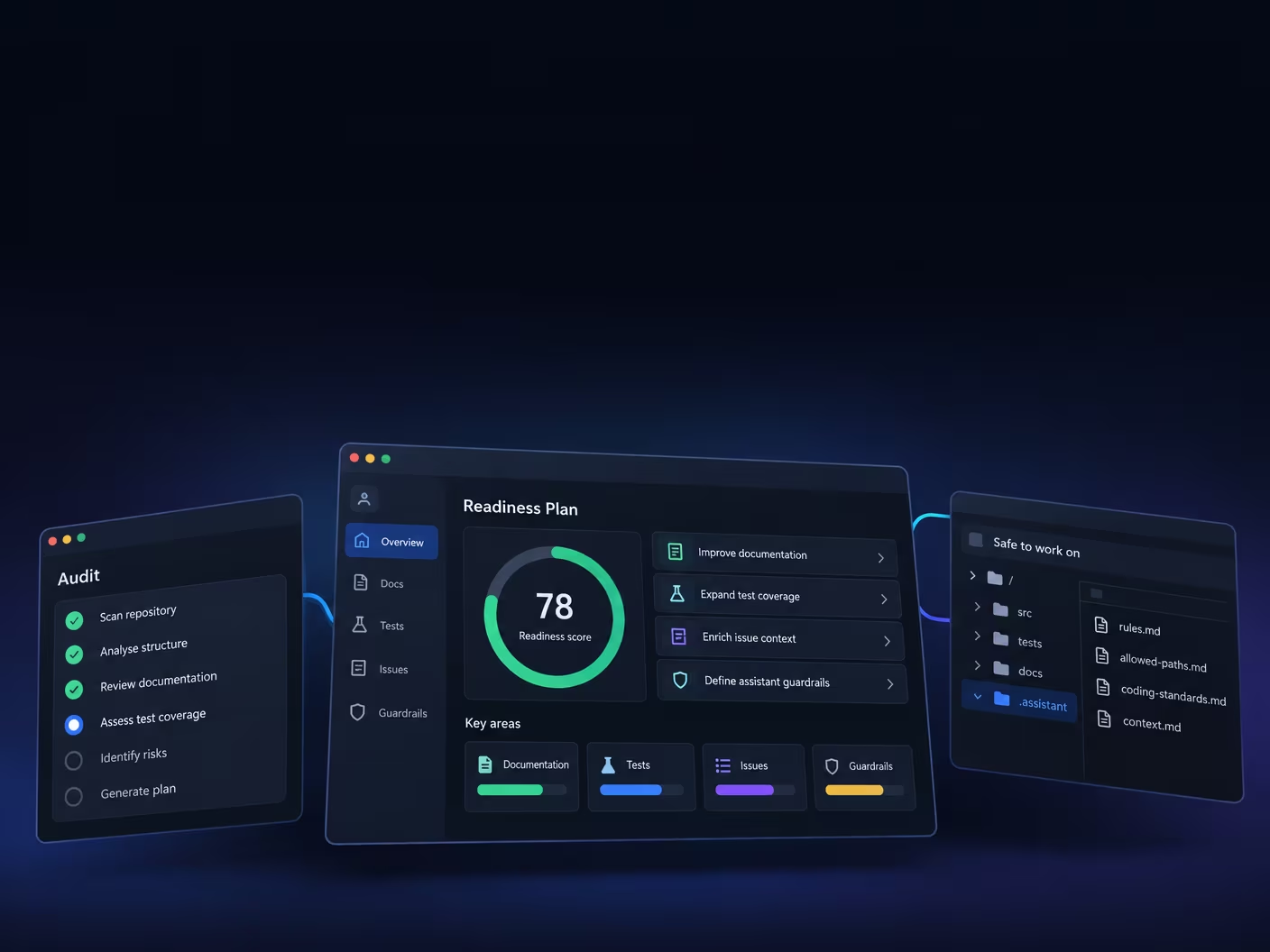
This is not AI enablement. AI enablement makes your repository, documentation, tests and tickets ready for AI to work in them. AI agent development puts an agent to work inside your product or operations. Most agent engagements begin with the enablement audit, because an agent is only as reliable as the codebase it acts on.
This is not business process automation. Business process automation applies rules where rules are enough, and rules are cheaper, faster and easier to reason about than any agent. Agent development is what we reach for when a step needs judgment, and it ships with the evaluation layer judgment requires.
We are not an AI company. SWARECO builds and runs engineering teams that ship AI-era software. The agent is a component; the engineering function around it is what we actually sell.
Industries We Serve
Deep industry expertise combined with cutting-edge technology to solve your unique challenges
How to choose the right AI agent development company
The market for AI agent development services is crowded and most of it looks identical from the outside. AI agent development companies specialize in a lot of things on their home pages; four questions separate the ones that have shipped agents from the ones that have shipped slide decks.
Ask to see an evaluation set. Not a benchmark, not a model leaderboard, but the actual set of cases they use to decide whether a specific client's agent improved. If they do not have one, they cannot tell you whether the agent works, and neither will you.
Ask what the agent is allowed to do on day one. Fully autonomous as an opening position is a warning, not a feature. The right answer describes a narrow scope and a route to widening it.
Ask who operates it in month six. AI agent development is not a build-and-hand-over discipline. If the answer is your team, ask what they are being handed: the eval set, the logs and the runbook, or a prompt.
Ask what they will not automate. An AI agent development company that has never talked a client out of an agent has not yet met the case where a rule was the correct answer.
Directory rankings and top AI agent development companies listicles answer none of these, because none of them is visible from outside an engagement.
These companies have relied on us to help expand their engineering teams with top talent who make a real impact.
Companies that trusted us to build and run their engineering.






Case Study
Real results for real clients. Discover how we've helped businesses achieve their digital transformation goals
FAQs
What does an AI agent development company actually deliver?
A working agent, the tools it calls, the evaluation set that proves it works, the permission scopes it runs under, the logs that explain its decisions, and a team that keeps operating it. SWARECO delivers all six. An AI agent developer who delivers only the first is handing you a prototype and calling it a deployment — the eval set and the scopes are the parts that survive a model change.
How do you evaluate whether an AI agent is working correctly?
With an evaluation set built from real cases that have known-correct outcomes, run against every version of the agent. That gives a number that moves when the agent changes, which is the only way to tell an improvement from a coincidence. In production we also track the human approval rate while the agent is proposing rather than acting, and every failure becomes a new case in the set. Benchmarks published by model vendors say nothing about your workflow.
Can AI agents run safely inside our production systems and data?
Yes, under three conditions we treat as non-negotiable. The agent gets narrow, named tools rather than a human's credentials, exposed through Model Context Protocol servers with explicit scopes. Every call is logged with inputs, outputs and the decision that produced it. And it starts in propose-and-approve mode, where a person confirms each action, widening only on measured evidence. We have published research on how coding agents get compromised through their own configuration, so this is a risk we treat as real.
What is the difference between AI agent development, AI enablement and process automation?
Process automation applies fixed rules to a repeatable step. AI enablement prepares your codebase, documentation, tests and tickets so that AI can work inside them safely. AI agent development builds software that reads a situation, chooses a tool and acts — and it belongs only on the steps that genuinely need judgment. Most workflows need all three in different places, and the money is wasted when an agent is put where a rule would do.
Which AI models and frameworks does SWARECO use to build agents?
Anthropic Claude, OpenAI and Google Gemini, chosen per workload rather than as a standard, with Model Context Protocol for tool access and retrieval-augmented generation over a vector database for grounding in your own content. The agent itself runs inside your application stack — commonly Ruby on Rails or Node with PostgreSQL, Redis and background workers. We assume the model choice will change during the engagement, which is why the evaluation set, not the prompt, is the durable asset.
Other Services
Bring us the workflow
Tell us the step a person currently reads and decides on, and we will tell you whether an agent belongs in it, or whether a rule would do the job for less.