
Website Redesign Services: From WordPress and Webflow to Code You Control
Your WordPress or Webflow site rebuilt as code you own: cheaper to run, tested for SEO and accessibility, editable by Claude Code.
A website redesign that also changes what you own
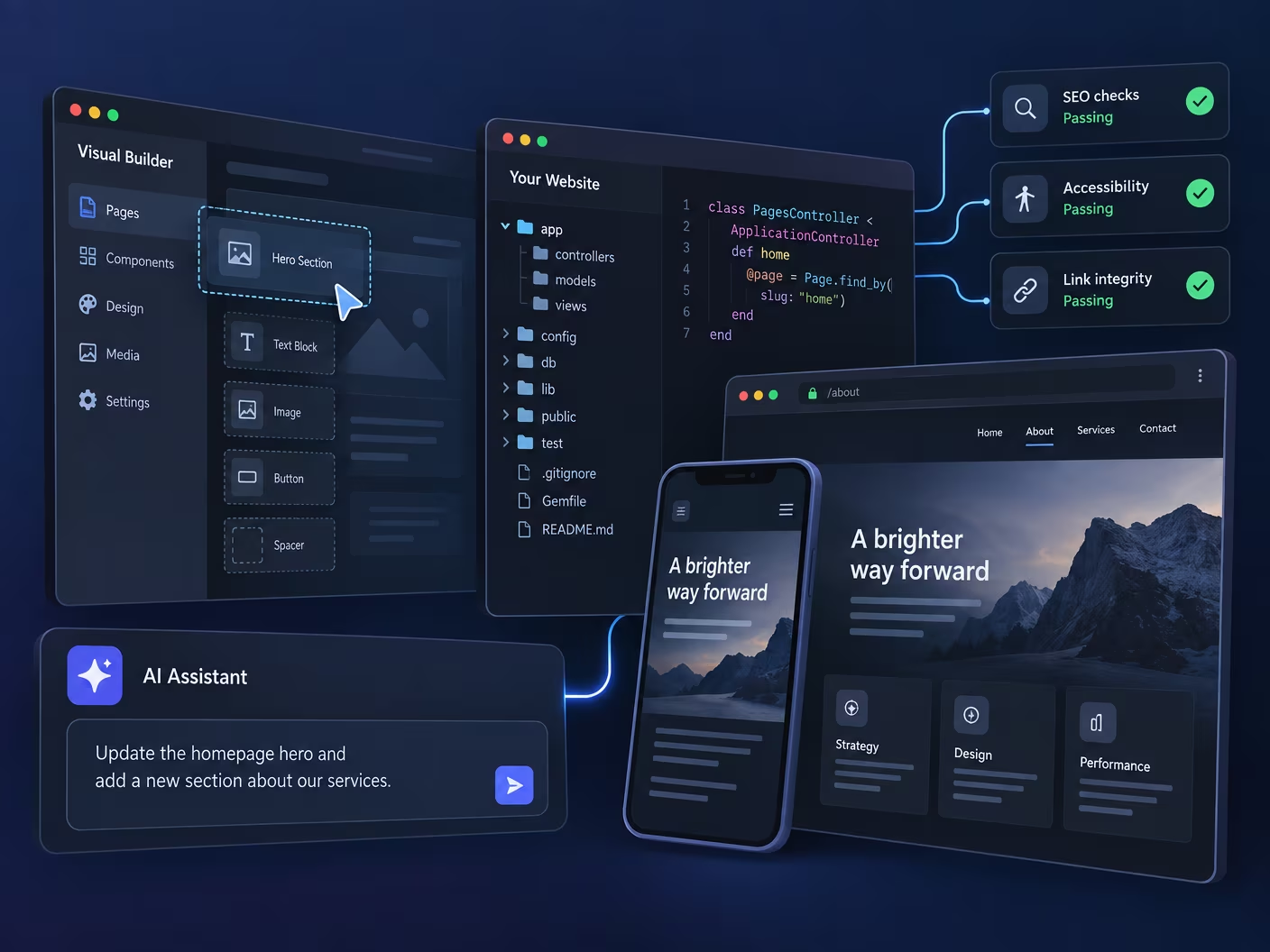
Most website redesigns hand back a new website on the same platform you started on. The web design improves, the user experience improves, and every constraint that made the last two years frustrating is still there: the same subscription, the same per-seat editor, the same list of things the platform will not let you do. SWARECO's website redesign moves the whole site onto a Rails application we build for you, so the redesign and the escape happen once instead of twice. The digital experience improves, and so does what you are able to do next year.
You get the ordinary things website redesigns should deliver, a clearer message, a navigation someone can actually use, a responsive layout, and a measurable lift in conversion rate, and one thing a builder cannot give you: the site is source code in your repository, and anything you can describe, an engineer or an AI assistant can change.
Why teams leave WordPress and Webflow
Three reasons come up again and again, and none of them is that the platform is bad at what it does.
Running cost. A builder charges a platform subscription, then charges again per editor seat, then again for the plugins or add-ons that supply what the core product does not. A coded site runs on commodity hosting, and the line stops growing when your team does.
The ceiling. Every builder has a list of things its own API cannot write, and it is longer than the sales page suggests. Webflow's Data API cannot write canonical tags, template-level structured data, robots.txt or llms.txt, and collection-list bindings have to be set by hand in the Designer. Its sitemap regenerates only on a full site publish. These are not complaints about a competitor. They are the specific constraints that decide whether your SEO work can be automated or has to be clicked.
AI cannot work in a builder. This is the new one, and it is why the question is being asked now. An AI assistant can read a codebase, change fifty pages consistently, run the tests and open a pull request. Pointed at a builder through a vendor plugin, the same assistant can fill a text field. The difference is not the model; it is what the platform exposes.
The redesign itself
None of the above replaces design work. A website redesign that ships better infrastructure and the same confusing message has failed.
We start with an audit of what you have: which pages earn organic traffic, which ones convert, which ones nobody has opened in a year, and what the current navigation is doing to people who arrive from search. That audit is how we prioritize. Website redesigns that spread effort evenly across sixty pages improve none of them, so the work goes where the traffic and the business goals actually are.
Then the message. Most site copy describes the company rather than the reader's problem, and fixing that does more to increase conversions than any visual change. Then the design and development work: a responsive layout, a navigation structure that matches how people actually look for things, a UX design pass on the paths that matter, and the handful of pages that carry lead generation rebuilt around a single clear action. Good user experience here is mostly subtraction: the conversion rate usually improves by removing choices, not by adding sections.
Optimization continues after launch, because a redesign is a hypothesis until the numbers arrive. Conversion rate optimization is a habit, not a phase of the project. The site ships instrumented, so the argument about what to change next is settled with data.
What ships on day one
Your new website is built on our Rails site foundation, which is already running for clients. It is not a blank application. The machinery below comes with it, and it is what makes the site hard to break later.
SEO enforced by tests, not by vigilance
Every public page must have a unique title, a unique meta description, an absolute canonical URL, one clear primary heading, a sensible heading order, alt text with dimensions on every image, and crawlable links. These are assertions in the test suite. A page that fails one of them cannot be merged. A page registry makes it impossible to add a new template and quietly leave it unaudited.
Accessibility held to the same standard
WCAG 2.1 AA contracts run against every page, with axe-core and keyboard navigation tested in a real browser on every change, and Lighthouse required to score 1.00 on both SEO and accessibility before anything merges.
A publish preflight, and security that is checked
Content cannot go live until it passes the same SEO contract the templates do. Drafts and scheduled posts are invisible until they are ready, and a failed check tells you exactly which rule it broke. Alongside it: a nonce-based content security policy, a response-header contract, injection tests, static analysis and four dependency audits, all blocking the build. App-rendered robots.txt and sitemap.xml mean the sitemap is always current instead of regenerating on a publish you might forget, and staging environments cannot be indexed by design.
A content API, an admin, and an MCP server for AI
Your team edits through a back office; your systems integrate through a bearer-token API with revocable, scoped credentials. Integration with your CRM, analytics or marketing tools is ordinary application work rather than a plugin hunt. The foundation also ships its own Model Context Protocol server with eight tools, so Claude Code or any MCP-capable assistant can list content types, read an item, create a draft, update it, run the SEO preflight and publish, under the same contract a human is held to. A refused publish comes back with the specific violations, which is exactly what a model needs to fix the content itself.
Two moves we have already made
This is not a service we are announcing before doing. Two client sites are already running on this foundation.
One was a WordPress site with 207 posts, of which 179 used real heading structure, 187 carried links, 64 had lists and 24 embedded images, structure that a naive migration flattens and a search engine notices. It was moved with the rich content intact, the original permalink shape served directly, and all 38 redirect destinations verified before launch.
The other had to leave its managed WordPress host on a deadline, with a redesign due afterwards. Rebuilding twenty page-builder pages as audited templates for a design about to be replaced would have been the wrong spend, so 55 pages were carried over at the same URLs with the same metadata, 24 redirect rules covering 51 source paths were ported, the checkout and gift flows were re-implemented server-side, and the cutover took about an hour plus DNS propagation. Seamless from a visitor's point of view, because every URL answered the same way before and after. New pages built since are real templates under the test suite, and the mirrored set shrinks as they are replaced.
What this is not
This is not our ecommerce service. If you are building a new store or a new platform rather than replacing an existing marketing site, start at web and ecommerce development.
This is not legacy application modernization. That service deals with application code, the software your business runs on. This page is about the marketing site.
We will tell you when not to move. If your site is five pages, nobody on your team wants to touch it, and the subscription is not the problem, a builder is the right tool and we will say so.
Industries We Serve
Deep industry expertise combined with cutting-edge technology to solve your unique challenges
Your rankings come with you
The risk everyone is right to worry about in a replatform is search. Our process treats it as the constraint, not the cleanup: every existing URL is inventoried, every redirect is mapped and tested before cutover, canonical tags and structured data are carried across, and the metadata your pages already rank under is preserved rather than rewritten for the sake of it. Where the old platform served a URL shape, the new site serves the same shape directly.
These companies have relied on us to help expand their engineering teams with top talent who make a real impact.
Companies that trusted us to build and run their engineering.






Case Study
Real results for real clients. Discover how we've helped businesses achieve their digital transformation goals
FAQs
How much cheaper is a coded website than WordPress or Webflow?
The saving is structural rather than a single number: a builder charges a platform subscription, then per editor seat, then for the plugins or add-ons that fill the gaps, and the total grows with your team. A coded site runs on ordinary hosting at a flat, small cost, and adding an editor costs nothing. Against that, you are taking on a codebase that needs maintaining — which is why this makes sense for a site your business depends on and does not for a brochure nobody edits. We will do the arithmetic with your actual plan and seat count before you commit.
Will we lose our search rankings when we move off WordPress or Webflow?
Not if the migration is done in the right order, and preserving them is the main constraint on the whole project. Every URL is inventoried, every redirect is mapped and tested before the switch, canonicals and structured data are carried across, and existing metadata is preserved rather than rewritten. On the two client sites we have moved, the original URL shapes are served directly rather than through a redirect hop. The honest caveat: any redesign that also changes content will move rankings somewhat, which is why we separate the replatform from the rewrite and measure between them.
Can our marketing team still edit content without a developer?
Yes. The site ships with a back-office admin for writing and publishing, and content changes do not require a developer or a deployment. The line to understand is this: editing a page's content is a normal task for your team, while adding a new type of page is a code change that goes through review. That boundary is deliberate — it is what stops a new template escaping the SEO and accessibility checks.
Can Claude Code or another AI assistant manage the site after the move?
Yes, and this is usually the reason clients call. The site exposes a Model Context Protocol server with eight tools, so an assistant can read, create, update, preflight and publish content under the same rules a person follows, and a refused publish returns the exact violations so the model can correct itself. Because the site is also a normal repository, an assistant can change templates, run the full test suite and open a pull request — work no builder plugin can do.
How long does a website redesign and migration take?
It is driven by page count and how much of the content can move as-is. A small marketing site with clean content moves in weeks; a large site with years of page-builder pages takes longer, and there is a middle path we have used in practice — carry the existing pages over at their current URLs first to make the deadline, then replace them with real templates one at a time. That option exists precisely because a redesign and a platform move do not have to happen on the same day.
Other Services
Send us your site URL
We will tell you what moves across as-is, what needs rebuilding, and what it costs to run afterwards against your current plan and seat count.