
Technical Due Diligence Services
An independent read on the code, the infrastructure and the team before you sign.
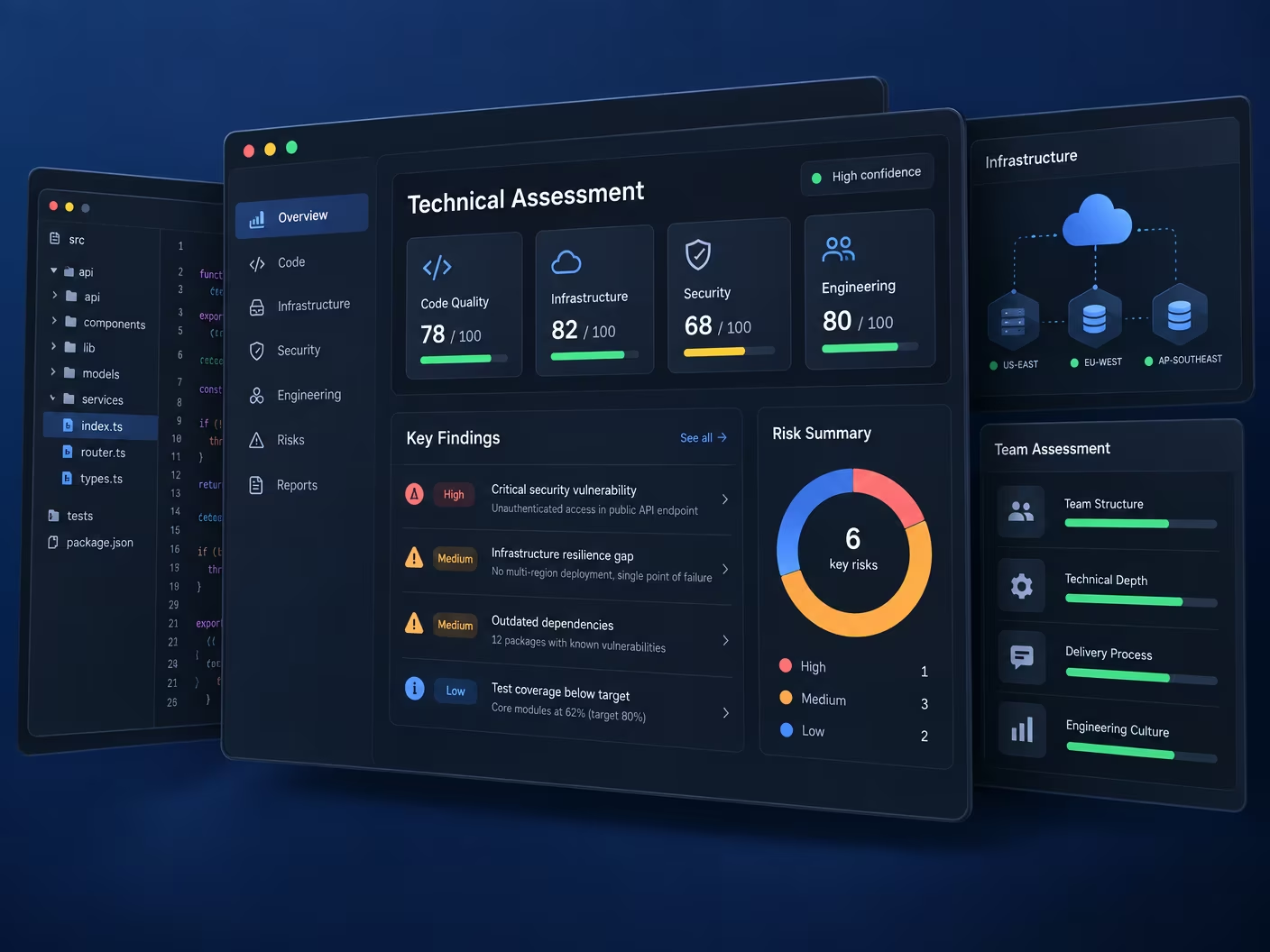
Technical Due Diligence
Technical due diligence is an independent assessment of a company's software, infrastructure and engineering practice, produced so an investor, acquirer or board can price technical risk before a deal closes. SWARECO carries out that assessment and delivers a written verdict you can act on, not a scorecard.
The questions that decide a deal are rarely the ones on a generic checklist. Will this architecture survive the growth the model assumes? How much of the roadmap is rewrite work in disguise? Is the team's velocity a property of the team, or of one person who has not taken a holiday in two years? We answer those, with the evidence attached.
What the Assessment Covers
Four areas, weighted to the investment thesis rather than covered uniformly. Code and architecture: structure, maintainability, test coverage, and the technical debt that will surface as slower delivery rather than as visible bugs. Infrastructure: hosting, deployment, monitoring, disaster recovery, and the single points of failure nobody has written down.
Security and compliance: access control, data handling, dependency risk, and readiness for whichever regime the business is actually subject to. Team and practice: who holds critical knowledge, how work gets reviewed, and whether the engineering function can absorb the plan it has just been handed.
How a Technical Due Diligence Engagement Runs
Engagements start with the investment thesis, not the codebase. What a buyer intends to do with the asset determines which risks matter, so we scope against that before requesting any access.
From there: read-only repository and infrastructure access, structured interviews with the engineering leads, static and dependency analysis, and a review of the deployment and incident history. How a system has failed before is the most reliable guide to where it is fragile now.
The output is a written report with findings ranked by cost to fix and consequence of not fixing, plus a verbal readout for the deal team. Turnaround is typically one to three weeks depending on codebase size and how many systems are in scope. Where the deal timeline is tighter, we scope a reduced assessment and state plainly what it does not cover.
How This Benefits Your Business
The purpose of diligence is to replace assumption with evidence before money moves. Everything else follows from that.
Risk priced, not merely listed
A finding with no cost attached is not decision-useful. Each issue carries an estimate of remediation effort and what it blocks, so it can enter the model rather than the appendix.
Independent of the remediation
We are not bidding to fix what we find as a condition of the report. That separation is the whole reason to commission an outside assessment.
Written for two audiences at once
Deal teams need the implication; engineers need the specifics. The report carries both, so it survives the handoff from investment committee to whoever inherits the system.
What We Evaluate in Detail
We evaluate four things in depth — the code, the infrastructure, the security posture and the engineering practice — and we weight them against what the buyer intends to do with the asset. A minority growth investment and a full acquisition ask different questions of the same system, and a report that ignores that distinction is a checklist rather than a judgement.
How we evaluate the code
We read the repository directly rather than relying on a questionnaire. Static analysis and dependency scanning establish the mechanical facts: unsupported runtimes, known vulnerabilities, packages nobody has updated in three years, and how much of the revenue-critical path the test suite actually covers. Then engineers read the parts that carry the business logic, because the expensive problems are structural and no scanner reports them. SWARECO works in Ruby on Rails, React, React Native, TypeScript, PostgreSQL, Redis, Docker, AWS and Heroku, so for systems on that technology the benchmark for normal comes from platforms we operate rather than from a maturity framework.
The AI questions now on every software deal
Two questions about artificial intelligence appear in most diligence engagements, and they are different from each other. The first is provenance: how much of this codebase was generated, whether it was reviewed to the same standard as hand-written code, and whether the licence position of the generated code is understood. Generated code is not a defect in itself, but a codebase where nobody can say which parts were generated and which were reviewed is a maintenance risk that will not show up in the metrics.
The second is capability. Where a company’s valuation rests on an AI feature, diligence has to establish what is actually running — a fine-tuned model, a retrieval system over a proprietary dataset, or a prompt against a third-party API that a competitor could reproduce in a fortnight. The defensibility of each is wildly different, and only one of them is a moat. We say which one it is, and what it would cost a competitor to match.
Concentration risk, which is usually the real finding
The most common material finding in a software business is not architectural. It is that one person holds the knowledge required to keep the system running, and the deal model assumes that person stays. We evaluate who can deploy, who understands the data model, who gets called at 3am, and what has been written down. Where the answer is one name, the report says so in those terms, because the mitigation is a retention condition rather than an engineering task.
What the report will not tell you
Diligence establishes the technical facts and prices the risk. It does not tell you whether to do the deal, and it cannot certify the absence of a vulnerability — no assessment can, and a report claiming otherwise is worth less than one that states its limits. We record what was in scope, what was not, and what we would want to look at with more time, so the deal team knows exactly which risks were assessed and which were merely accepted.
Industries We Serve
Deep industry expertise combined with cutting-edge technology to solve your unique challenges
Why Work With SWARECO
We assess systems we could also be asked to run, and that changes what a report is willing to say. A firm that only advises can afford a vague recommendation; one that might have to live with its own effort estimate cannot.
SWARECO builds and operates engineering functions across fintech, healthcare, real estate and media, so the benchmark for normal comes from systems we maintain rather than from a framework. Assessments are led by engineers who still work in code.
These companies have relied on us to help expand their engineering teams with top talent who make a real impact.
Companies that trusted us to build and run their engineering.






Case Study
Real results for real clients. Discover how we've helped businesses achieve their digital transformation goals

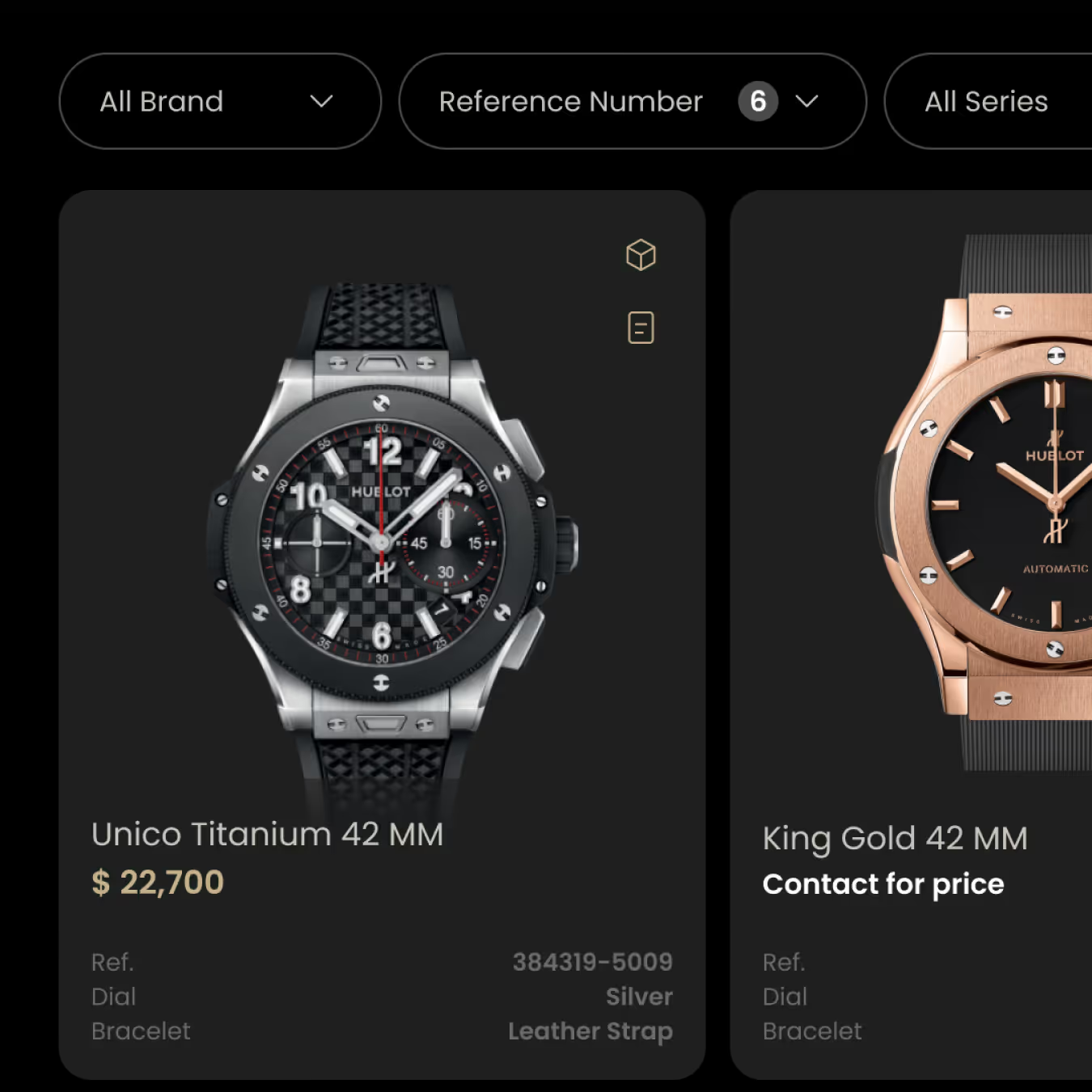
Elefta: Turning a Dealer Prototype into a B2B SaaS Platform Operating Across 30+ Countries
1,628 users, 534 organizations, 30+ countries: SWARECO rebuilt Elefta's watch-dealer prototype into a scalable B2B SaaS inventory management platform.
FAQs
What is technical due diligence?
Technical due diligence is an independent assessment of a company's software, infrastructure and engineering practice, commissioned so a buyer, investor or board can price technical risk before making a decision. It covers the codebase, the systems it runs on, the security posture and the team that maintains it.
It differs from a general IT review in that it is scoped to a specific decision. The question is not "is this good software" but "does this software support what we are about to pay for".
What does technical due diligence cover?
Four areas: code and architecture (structure, maintainability, test coverage, technical debt), infrastructure (hosting, deployment, monitoring, disaster recovery, single points of failure), security and compliance (access control, data handling, dependency risk), and the engineering team and its practices.
The weighting between them follows the investment thesis. An acquirer planning to integrate two systems needs a different depth of architectural review than an investor backing a team to keep scaling the one they have.
How long does technical due diligence take?
Typically one to three weeks, driven by the size of the codebase and how many systems are in scope rather than by the size of the deal.
Where a deal timeline is shorter than that, a reduced assessment is possible. SWARECO scopes it explicitly and states in the report what was not examined, because an assessment that quietly skipped the infrastructure review is worse than one that says so.
Who commissions technical due diligence?
Usually an investor or acquirer assessing a software asset, but also boards wanting an independent read after a period of missed delivery, and companies preparing to be audited by someone else who would rather find the problems first.
That last case is sometimes called sell-side or reverse diligence, and it is often the highest-value version: findings surfaced before a buyer's team arrives are still fixable, and are not yet a negotiating lever.
What is the difference between technical due diligence and a code audit?
A code audit examines a codebase and reports on its architecture, security and performance. Technical due diligence is broader: it takes in the code but also the infrastructure, the team, the process and the compliance position, and it is framed around a transaction.
The practical test is who is asking. If an operator wants to know what their software is costing them, that is a code audit. If a buyer wants to know what they are acquiring, that is due diligence.
How do you prepare for technical due diligence?
Get the documentation in order before access is granted: architecture overview, deployment process, dependency inventory, security policies, and an honest list of the known technical debt.
Volunteering the known problems is the counter-intuitive part, and it works. An assessor who finds an undisclosed issue starts questioning everything else they were told. A team that names its own debt and shows a plan for it reads as competent rather than careless.
Other Services
Get an independent read before you commit capital.
A scoped technical due diligence engagement, with findings ranked by cost to fix and a readout for your deal team.