
Legacy Applications Modernization
Bring your existing systems up to speed without rebuilding from scratch — from decades-old platforms to AI-generated codebases that outgrew their authors.
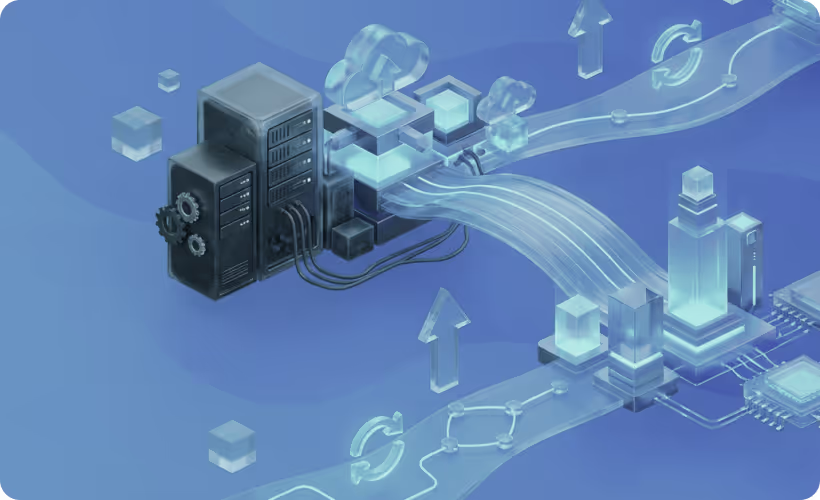
Legacy Application Modernization
Old systems do not announce when they become a problem. The signs are quieter: slower response times, rising maintenance costs, security vulnerabilities that are harder to patch, integrations that break when connected systems update. And eventually, the system that once ran your business starts holding it back.
Legacy modernization fixes this without discarding what still works. We update your existing applications to run on current technology, connect with modern tools, and support your current and future requirements... while preserving the business logic and institutional knowledge built into the original system over years of use.
We treat every modernization project as an evolution, not a replacement. The goal is to get you the benefits of modern software without the risk and disruption of building from scratch.
Legacy Modernization Built Around Your Business
Most legacy systems were not built badly. They were built for a different time. The technology has aged, the architecture has become rigid, and the maintenance cost keeps growing. But the business logic inside them is often still sound.
The challenge is moving forward without breaking what works.
We modernize legacy applications so they:
- Run on current technology and infrastructure
- Connect reliably with your modern systems and data sources
- Become easier and cheaper to maintain, update, and extend
We preserve what still delivers value and modernize the parts that are holding you back.
A Path Forward Without the Risk of Starting Over
Outdated systems become more fragile and costly as a business grows. They struggle with new user demands, increasing data volumes, and tighter security requirements. Continuing with them means higher maintenance costs, slower delivery of new capabilities, and increasing risk.
Our modernization approach addresses the core issues directly. We move your applications to modern architectures while keeping your proven business logic intact. The result is a system that performs better, integrates cleanly, and costs less to run long term.
How This Benefits Your Business
Modernization is judged on what does not happen: no outage, no lost business logic, no six-month freeze while the rewrite catches up. That is the whole design goal.
The business logic survives
Years of edge cases are encoded in the old system, most of them undocumented and all of them load-bearing. We extract and preserve that behavior rather than rediscovering it through incidents.
You choose the risk level
Rehost, replatform, refactor or rebuild are four different bets on speed against cost. We tell you which one your situation actually calls for, including when the answer is to leave a component alone.
It runs in parallel before it runs alone
Old and new operate side by side and get compared on real traffic until the new path is proven. Cutover is a decision, not a leap.
How We Modernize, and Onto What
Modernization runs in five phases. The order is what keeps the risk low — each phase produces something you can check before the next one starts.
1. Assessment — what the system is actually doing
We start read-only, with the codebase, the dependency graph, the data model and the incident history. The output is a map: which parts of the application carry business logic worth preserving, which parts are pure technical debt, and which dependencies are unsupported. In practice the unsupported dependencies set the timeline rather than the architecture — a runtime or framework that has stopped receiving security patches is a compliance problem with a date attached, and it outranks every preference about target architecture.
2. Sequencing — the order that lowers risk
We modernize one capability at a time, with the old system still serving everything we have not moved yet. New code sits in front of the monolithic application and takes over a single route, a single job, or a single table, and the amount it owns grows as it proves itself. Nothing requires a freeze on feature work, which is the reason most rewrites fail: the business cannot stop for two quarters while engineering catches up to where it already was.
Cloud migration is a common target but it is not a strategy on its own. Moving an unchanged application onto a managed platform lowers the operational burden and buys you patchable infrastructure, and that alone can accelerate everything that comes after it — but it does not make the application software easier to change. Enterprise systems in particular tend to need the refactoring work regardless of where they end up running.
Whether the end state is microservices is a separate question from whether the migration is incremental, and the honest answer for most mid-sized systems is no. Splitting a monolithic application into services adds network calls, deployment complexity and operational burden that a team of six will feel immediately. We recommend a modular monolith far more often than we recommend microservices, and we will say so even when the brief assumes otherwise.
3. Data migration — usually the hardest part
Moving code is tractable. Moving data while the business keeps trading is where legacy system migration projects actually fail. We write to both the old and new stores during the transition, backfill history in batches, and reconcile the two continuously so that any divergence surfaces as a report rather than as a customer complaint. Reconciliation runs until the counts match for long enough to be boring. That is the point at which a cutover becomes a scheduling decision instead of an act of faith.
4. Parallel running, then cutover
Old and new run side by side against real traffic and get compared before anything is switched off, which is what makes the cutover reversible. If the new path is wrong, traffic goes back to the old one in minutes and no data is lost, because both were being written the whole time.
5. Making sure it does not become legacy again
A modernized application that nobody can safely change is a system with a new expiry date. So the last phase is the automation that was missing from the original: continuous integration, a test suite that covers the paths the business depends on, Playwright coverage on the flows that generate revenue, and containerized environments so that what runs in production is what was tested. Scalability follows from this more often than it follows from any particular architecture — a system you can deploy confidently is a system you can grow.
We also use AI-assisted code comprehension in the assessment phase to read and summarize large unfamiliar codebases faster than a manual review would. It shortens the assessment, and every finding it produces is verified by the engineer who signs the report.
The technology we modernize onto
SWARECO modernizes legacy applications onto Ruby on Rails, React and React Native, TypeScript, and PostgreSQL, with Sidekiq for background processing, Redis for caching and queues, and Elasticsearch or OpenSearch where the old system was doing search badly in the database. We deploy to AWS and Heroku in Docker containers, which is what makes a cloud-native target realistic for a team that does not want to hire a platform engineer to keep it running.
The integration layer is usually the reason a legacy application cannot be left alone. Enterprise systems that were isolated when they were built now need to exchange data with Salesforce, HubSpot, Shopify or NetSuite, and a legacy app with no API is the thing standing in the way. We build that layer as part of modernization rather than as a later project, because the integration requirements often determine how the data model should be reshaped.
We do not migrate onto a stack we do not run ourselves. Every technology named above is one SWARECO uses in production for clients today, which is why the effort estimates behind a modernization plan are ours to defend rather than a vendor’s to guess at. Where your system runs on something outside that list and should stay there, we will say so — the goal is a supported, patchable dependency set, not a uniform one.
How SWARECO uses AI in modernization
SWARECO's engineers work with Anthropic's Claude Code across the modernization lifecycle: reading and mapping unfamiliar codebases in days rather than weeks, generating the test coverage a legacy system never had, and executing large mechanical refactors that would otherwise burn senior time. The review bar does not move — every change still passes human review, the test suite and QA before it ships. AI shortens the work; it does not sign off on it.
We also modernize systems into the AI era, not just out of the past. That means building Model Context Protocol (MCP) servers so AI assistants like Claude can safely read and operate the modernized system — querying records, drafting reports, triggering workflows — under the same access controls as any user. A system that speaks MCP is one your team can put an assistant in front of; a legacy system that speaks nothing is invisible to the tools your competitors already use.
A growing share of our modernization work is AI-generated codebases: prototypes built fast with AI tools that outgrew their authors. The rescue playbook is the same four paths — assess, stabilize what works, refactor what cannot be changed safely, rebuild what was never real — applied earlier in a system's life than the industry is used to.
Industries We Serve
Deep industry expertise combined with cutting-edge technology to solve your unique challenges
Why Work With Us for Legacy Modernization
We understand that what is inside your legacy system matters. Years of business logic, operational rules, and institutional knowledge are embedded in that code. Losing it in a rush to modernize creates new problems.
Our approach is careful and risk-aware. We preserve what works, replace what does not, and give you a system that is faster, more maintainable, and ready for the integrations and capabilities your business needs to move forward.
These companies have relied on us to help expand their engineering teams with top talent who make a real impact.
Companies that trusted us to build and run their engineering.






Case Study
Real results for real clients. Discover how we've helped businesses achieve their digital transformation goals

FAQs
Can I modernize a legacy system without rewriting the source code?
Yes. Most legacy systems SWARECO modernizes keep the majority of their original source code. Rehosting and replatforming change what the application runs on - the infrastructure, database and runtime - without rewriting the application itself, and refactoring reorganizes existing code incrementally rather than replacing it. A rebuild is reserved for components whose code genuinely cannot be extended safely. During assessment, SWARECO uses AI-assisted code comprehension to map the existing codebase, so you know which path - rehost, replatform, refactor or rebuild - each part of your system actually needs before any code changes.
What is legacy application modernization?
It is the process of updating or re-architecting outdated software systems using current technologies. This can mean moving to the cloud, improving performance, replacing fragile components, or adding modern capabilities, while keeping the business logic and data that still works.
Why modernize instead of replacing the system entirely?
Modernization keeps your proven processes, business logic, and data intact while reducing cost, risk, and downtime. A full replacement discards years of institutional knowledge and typically takes longer and costs more than modernizing what you have.
How long does legacy modernization take?
Smaller applications may take 12 to 20 weeks. Large enterprise systems with multiple integrations and complex migration requirements typically range from 6 to 18 months. We provide clear milestones and phase gates throughout.
Will our data and operations stay safe during the project?
Yes. We use phased approaches, parallel systems, and rigorous testing to protect your data and keep your operations running at every stage.
Can you connect the modernized system to our newer tools?
Yes. Integration with cloud platforms, modern APIs, CRMs, and other current systems is one of the most common outcomes of a modernization project.
Do you support cloud migration?
Yes. We help migrate legacy applications to AWS, Google Cloud, Azure, or hybrid environments, with the right architecture for each platform.
How do you reduce risk during the project?
We work in small, testable increments, keep legacy systems running in parallel until the new version is validated, and apply formal testing at every phase before cutover.
Can you add new features during modernization?
Yes. Many clients add new functionality, automation capabilities, or integrations as part of the modernization scope. We factor this into the approach from the start.
Can you fix an AI-generated codebase that outgrew its authors?
Yes — it is modernization's newest category. A prototype built with AI tools usually fails on structure, not features: no tests, tangled data models, and code nobody can safely change. SWARECO assesses it like any legacy system — AI-assisted comprehension to map it in days, then stabilize, refactor or rebuild per component — and adds the test suite and deployment pipeline that make it changeable again.
How does SWARECO use AI when modernizing legacy systems?
In three places: Claude Code for reading and mapping large unfamiliar codebases during assessment, AI-assisted refactoring and test generation during the build, and Model Context Protocol (MCP) integrations so the modernized system can be operated by AI assistants afterward. Every AI-assisted change passes the same human review, tests and QA as hand-written code.
Other Services
Your old system does not have to hold you back.
Tell us what you are working with and where it is creating problems. We will assess what needs to change and how to do it without disrupting what works.